Asbestos pipe insulation is one of the most common — and most misidentified — hazardous materials in Long Island homes built before 1980. It sits in basements and mechanical rooms across Nassau and Suffolk County, wrapping steam pipes, boiler feeds, and hot water lines in materials that were installed specifically because of their heat resistance. The problem is that age, moisture, and physical disturbance cause that insulation to deteriorate, releasing microscopic asbestos fibers into the air.
This guide shows you exactly what to look for. The images below are organized by what you will actually see when you walk into a Long Island basement: intact pipe wrap, deteriorating sections, damaged elbows and joints, and overhead pipe runs. If what you see matches these images, do not touch it. Call a NYS-licensed asbestos contractor for testing before any renovation, plumbing work, or HVAC service in that space.
Asbestos pipe insulation is typically friable — meaning it can be crumbled by hand pressure and releases fibers into the air when disturbed. This is the highest-risk form of asbestos in residential settings. Non-friable asbestos (floor tiles, siding) is less immediately dangerous when intact. Pipe insulation is rarely intact by the time a homeowner sees it.
What Intact Asbestos Pipe Insulation Looks Like
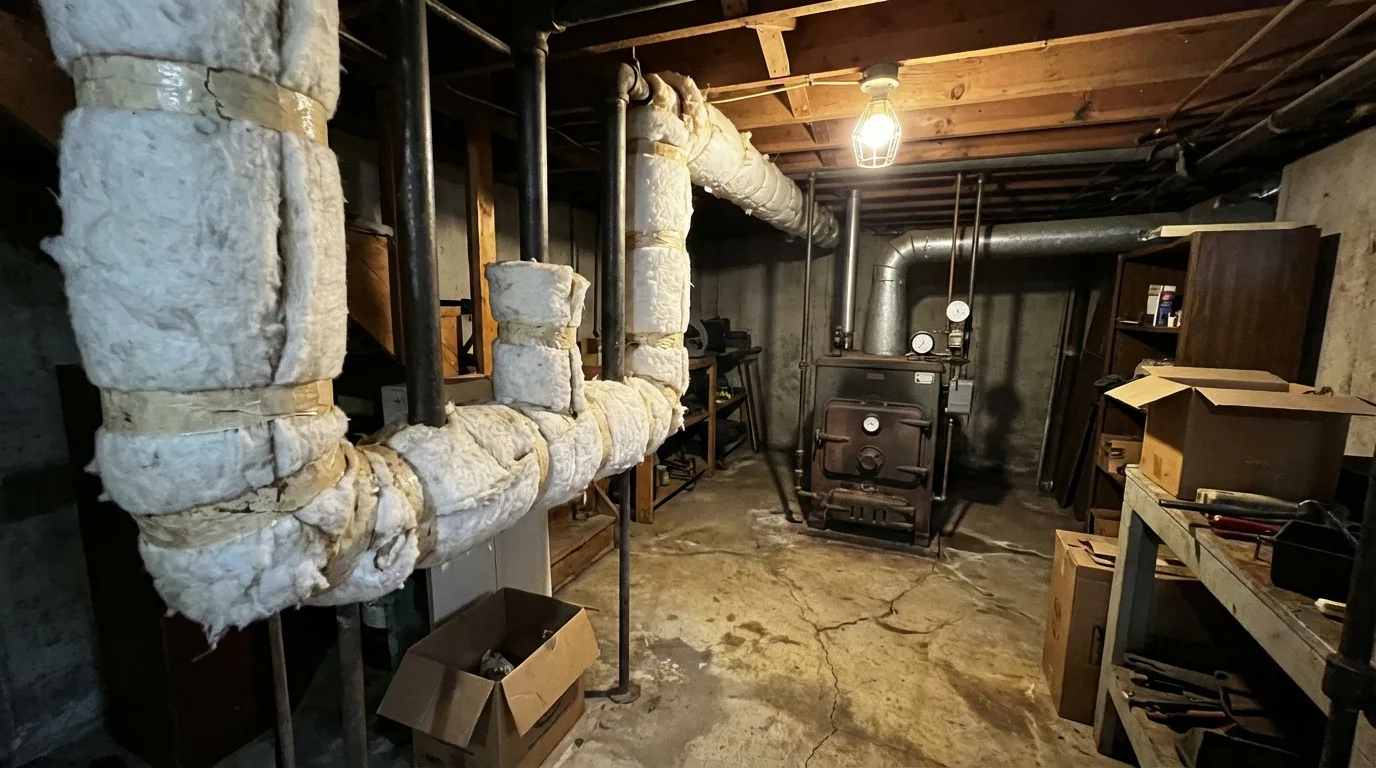
Intact asbestos pipe insulation has a distinctive appearance that differs from modern fiberglass or foam pipe insulation. On steam pipes and boiler feeds in Long Island homes built between 1930 and 1975, you are most likely to encounter one of two forms:
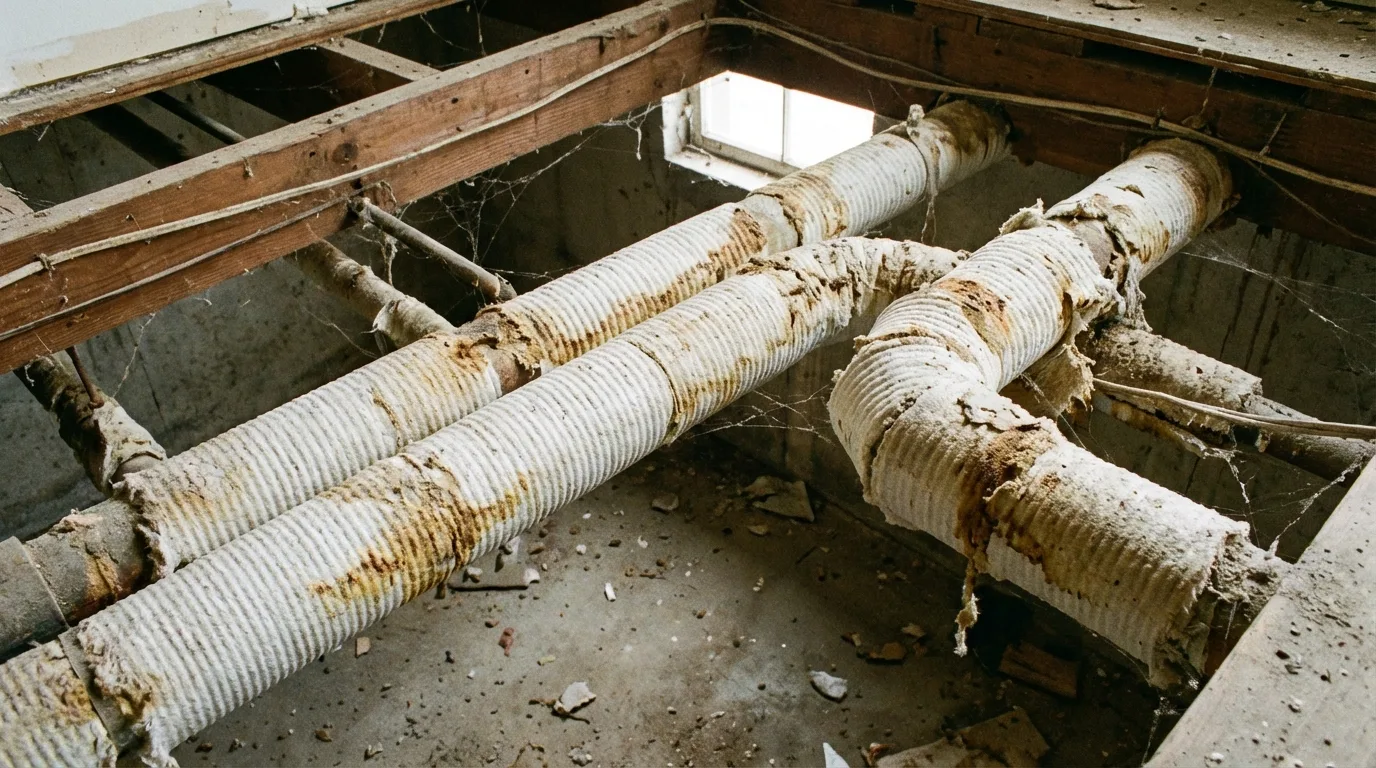
Air-cell or corrugated wrap — a white or off-white insulation with a ridged, corrugated surface texture running along the length of the pipe. This is the most common form on larger steam pipes. It is typically held in place with metal bands or canvas tape at regular intervals. From a distance it looks almost papery or plaster-like.
Fibrous blanket wrap — a dense, cloth-covered blanket of mineral fiber wound around the pipe and secured with canvas tape or wire. The outer jacket is typically a burlap or canvas material. On older installations, the outer jacket has often aged to a brown or tan color.
Both forms were standard residential and commercial insulation materials through the mid-1970s. If your Long Island home has a pre-1980 boiler, steam heat, or original plumbing in an unfinished basement, assume the pipe insulation contains asbestos until tested.
The Warning Signs: Deteriorating Pipe Insulation
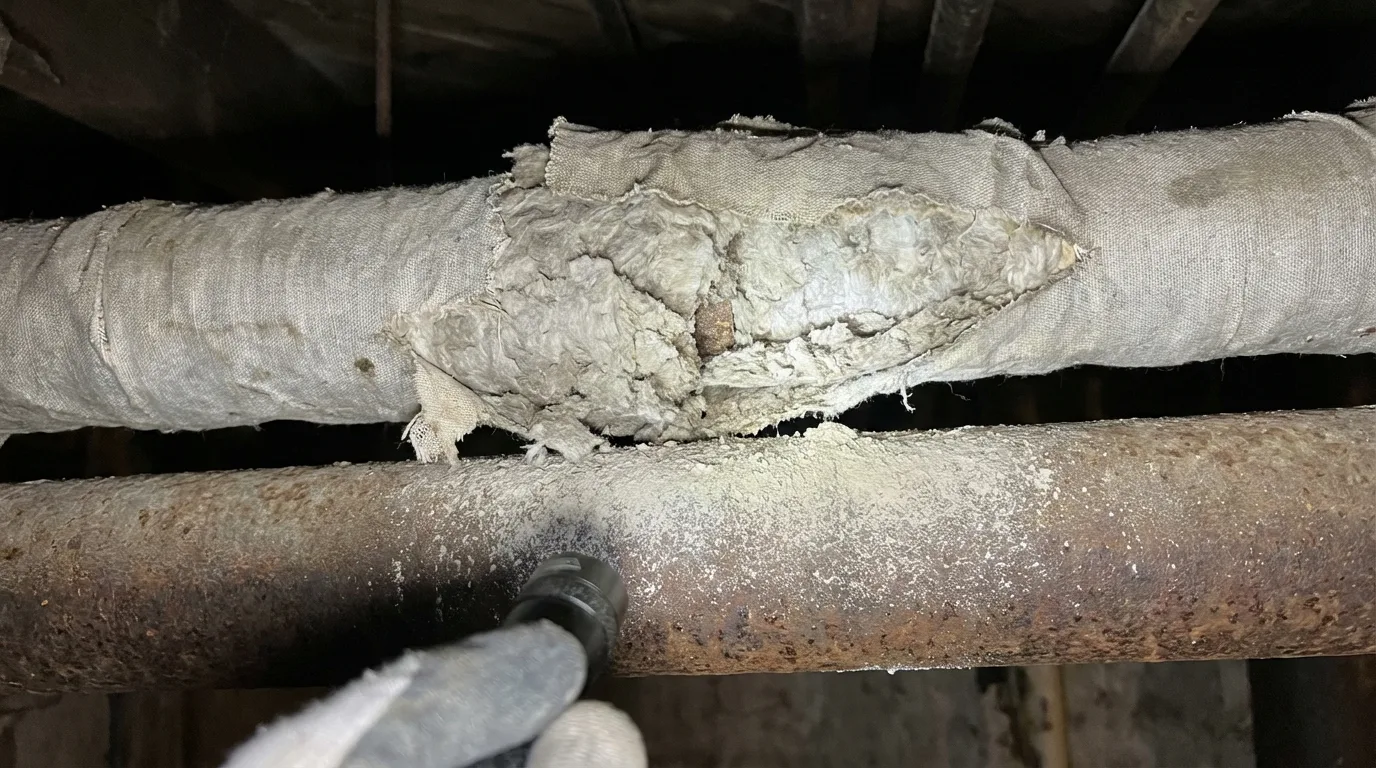
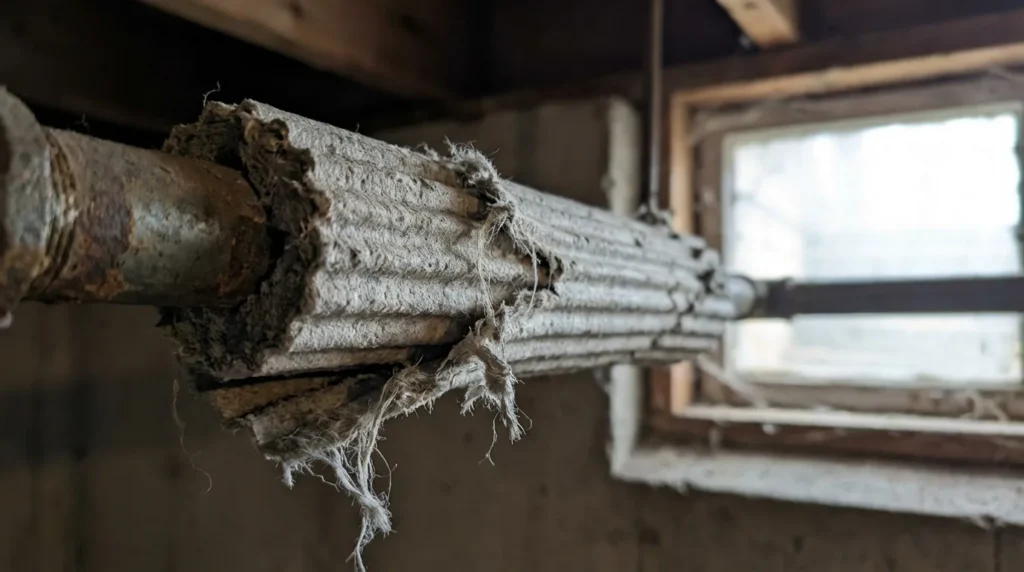
Deteriorating asbestos pipe insulation is significantly more dangerous than intact insulation because fibers are already becoming airborne. The most important warning signs:
White or gray powder beneath the pipe. If you see fine white or gray dust on the pipes below the insulation, on the floor, or on stored items under the pipes, that material has already been releasing fibers. The image above shows this exactly — the lower pipe has a visible powder deposit directly below the breach in the insulation above it. This is the most urgent situation.
Cracks, holes, or missing sections. Any opening in the outer jacket that exposes the inner mineral fiber is a friable asbestos hazard. Even small cracks from pipe movement, water damage, or accidental contact count.
Tape that is peeling or failing. The canvas or fabric tape holding sections together ages and fails over decades. When the tape releases, the sections beneath begin to shift and crack.
Asbestos Insulation at Pipe Elbows and Joints
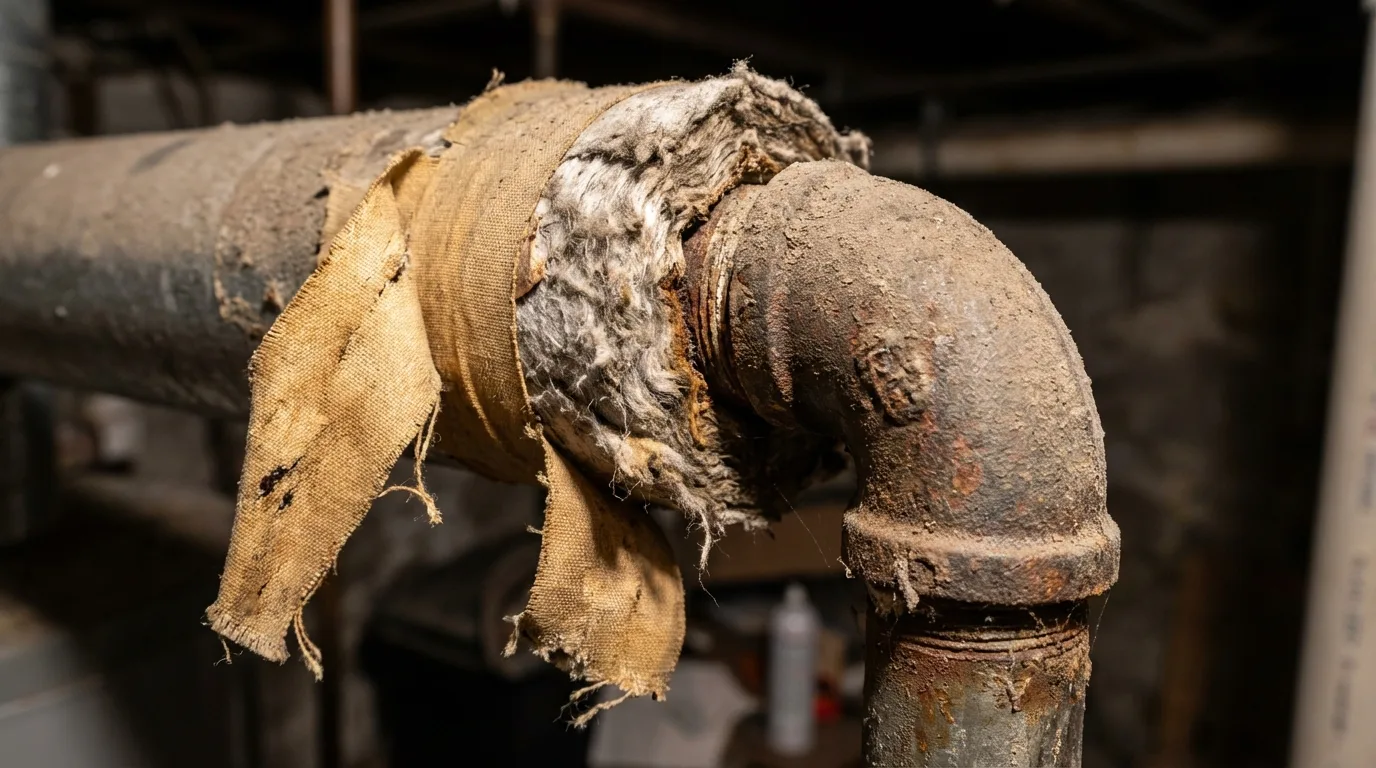
Elbows and joints are the most commonly damaged sections because thermal expansion causes the pipes to move slightly with each heating cycle. Over decades, this movement works the insulation loose at every connection point. When you inspect a basement, pay particular attention to every elbow, T-junction, and valve connection — these points receive the most mechanical stress and show deterioration first.
The areas immediately adjacent to the boiler and any shutoff valves on steam systems are high-movement zones. The insulation at these points is typically in the worst condition in any pre-1980 system.
Overhead Pipe Runs: The Most Common Discovery
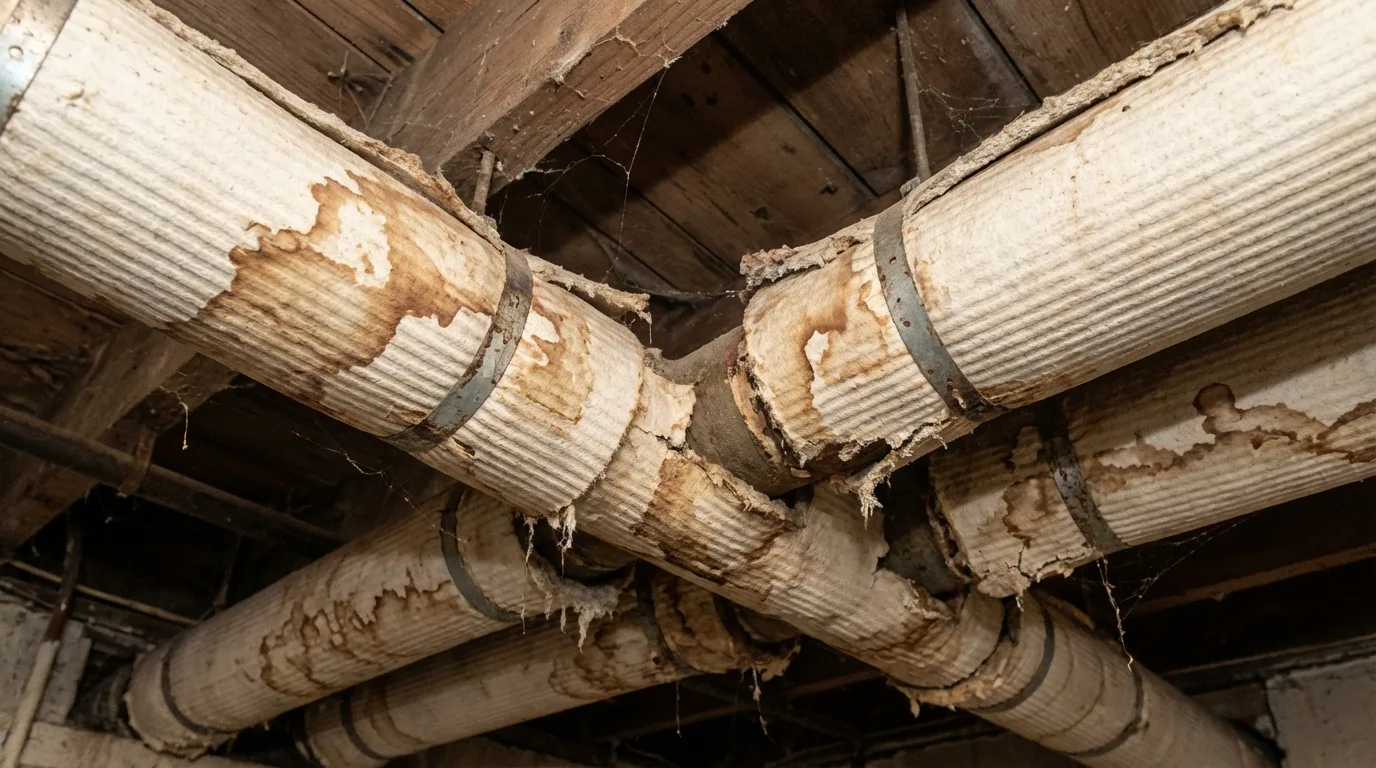
Most asbestos pipe insulation in Long Island homes is found running along the basement ceiling, where steam and hot water distribution pipes connect the boiler to radiators throughout the house. Looking up at this type of installation, the corrugated white wrap is distinctive at this scale — the ridged texture is visible even from below. The metal bands appear at regular intervals, typically every 12 to 18 inches.
Brown staining is common at joints and along sections that have experienced moisture exposure. Water infiltration from a basement leak, flooding, or condensation accelerates deterioration significantly. If asbestos pipe insulation has been wet, it is almost always in worse condition than it appears from below.
Close Detail: What Surface Deterioration Looks Like
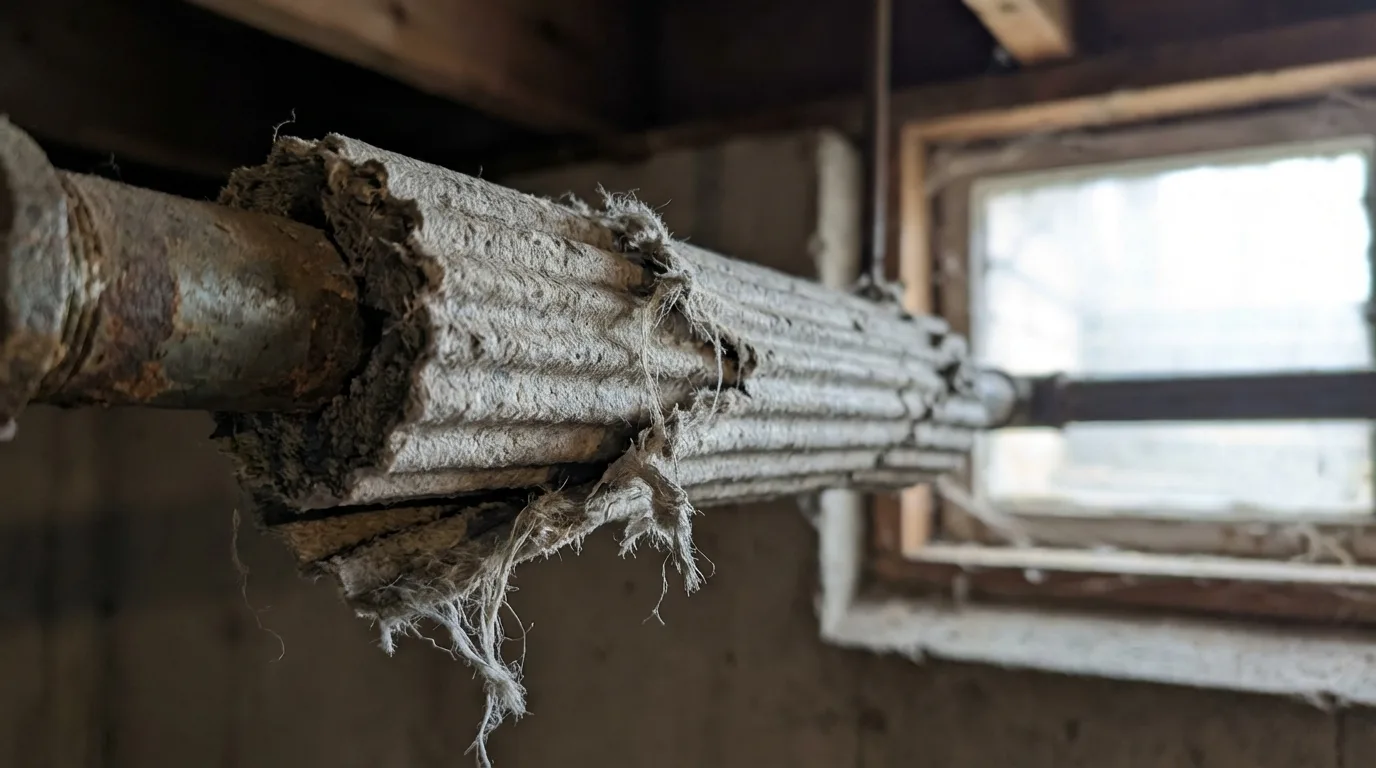
The fiber structure of asbestos pipe insulation is dense and tightly layered — similar in appearance to corrugated cardboard from the edge but with a dusty, mineral quality. Modern fiberglass insulation is distinctly different: fluffy, pink or yellow, and cotton-like. Asbestos pipe insulation is gray-white, dense, and when deteriorating produces a fine mineral dust rather than coarse glass strands.
If you are unsure whether what you are seeing is asbestos or fiberglass, do not disturb it. The only way to confirm the presence of asbestos is laboratory testing of a sample collected by a trained professional using proper containment procedures.
Long Island Housing Stock: Where You Are Most Likely to Find This
Based on Upper Restoration’s work across Nassau and Suffolk County, asbestos pipe insulation is most common in cape cods and ranches built 1945–1965 with original steam or hot water boiler systems — Hempstead, Levittown, Hicksville, Westbury, and the early postwar developments throughout Nassau County. Split-level and colonial homes built 1955–1975 in Smithtown, Huntington, Islip, and Brookhaven townships with original boiler rooms are also high-frequency sites. Pre-war homes in Great Neck, Garden City, Rockville Centre, and Babylon Village with steam heat systems installed in the 1920s through 1940s represent the oldest — and often most deteriorated — installations.
What To Do If You Find Asbestos Pipe Insulation
Do not touch it, sweep near it, cut it, or attempt to remove it yourself. Under NYS 12 NYCRR Part 56, asbestos abatement in New York State requires a licensed contractor. If the insulation is intact and undisturbed, the immediate risk is lower — restrict access to the area for children and pets, avoid activities that create air movement near the pipes, and schedule a professional assessment. If the insulation is deteriorating — cracked, friable, powder visible, or sections missing — treat the area as an active hazard and call a licensed asbestos contractor immediately.
Upper Restoration holds NYS asbestos contractor certification and serves all of Nassau and Suffolk County, the five boroughs, and the greater NYC metro area. We conduct asbestos inspections, sample collection, abatement, and post-abatement air clearance testing. Learn more about our Long Island asbestos abatement services or schedule a free consultation. For 2026 pricing, see our asbestos removal cost guide for New York.
Frequently Asked Questions: Asbestos Pipe Insulation
How do I know if my pipe insulation contains asbestos?
You cannot determine asbestos content by visual inspection alone — laboratory testing of a sample is required for confirmation. However, pipe insulation in homes built before 1980 should be treated as potentially containing asbestos until tested. The white corrugated wrap or canvas-covered blanket insulation common on steam pipes in pre-1980 Long Island homes is the most frequently asbestos-containing type.
Is asbestos pipe insulation dangerous if I leave it alone?
Intact, undisturbed asbestos pipe insulation poses a lower immediate risk than deteriorating insulation. The danger comes when fibers become airborne. However, most asbestos pipe insulation in Long Island homes has been in place for 50 to 80 years and is in some state of degradation. A professional assessment will determine whether abatement, encapsulation, or monitoring is the appropriate response.
Can a plumber work near asbestos pipe insulation?
Plumbers and HVAC technicians are not licensed to disturb asbestos-containing materials in New York State. If a plumber needs to access a section of pipe that has asbestos insulation around it, a licensed asbestos contractor must remove that insulation first under proper containment before the plumbing work can proceed.
How much does asbestos pipe insulation removal cost on Long Island?
Asbestos pipe insulation removal on Long Island typically runs $15–$50 per linear foot for accessible basement runs, with boiler wrap priced per unit ($800–$3,000 per boiler section). Full basement systems in a typical Long Island ranch or cape cod range from $4,000 to $14,000 depending on linear footage, accessibility, and whether post-abatement air clearance testing is included.
What is the white powder I see on my basement pipes?
White powder on basement pipes below asbestos pipe insulation indicates that insulation material has already become friable and settled as dust. Do not sweep or vacuum this material — standard vacuums release fibers back into the air. Contact a licensed asbestos contractor immediately for assessment and remediation.