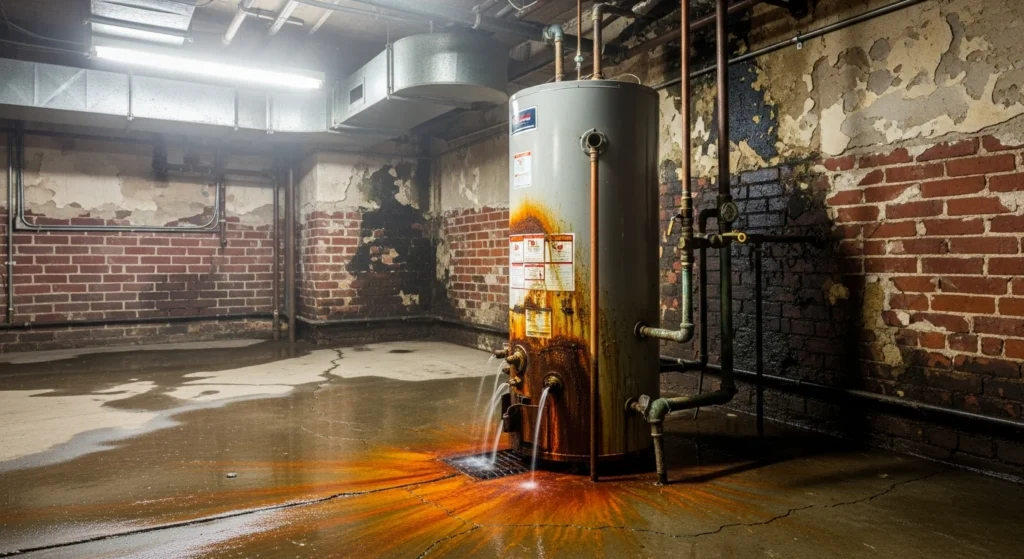
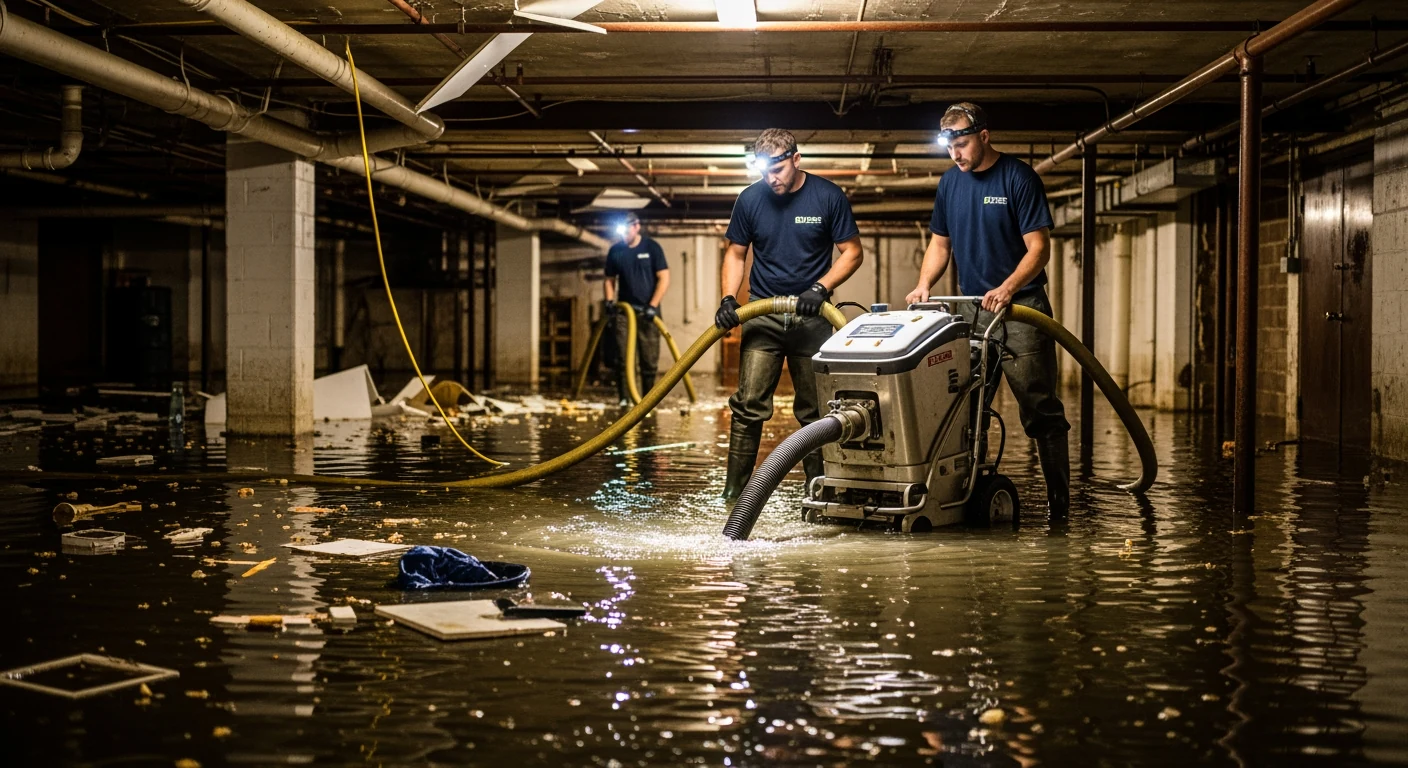
Water heater failures spike in late winter and early spring for a specific reason: the thermal cycling of heating systems reaches its peak cumulative stress over a full heating season, and systems that were borderline in October have been pushed toward failure by March. In NYC and Long Island buildings, the pattern is predictable — restoration companies begin receiving water heater leak calls in February and the volume builds through April. What’s less predictable is the secondary damage, because water heater leaks in NYC’s dense building stock often go undetected for days, weeks, or even months before anyone notices standing water in a basement mechanical room or water staining on a first-floor ceiling.
Water Heater Failure Taxonomy: What the Leak Location Tells You
The location and appearance of a water heater leak is diagnostic — each failure type has a different urgency level and different water damage scope:
Pressure relief valve (PRV) discharge: A trickle or stream of water from the discharge pipe of the temperature-pressure relief valve located on the upper side of the tank. The PRV is a safety device designed to release water when tank temperature or pressure exceeds safe limits. A continuously discharging PRV is not a normal drip — it indicates that the system is operating above its rated temperature or pressure, or that the valve itself has failed (failed open or with mineral deposit preventing reseating). A continuously discharging PRV in an enclosed mechanical room can produce significant water accumulation over 24–48 hours. Urgency: high. Requires immediate diagnosis of the overpressure condition before the valve is replaced.
Tank body corrosion leak: Rust-colored water weeping from the tank body, or a rust stain on the tank exterior at the base or lower side. Internal tank corrosion is the terminal failure mode for steel tank water heaters — the sacrificial anode rod inside the tank is designed to corrode preferentially to protect the tank, but when the anode is consumed, the tank itself begins corroding from the inside. A tank that is actively corroding is nearing catastrophic failure — not a slow drip situation but a potential sudden tank rupture that releases 40–80 gallons instantly. Urgency: replace immediately. Do not attempt to repair a corroding tank body.
Inlet/outlet connection leak: Dripping from the pipe connections at the top of the tank (cold water inlet, hot water outlet) or from the drain valve at the bottom. These are fitting failures — typically corroded threaded connections, failed dielectric unions, or cracked drain valves. They can often be repaired by a licensed plumber without full tank replacement, but the water damage scope from a slow fitting leak can be significant if undetected.
Expansion tank failure: In closed plumbing systems (common in NYC high-rise and mid-rise buildings with pressure reducing valves), a failed expansion tank creates excess pressure that discharges through the PRV. This is often misdiagnosed as a PRV failure and the PRV is replaced — which solves nothing because the pressure source is the failed expansion tank. Correct diagnosis requires measuring system pressure; if it exceeds 80 psi, the expansion tank is the likely culprit.
How Long a Slow Water Heater Leak Goes Undetected in NYC Buildings
In single-family Long Island homes where the water heater is in a finished utility room with regular occupant access, a visible drip at the base of the tank might be noticed within days. In NYC’s building typology, the situation is frequently different:
Water heaters in NYC multi-unit residential buildings are often located in basement mechanical rooms that are accessed by building staff weekly or less frequently. A slow PRV discharge or fitting drip in a basement mechanical room can produce significant water accumulation over two to four weeks — saturating adjacent concrete block walls, migrating under expansion joints to adjacent spaces, and wicking up into wood framing or sheetrock in finished areas above. The first visible sign may be a water stain on a first-floor ceiling directly above the mechanical room, by which time the underlying damage is well established.
In high-rise NYC buildings, water heater closets in individual apartments — often enclosed behind drywall with no inspection access — can sustain slow fitting leaks for months before the drywall becomes visibly damaged or the occupant notices floor damage at the closet base. IICRC moisture mapping frequently reveals water heater closet leaks that have been ongoing for one to three months, producing Class 3 or Class 4 drying situations in the surrounding wall assembly.
Water Migration Patterns by Building Construction Type
Where a water heater leak travels in a building depends on the construction type — and this determines what remediation scope is required:
NYC brownstone/rowhouse (wood frame with masonry facade): Water from a basement water heater follows wood floor framing toward the building perimeter (where frame meets masonry). This creates a hidden moisture accumulation at the sill plate level — one of the most difficult drying scenarios because the sill is enclosed by both the masonry exterior and the interior finish, and moisture meters cannot reach it without opening the assembly.
Mid-century concrete slab construction: Water on a slab spreads laterally under flooring. In apartments with wood or laminate flooring over a concrete slab, a water heater closet leak migrates under the flooring across the entire room before it becomes visible. When discovered, the scope often involves full floor replacement and evaluation of whether the concrete slab itself has absorbed moisture that must be dried before new flooring is installed.
Long Island basement mechanical rooms: Water heater leaks typically spread across the concrete basement floor and then wick up into adjacent wood framing (basement wall studs, any finished basement walls) and into the subfloor above. If the basement is partially finished, the damage scope can be substantially larger than what’s visible in the immediate area of the water heater.
Category 1 vs. Category 2 Classification for Water Heater Leaks
Water heater leaks are classified under the IICRC S500 water damage standard as Category 1 (clean water from a sanitary source) when fresh water is discharged from the tank through a supply-side failure. This means porous materials in contact can potentially be dried in place rather than removed — a significant difference from the Category 3 sewage backup scenario.
However, Category 1 water that is not addressed promptly can be reclassified as Category 2 or higher when it contacts soils, building materials with pre-existing contamination, or when it has been standing long enough for microbial growth to begin (again, the 24–48 hour threshold). A water heater leak in a basement mechanical room that went undetected for two weeks is not being treated as Category 1 by any competent restoration contractor — it has had ample time to acquire secondary contamination and microbial growth in the standing water and saturated materials.
NYC DOB Notification Requirements for Plumbing Failures
For multi-unit residential buildings in NYC, significant plumbing system failures have specific NYC Department of Buildings notification implications. A water heater failure that requires replacement in a building with more than three units typically triggers a DOB permit for the new appliance installation. In buildings served by combined domestic hot water and heating systems (common in pre-war NYC buildings with steam or hydronic distribution), the permit requirements are more extensive and may involve DOB-licensed plumbers and licensed boiler inspectors depending on system classification.
Property owners and building managers should maintain documentation of all water heater replacements, including the licensed plumber’s work permit number, inspection records, and certificate of compliance for the new installation. This documentation is relevant to insurance claims for appliance-originated water damage and to HPD compliance if tenant unit damage is involved.
Frequently Asked Questions About Water Heater Leaks in NYC
What does it mean when water is leaking from the bottom of my water heater? Water at the base of the tank most likely indicates either a leaking drain valve (usually a slow drip from the valve body), a corroding tank bottom (rust-colored water, indicates terminal tank failure), or water tracking down from a connection leak at the top fittings. A drain valve drip is a minor repair; rust-colored water at the base is an emergency replacement situation.
Should I turn off my water heater if it’s leaking? If the leak is significant (steady stream or significant pooling), turn off the water supply valve to the heater (typically located on the cold water inlet pipe above the tank) to stop additional water input. For an electric water heater, shut off the circuit breaker serving the unit. For a gas heater, turn the gas valve to the pilot position. Do not turn off the main building water supply unless the supply valve to the heater is inoperative — this disrupts water service to the entire building.
Can a leaking water heater cause mold? Yes. Any sustained moisture source in an enclosed space — including a slow water heater drip over days or weeks — creates the moisture conditions for mold growth in adjacent materials. Basement mechanical rooms, water heater closets, and utility areas are often warm, dark, and have limited air circulation — ideal mold growth conditions. If a water heater leak has been present for more than 48 hours, mold assessment should be part of the water damage evaluation.
Is water heater damage covered by homeowners insurance? Sudden and accidental water heater failures are typically covered under standard homeowners policies — the resulting water damage to the structure and contents is covered, though the water heater itself is generally not covered as an appliance. Damage from a slow leak that has been present for an extended period may be characterized as resulting from a maintenance deficiency rather than a sudden event, potentially limiting or denying coverage. Document the date you discovered the leak and report promptly.
How much does water heater replacement cost in NYC? A standard residential tank water heater replacement by a licensed NYC plumber runs $1,200–$2,800 including the unit, labor, and disposal of the old heater. Tankless water heater installation runs $2,500–$5,000+ depending on venting and gas line requirements. High-rise or commercial multi-unit water heater systems are priced individually based on system configuration.
Related reading: The April Property Assessment for NYC and Long Island Owners | Why March Is the Most Dangerous Month for NYC Properties | The March Mold Discovery Problem — What Grew Over Winter