If your Long Island commercial or industrial property was built before 1980, there’s a strong chance asbestos-containing materials are somewhere in the structure — and if you’re planning a renovation, demolition, or even routine maintenance, that asbestos becomes your legal responsibility. Upper Restoration provides licensed asbestos abatement across Nassau County, Suffolk County, and New York City, helping commercial property owners stay compliant while protecting workers, tenants, and the surrounding community from exposure.
Industrial asbestos abatement is the licensed process of identifying, containing, and safely removing asbestos-containing materials (ACMs) from commercial, industrial, and institutional buildings. In New York State, all abatement work must be performed by a licensed contractor under strict EPA, OSHA, and NYS DOL regulations.
Why Long Island Industrial Properties Face Elevated Asbestos Risk
Long Island’s industrial corridors — Hauppauge, Bethpage, Melville, Amityville, and Bay Shore among them — developed heavily during the postwar manufacturing boom of the 1950s through 1970s. During that era, asbestos was the go-to material for fire resistance, thermal insulation, and soundproofing. It was installed in virtually every type of commercial construction: factory floor tiles, boiler room pipe insulation, roof decking, HVAC duct wrap, ceiling tiles, and spray-on fireproofing.
Many of these buildings are still in active use today — or are being converted for warehousing, light manufacturing, medical offices, or mixed-use development. Any physical disturbance to the structure triggers regulatory requirements under New York State Department of Labor (NYS DOL) rules, which require a licensed asbestos survey before renovation or demolition can begin. Learn more about NYS Code Rule 56 compliance requirements for Long Island renovation projects.
Common Asbestos-Containing Materials in Long Island Industrial Buildings
In older commercial and industrial structures, asbestos is most commonly found in the following locations:
- Pipe and boiler insulation — Mechanical rooms and boiler areas in pre-1980 buildings almost universally contain asbestos-wrapped pipes and fittings.
- Floor tiles and adhesive — 9×9 vinyl asbestos floor tiles were standard in warehouses, offices, and industrial spaces through the 1970s. See our guide on asbestos tile mastic in Long Island buildings.
- Roof decking and insulation — Built-up roofing systems from this era frequently contain asbestos in the insulation board and mastic.
- Ceiling tiles and spray-on fireproofing — Common in industrial facilities and commercial buildings subject to fire codes.
- HVAC duct wrap and gaskets — Ductwork insulation and mechanical gaskets were routinely manufactured with asbestos through the late 1970s. Read more about asbestos in HVAC systems on Long Island.
- Drywall joint compound and plaster — Found in office areas within industrial buildings, particularly in structures built or renovated before 1977.
New York State Asbestos Regulations for Commercial Properties
New York maintains some of the strictest asbestos abatement regulations in the country. Before any renovation or demolition of a commercial or industrial property, property owners are required to:
- Commission a licensed asbestos survey — A certified industrial hygienist or asbestos inspector must survey the affected area and submit findings before work begins.
- File a notification with NYS DOL — Projects involving more than 10 linear feet or 10 square feet of ACMs require formal notification to the New York State Department of Labor Asbestos Control Bureau at least 10 business days before work begins.
- Hire a licensed abatement contractor — Only contractors holding a current NYS asbestos abatement license may perform removal. Upper Restoration holds all required state licenses and NYC DEP certifications.
- Conduct post-abatement air clearance testing — An independent industrial hygienist must clear the area before workers re-enter and before any subsequent construction can proceed.
Failure to comply can result in stop-work orders, substantial fines from NYS DOL or NYC DEP, and personal liability for property owners and contractors. For schools and institutional buildings, additional federal requirements under AHERA apply to Long Island institutions.
The Upper Restoration Industrial Abatement Process
Our team handles commercial and industrial asbestos projects from initial assessment through regulatory filing, abatement, and post-clearance documentation. Here is what the process looks like on a typical Long Island industrial project:
Step 1: Site Assessment and Bulk Sampling
We conduct a thorough visual survey of the affected areas and collect bulk samples of suspected ACMs. Samples are sent to an accredited laboratory for analysis. This step produces the documentation required for NYS DOL notification.
Step 2: Regulatory Notification and Permitting
Once the survey confirms the presence of ACMs, we file all required notifications with NYS DOL and, where applicable, NYC DEP. We handle the paperwork — property owners do not need to navigate the regulatory process alone.
Step 3: Containment and Engineering Controls
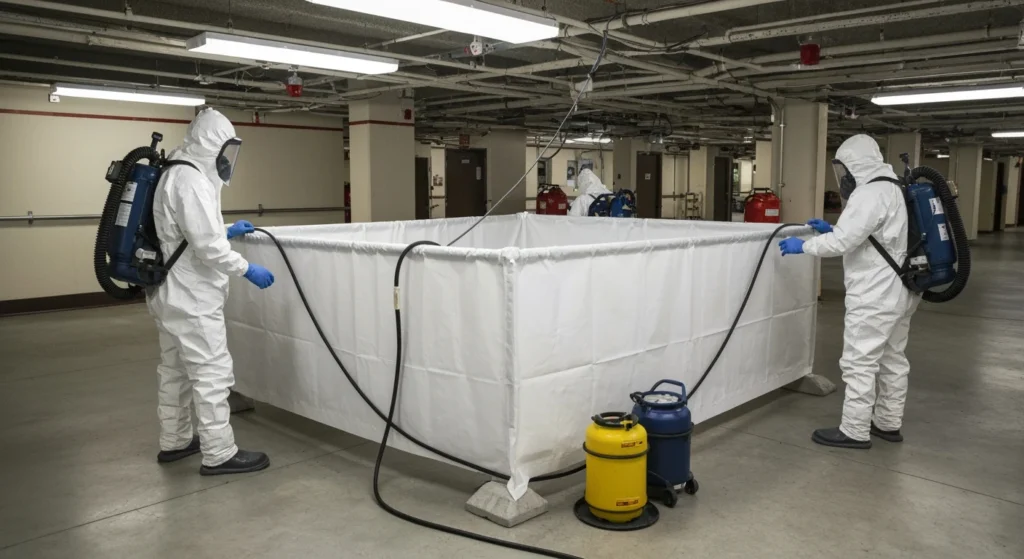
Before removal begins, our crew establishes negative air pressure containment using HEPA-filtered air scrubbers and polyethylene barriers. This prevents asbestos fibers from migrating into adjacent occupied areas or the surrounding environment.
Step 4: Licensed Abatement
All asbestos-containing materials are wetted, carefully removed, and double-bagged in labeled disposal containers in accordance with EPA and OSHA standards. Our workers are fully trained, equipped with appropriate PPE, and operate under the supervision of a licensed asbestos supervisor at all times.
Step 5: Disposal and Air Clearance
ACM waste is transported to an approved disposal facility. After abatement is complete, an independent industrial hygienist conducts post-abatement air monitoring. Only after a passing clearance is the area returned to the property owner and released for follow-on construction.
Industrial Asbestos Abatement Across Long Island: Areas We Serve
Upper Restoration serves commercial and industrial clients throughout Nassau County and Suffolk County, including Hauppauge, Melville, Bethpage, Amityville, Bay Shore, Deer Park, Ronkonkoma, Farmingdale, Garden City, and Hempstead. We also serve all five New York City boroughs for larger commercial and institutional projects.
If you are managing a property in any of these areas and have a renovation, expansion, or demolition project on the horizon, contact us early. Asbestos surveys and regulatory filings take time, and building that time into your project schedule is far less costly than stopping work mid-project for compliance issues. For full-service commercial restoration beyond asbestos, see our commercial mold remediation services for Long Island businesses.
Frequently Asked Questions: Industrial Asbestos Abatement on Long Island
Do I need an asbestos survey before renovating a commercial building on Long Island?
Yes. New York State law requires a licensed asbestos survey before any renovation or demolition activity in a commercial or industrial building that may disturb existing materials. This applies regardless of the building’s age, though pre-1980 structures carry the highest likelihood of containing asbestos-containing materials (ACMs).
How long does an industrial asbestos abatement project take?
Timeline depends on the scope and quantity of ACMs involved. A single mechanical room with pipe insulation may be cleared in 3 to 5 days. A full-floor renovation of an older industrial building can take 2 to 4 weeks, including the required regulatory notification period (10 business days) and post-abatement air clearance testing.
What does commercial asbestos abatement cost on Long Island?
Commercial and industrial asbestos projects on Long Island typically range from a few thousand dollars for isolated materials to $50,000 or more for large-scale industrial abatement. Accurate pricing requires an on-site assessment. Upper Restoration provides detailed written estimates at no charge for qualifying commercial projects.
Can my tenants or employees remain in the building during abatement?
In most industrial abatement scenarios, the affected area must be vacated and sealed off with negative air pressure containment. Adjacent areas and other floors may remain occupied if proper engineering controls are in place. Your project manager will assess the building layout and provide specific occupancy guidance before work begins.
Is Upper Restoration licensed to perform asbestos abatement in New York State and New York City?
Yes. Upper Restoration holds current New York State asbestos abatement contractor licensure and is certified by the New York City Department of Environmental Protection (NYC DEP). We work in compliance with EPA, OSHA, NYS DOL, and NYC DEP regulations on every project.
What types of industrial facilities does Upper Restoration serve on Long Island?
We serve warehouses, manufacturing facilities, distribution centers, office buildings, schools, hospitals, municipal buildings, and mixed-use commercial properties throughout Nassau County, Suffolk County, and New York City. No project is too large or too complex for our licensed abatement team.
Contact Upper Restoration for Industrial Asbestos Abatement on Long Island
If you are planning a renovation, demolition, or property sale that may involve asbestos-containing materials, do not wait until you are already under regulatory scrutiny. Upper Restoration’s licensed abatement team works with commercial property owners, general contractors, property managers, and industrial facility operators across Long Island and New York City. Call us or use the contact form to schedule a no-cost site assessment.