Water Mitigation in NYC & Long Island: Process, Cost & Insurance Guide
When water damage happens — a burst pipe, failed appliance, storm-driven roof leak, or backed-up drain — the first question is not how to fix the house. The first question is how to stop the damage from spreading. That’s water mitigation: the emergency discipline of limiting loss before it compounds.
Every hour that wet structural materials sit without professional drying, the damage worsens. Drywall wicks upward. Wood subfloor swells. Insulation retains moisture. And within 24–48 hours in New York’s climate, mold begins. This guide explains the full mitigation process, what it costs in 2026, how insurance covers it, and what separates a properly dried structure from one that produces mold problems months later.
Water Mitigation vs. Water Damage Restoration: The Distinction That Matters for Your Claim
These terms are used interchangeably by homeowners but describe fundamentally different scopes — and the distinction matters for your insurance claim, your timeline, and who you hire.
| Phase | What It Covers | Timeline | Goal |
|---|---|---|---|
| Water Mitigation | Source control, extraction, drying, containment, material removal | Hours to days | Stop damage from spreading |
| Water Restoration | Demo, rebuild, drywall, flooring, finishing, contents return | Weeks to months | Return property to pre-loss condition |
Mitigation is emergency medicine. Restoration is reconstruction. You cannot skip to restoration without completing mitigation — structural materials rebuilt over undried framing will fail and produce mold regardless of how well the finish work is done. Insurance adjusters review mitigation documentation before approving restoration scope. Gaps in the mitigation record create claim disputes.
IICRC Water Damage Categories: Why Category Determines Protocol
The IICRC S500 Standard classifies water damage into three categories based on contamination level. Category determines cleaning requirements, PPE levels, which materials can be dried in place vs. removed, and disposal requirements.
| Category | Water Source | Examples | Protocol |
|---|---|---|---|
| Category 1 Clean Water |
Sanitary water source | Burst supply line, clean appliance overflow, rain through intact roof | Extraction and drying; some porous materials can be dried in place if caught quickly |
| Category 2 Grey Water |
Contaminated but not sewage | Dishwasher overflow, washing machine discharge, toilet overflow (urine only) | Antimicrobial treatment required; porous materials in contact must be removed |
| Category 3 Black Water |
Grossly contaminated | Sewage backup, exterior floodwater, toilet overflow with feces | Full hazmat protocols; all porous materials removed; EPA-registered disinfection required |
Category 1 water left standing for more than 24–48 hours degrades to Category 2. Category 2 left standing degrades to Category 3. This is why response time directly determines both the scope of damage and the cost of remediation — a Category 1 burst pipe caught in two hours is a fundamentally different job than the same pipe discovered two days later.
The Water Mitigation Process: Step by Step
Step 1: Source Control (Hour 0)
Nothing else matters until the water source is stopped. Burst pipe — shut off the building water supply. Roof leak — emergency tarping. Appliance failure — isolate the appliance. Sewer backup — contact the municipality and stop using all water fixtures. Upper Restoration coordinates source control on arrival and can help locate the shutoff in complex NYC buildings where mechanical rooms are shared or access is restricted.
Step 2: Safety Assessment
Before entering a water-damaged space, the crew confirms electrical safety (panels, outlets, and fixtures in flooded areas must be de-energized), structural safety (saturated floors and ceilings can fail), and contamination category. In NYC high-rises, this includes coordination with building management to confirm utility shutoffs and elevator access for equipment.
Step 3: Moisture Mapping
Thermal imaging cameras and calibrated moisture meters map every wet area — including inside wall cavities, under flooring, and in ceiling assemblies — before any extraction begins. This step is the difference between a complete job and one that misses hidden moisture that turns into a mold problem six weeks later. The moisture map generates the baseline readings that drying logs track daily until completion.
Step 4: Water Extraction
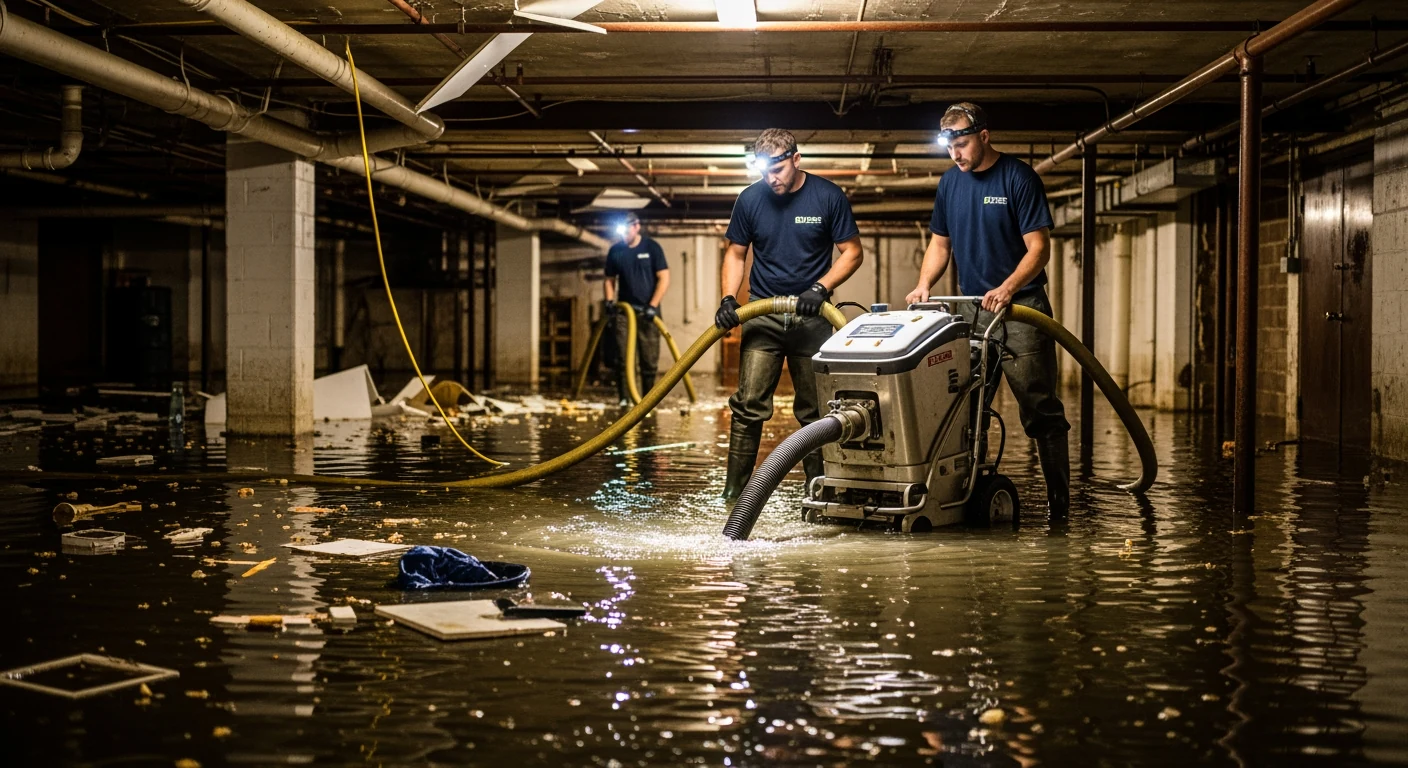
Truck-mounted extraction units remove standing water at rates of hundreds of gallons per hour. Portable extractors follow for confined spaces and upper floors in buildings without freight elevator access. For Category 3 events (sewage, floodwater), extraction is conducted under full PPE with the affected area under negative air pressure to contain contamination spread.
Step 5: Controlled Material Removal
Porous materials that cannot be effectively dried — or that carry contamination they cannot be cleaned from — are removed before drying begins. The threshold depends on category:
- Category 1: Carpet pad always removed (cannot dry effectively); drywall may be saved if moisture readings are within range and response was fast
- Category 2: All carpet, pad, and drywall in contact removed; subfloor assessed individually
- Category 3: All porous materials in contact removed regardless of moisture level — contamination, not just moisture, drives removal decisions
Step 6: Antimicrobial Treatment
For Category 2 and 3 events, remaining structural surfaces are treated with EPA-registered antimicrobial products after material removal. Two-pass application is standard: a broad-spectrum bactericide followed by a mold preventative. This step is documented photographically and by product — your insurer and any future buyer’s inspector will look for this in the claim file.
Step 7: Commercial Structural Drying
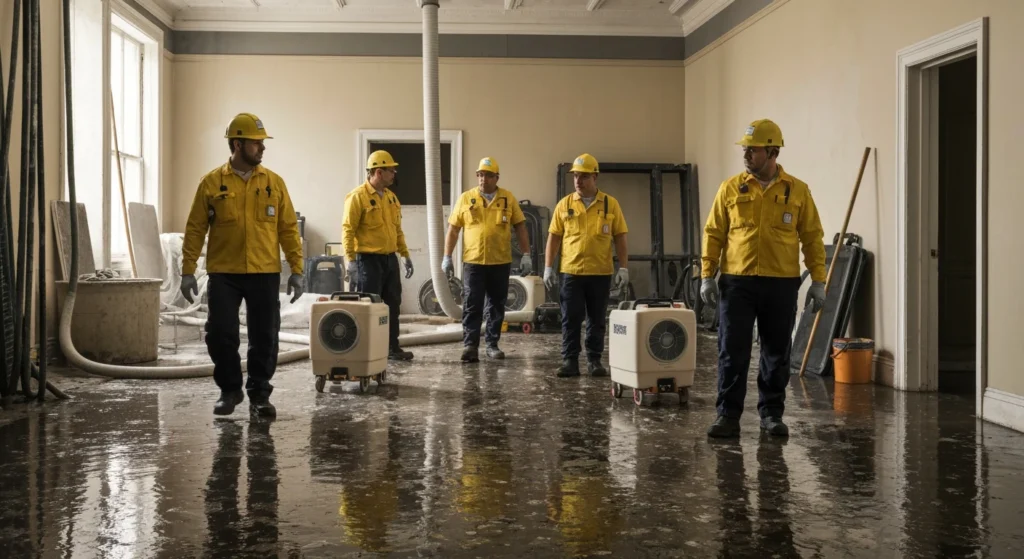
Industrial desiccant dehumidifiers and high-velocity air movers are placed using psychrometric calculations — not guesswork. Equipment placement is engineered based on cubic footage, material types, ambient temperature and humidity, and moisture readings. Typical residential drying takes 3–5 days with commercial equipment under normal NYC/Long Island conditions; Category 3 events and coastal properties with high ambient humidity may take longer.
Step 8: Daily Moisture Monitoring and Drying Logs
Technicians take daily moisture readings at every mapped location. Readings are recorded in drying logs that document the date, time, reading location, and moisture level at each measurement point. When all readings reach IICRC S500 target levels, equipment is removed. Drying logs are a required component of insurance documentation — without them, adjusters cannot verify drying was completed to standard.
Step 9: Post-Mitigation Clearance
A final moisture survey confirms all structural assemblies are at target moisture content before the mitigation scope is closed and the restoration scope begins. This clearance is documented in writing and handed off with the drying log package to the adjuster and the reconstruction team.
Water Mitigation Cost in NYC & Long Island: 2026 Pricing
| Scenario | Typical Cost Range | Key Drivers |
|---|---|---|
| Minor — Cat 1, single room, fast response | $2,500–$5,000 | Limited material removal, 3-day dry |
| Moderate — Cat 1–2, multi-room | $5,000–$10,000 | Drywall removal, full drying cycle |
| Major — Cat 2–3, full floor or basement | $10,000–$20,000 | Full material removal, antimicrobial, extended dry |
| Cat 3 / sewage backup | $4,000–$15,000 | Hazmat protocols, licensed waste disposal |
NYC jobs carry a 20–35% premium over national averages. Long Island runs 15–20% above national. These figures cover mitigation only — water damage restoration (reconstruction) is a separate scope that follows after clearance. For sewage-specific pricing, see our detailed guide on sewage backup cleanup cost in NYC and Long Island.
Does Insurance Cover Water Mitigation?
Water mitigation is covered under standard HO-3 homeowners insurance when the water source is a covered peril — burst pipes, appliance failures, sudden roof leaks, and similar sudden and accidental events. Coverage typically includes extraction, material removal, drying equipment, antimicrobial treatment, and daily monitoring.
What is not covered: gradual leaks that developed over time, flooding from exterior sources (requires NFIP flood insurance), and damage from neglected maintenance. The insurer will look for evidence that the event was sudden and accidental — not the result of deferred maintenance or a known existing condition.
The documentation imperative: Insurers require drying logs, moisture maps, material removal documentation, and antimicrobial records to process mitigation claims. A contractor who doesn’t produce these documents leaves you without the evidence to close your claim. Upper Restoration provides complete documentation from day one — the same package adjusters at every major carrier recognize and accept. Learn more about how Upper Restoration works with insurance adjusters and see our guide on whether homeowners insurance covers water damage from a leaking roof.
NYC and Long Island Specific Considerations
High-Rise and Multi-Unit Buildings
Water damage in NYC apartment buildings, co-ops, and condos creates immediate questions about building vs. unit owner responsibility. Water that originates from an upstairs neighbor’s unit, a building pipe, or a common-area failure may be the building’s master policy responsibility. Establishing the source — documented by your restoration contractor on day one — determines whose insurance covers the mitigation. Upper Restoration’s project managers are experienced with NYC building management protocols and can coordinate access, documentation, and liability assignment across multiple units.
Coastal Long Island Humidity
Long Island’s coastal climate — particularly in South Shore communities and the Hamptons — means ambient humidity is consistently elevated. Commercial drying equipment works against ambient conditions; in summer months especially, drying timelines extend beyond what calculators predict for inland properties. Our crews adjust equipment deployment for local humidity conditions, not national averages.
Mold After Water Damage
In New York’s climate, any water event that goes unaddressed for 24–48 hours carries significant mold risk. Mold remediation in New York requires a separate NYS Article 32 license — it is not simply part of general contractor scope. Upper Restoration holds Article 32 certification and handles mold remediation concurrent with water mitigation when necessary, under one contract and one documentation package. See our guide on mold remediation on Long Island for NYS law details.
For specific geographic coverage, see our water damage guides for Nassau County and Suffolk County, and our 24/7 emergency water damage response guide for Long Island.
Water Mitigation: Frequently Asked Questions
What is water mitigation?
Water mitigation is the emergency phase of water damage response — stopping the water source, extracting standing water, removing unsalvageable materials, and drying the structure using commercial equipment before secondary damage like mold and structural deterioration can develop. It is the phase that happens before reconstruction.
How much does water mitigation cost?
Water mitigation in NYC and Long Island costs $2,500–$5,000 for minor single-room events caught quickly, $5,000–$10,000 for moderate multi-room damage, and $10,000–$20,000 for major events involving full floors or basements. Category 3 sewage backup jobs cost $4,000–$15,000 depending on scope.
How long does water mitigation take?
Most residential water mitigation jobs take 3–5 days from initial response to completed drying. Day 1 covers extraction and material removal. Days 2–4 are commercial drying with daily moisture monitoring. Day 5 is final clearance testing. Complex jobs or Category 3 events take longer.
What is the difference between water mitigation and water damage restoration?
Water mitigation stops the damage and dries the structure — it’s the emergency phase. Water damage restoration is the rebuild phase: installing new drywall, flooring, cabinets, and finishes after the structure is cleared. Mitigation must be completed and documented before restoration can begin.
Does insurance cover water mitigation?
Yes, when the water source is a covered peril — burst pipes, appliance failures, sudden roof leaks. Insurers require drying logs, moisture maps, and material removal documentation to process the claim. Flooding from exterior sources requires separate flood insurance.
What are IICRC water damage categories?
The IICRC S500 Standard classifies water damage as Category 1 (clean water from sanitary sources), Category 2 (grey water with some contamination), or Category 3 (black water — sewage, floodwater, grossly contaminated). Category determines cleaning protocols, which materials must be removed, and disposal requirements.
Can I do water mitigation myself?
For very minor Category 1 events caught immediately — a small appliance overflow on a tile floor — basic extraction and drying may be manageable. For anything involving carpet, drywall, subfloor, or Category 2/3 water, professional mitigation is essential. DIY drying without commercial equipment leaves residual moisture in structural assemblies that cannot be detected without moisture meters — and that moisture produces mold within weeks.
What is a drying log and why does my insurer need one?
A drying log is a daily record of moisture readings taken at documented locations throughout the drying period. It shows your insurer that structural drying was completed to IICRC S500 standard — not just that equipment was placed and removed. Without drying logs, adjusters cannot verify the mitigation was complete and may dispute or reduce the claim settlement.