Emergency Water Damage Restoration on Long Island: What to Do in the First Hour (2026)
Water damage doesn’t wait for business hours. A pipe bursts at 2 AM during a January nor’easter. A water heater fails on a Sunday while you’re at your kid’s soccer game. Storm surge from a tropical system pushes bay water through your front door at midnight. The decisions you make — and the speed with which you make them — in the first 60 minutes after a major water event have more impact on your home’s outcome than anything that happens in the weeks of restoration that follow.
This guide covers exactly what to do in a water emergency on Long Island, how professional 24/7 restoration response works, what drives after-hours costs, and how to protect both your home and your insurance claim from the moment water appears.
The First 60 Minutes: What You Must Do Before Help Arrives
Stop the source if you safely can. Locate your main water shutoff valve and close it if the emergency is from a plumbing failure. Know where your shutoff is before an emergency — it is typically in the basement near where the main supply enters the house, or in a utility closet on the ground floor. Turning off the water immediately can reduce a catastrophic burst pipe from 250 gallons per hour of flow to zero. If the source is storm surge or exterior flooding, you cannot stop the source — focus on protecting what you can and getting out of the water’s path.
Cut power to affected areas if it’s safe to do so. Water and electricity are an immediately lethal combination. If water is near electrical outlets, panels, or appliances, turn off power to those circuits at the breaker before entering the space. If the panel itself is in a flooded area, call 911 or your utility rather than attempting to cut power — LIPA and PSEG LI have 24/7 emergency response lines for exactly this situation.
Document everything before touching anything. Walk through with your phone camera and take video of every affected area from multiple angles. This 3–5 minutes of documentation is the foundation of your entire insurance claim. Adjusters arrive days after the event; your documentation taken immediately after is the record of pre-mitigation conditions that is impossible to recreate once cleanup begins.
Move high-value items out of water’s path if you can do so safely. Electronics, documents, artwork, and irreplaceable personal items that are above the waterline can be moved to dry areas. Do not wade through Category 3 floodwater (exterior flooding, sewage) — the contamination risk is real and serious. Waterline items in a burst-pipe event (clean water) can generally be moved safely.
Call a 24/7 restoration contractor. Not a general contractor. Not a plumber. A certified water damage restoration company with IICRC-trained technicians and industrial equipment — air movers, LGR dehumidifiers, extraction units — that can be on site within the hour. The 24–48 hour window for preventing mold growth in Long Island’s coastal humidity is not theoretical; it is the documented biological threshold for mold establishment on wet porous materials. Every hour without professional extraction and drying is mold risk compounding.
How 24/7 Emergency Restoration Response Works on Long Island
A professional 24/7 emergency response from an IICRC-certified restoration company follows a specific sequence regardless of what time you call:
Initial call triage (0–15 minutes). The on-call coordinator takes the loss description, confirms the address and access, dispatches the on-call crew, and provides immediate guidance — where to shut off water, which areas to avoid, what not to touch. This conversation is also the beginning of claim documentation.
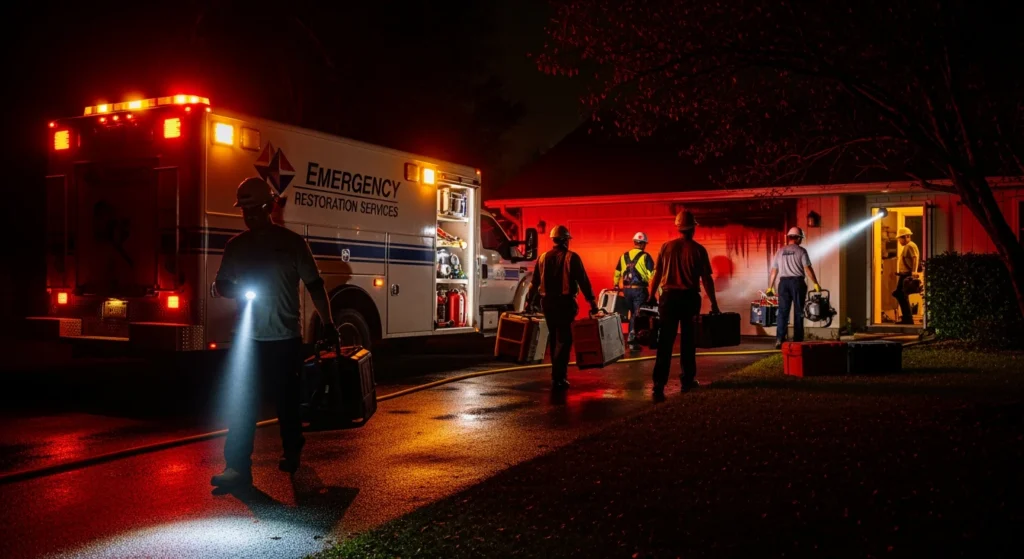
Emergency crew arrival (30–90 minutes). On Long Island, professional restoration companies aim for 60-minute response times throughout Nassau County and most of Suffolk County. Response to East End communities may run 90–120 minutes from a Farmingdale or Ronkonkoma staging location. The crew arrives with extraction equipment, moisture meters, cameras, and enough air movers and dehumidifiers to begin stabilization immediately.
Moisture assessment and safety check (first 30 minutes on site). Before any equipment is placed, the lead technician walks the entire property with calibrated moisture meters, mapping the extent of water migration through floors, walls, and ceilings. Thermal imaging cameras identify hidden moisture in wall cavities that isn’t visible through surface inspection. The safety check confirms electrical hazards have been addressed and that the structure is safe to work in. This assessment determines the scope of the emergency response and the initial equipment load.
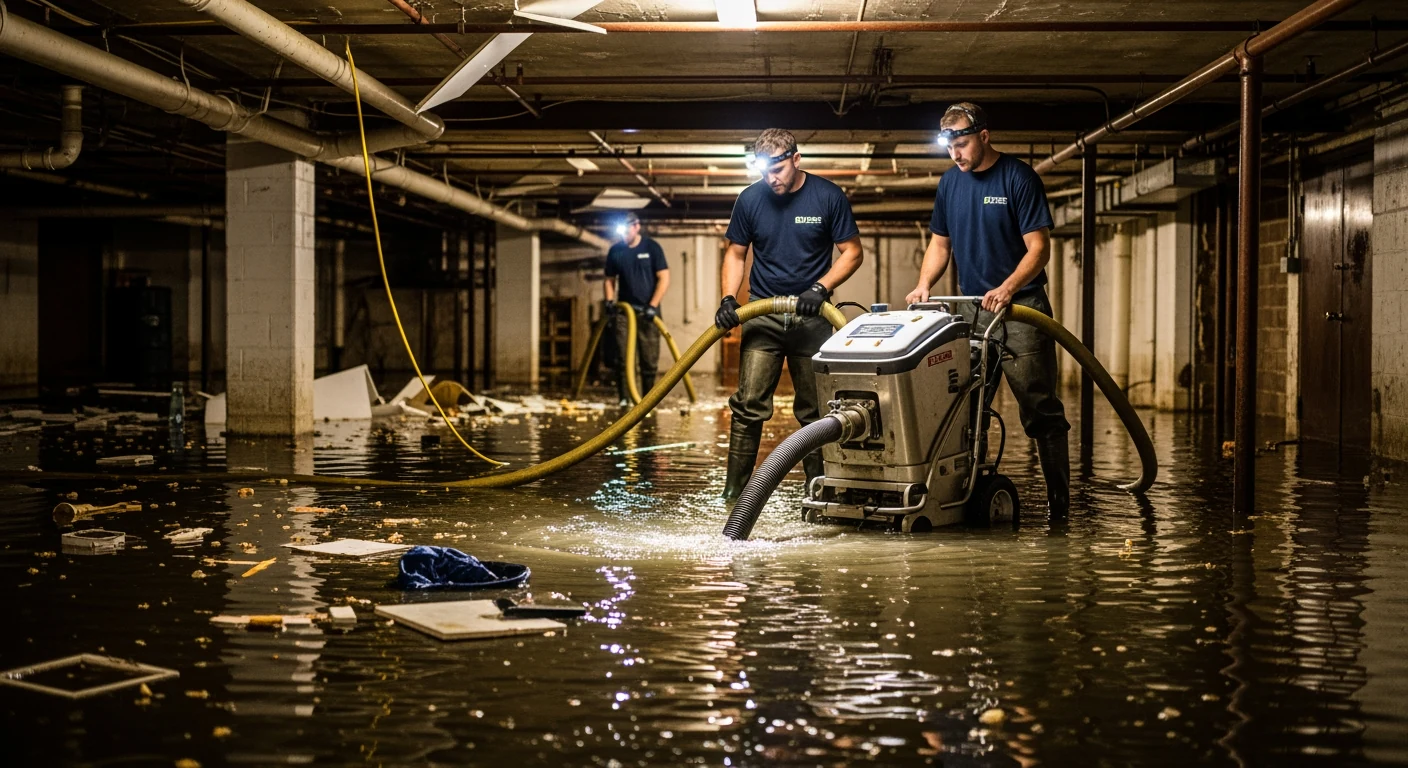
Emergency extraction and equipment placement (1–3 hours). Industrial extraction removes standing water from all affected areas. Air movers are placed to create maximum evaporation from wet materials; commercial LGR dehumidifiers are positioned to capture that evaporation and prevent it from re-depositing on drier surfaces. The equipment operates continuously — technicians return daily to monitor psychrometric conditions, adjust equipment placement, and document drying progress with moisture readings logged at fixed grid points.
After-Hours Emergency Response: What Drives the Cost
Emergency response at 2 AM costs more than the same response at 10 AM — this is standard across the restoration industry and reflects real costs: after-hours crew premiums, emergency dispatch overhead, and the mobilization costs of standing up a response at irregular hours. Understanding these components helps you evaluate what you’re paying for.
Most restoration companies charge an emergency service fee (typically $300–$700) for after-hours dispatch, in addition to standard extraction and drying rates. This fee is a legitimate, claimable expense under your homeowners policy — include it in your initial documentation. The IICRC S500 standard governs what qualifies as appropriate emergency response and what equipment loads are standard for different water damage classes. When you review your restoration contractor’s invoice or a Xactimate estimate from the adjuster, the emergency fee should appear as a line item and should be present in both.
The total cost of a 24/7 emergency response on Long Island for a contained burst-pipe event (Category 1, Class 2 saturation, affected first floor of a typical Nassau or western Suffolk home): $3,500–$8,000 for the emergency response phase — extraction, equipment for the first week of drying, and daily monitoring. This covers mitigation only; reconstruction is a separate scope scoped after drying is complete and moisture documentation confirms target moisture content has been reached.
Protecting Your Insurance Claim During Emergency Response
The actions you take in the first few hours after a water emergency either build or damage your insurance claim. The two most important: document before cleanup, and keep every receipt.
Insurers are entitled to see the pre-mitigation condition of the property. Your phone photos and video taken immediately after the event — before any extraction or cleanup — satisfy this requirement. If you begin cleaning before documenting, the adjuster has no record of what the damage actually looked like, which gives them latitude to argue scope. Take the documentation first. Clean second.
Every receipt from the emergency response phase is a claim expense: the restoration contractor’s emergency service invoice, hotel receipts if you needed to leave the property, any items you purchased for emergency mitigation (tarps, shop vac rentals, extension cords for temporary lighting). NYS homeowners policies include Additional Living Expenses coverage; keep a daily log of ALE costs from day one.
Notify your insurer same-day or the following morning. Under NYSDFS regulations, they must acknowledge your claim within 15 business days. Call first; follow up in writing by email to create a time-stamped paper trail of when notice was given.
Long Island Emergency Water Damage: 2026 Response Timelines
Nassau County (Hempstead, North Hempstead, Oyster Bay): 45–75 minutes typical response time. Suffolk County west (Babylon, Islip, Huntington, Smithtown, Brookhaven western): 60–90 minutes. Brookhaven eastern, Riverhead, North Fork: 75–120 minutes. East End (Southampton, East Hampton, Montauk): 90–150 minutes depending on origin point.
These response times reflect driving conditions under normal circumstances. During active storm events — when emergency calls spike across the entire service area simultaneously — response times extend. When a major nor’easter or tropical system hits Long Island, every restoration company in Nassau and Suffolk is receiving emergency calls simultaneously, and triage by damage severity (active flooding, structural collapse risk, occupied vs. vacant properties) prioritizes dispatch. If you are in a high-risk area before a storm, pre-call your restoration contractor and get on the list before the storm hits.
Frequently Asked Questions: Emergency Water Damage on Long Island
What is the most important thing to do immediately after a water emergency on Long Island?
Stop the source if safely possible (shut off the main water supply valve), cut power to affected areas to eliminate electrical hazards, document all damage with photos and video before touching anything, then call a 24/7 IICRC-certified restoration company. The documentation taken before any cleanup begins is the foundation of your insurance claim and cannot be recreated after mitigation starts.
How quickly can a restoration company respond to emergencies on Long Island?
Upper Restoration responds to emergencies throughout Nassau County in 45–75 minutes and most of Suffolk County within 60–90 minutes. East End communities (Southampton, East Hampton, Montauk) typically see 90–150 minute response times from our Farmingdale staging location. During active major storm events, response times extend as multiple simultaneous calls require triage.
Does emergency after-hours water damage response cost more?
Yes — after-hours emergency dispatch carries a service fee (typically $300–$700) that reflects real crew premium and mobilization costs. This fee is a legitimate, claimable expense under your homeowners policy. Include it in your claim documentation. Standard extraction and drying rates apply regardless of time of day; only the emergency dispatch component carries the after-hours premium.
How do I prevent mold after water damage in Long Island’s humid climate?
Professional industrial extraction and drying equipment within 24–48 hours is the only reliable prevention in Long Island’s coastal humidity environment. Consumer-grade fans and dehumidifiers cannot create the airflow and dehumidification capacity to meet the biological clock — average summer relative humidity above 70 percent means mold begins colonizing wet porous materials within 24–48 hours. Call a professional restoration company the same day the water event occurs, not after you’ve assessed the situation over several days.