Long Island’s housing stock spans from pre-war construction through the post-1980 era that is largely asbestos-free. But within the pre-1980 stock that dominates Nassau County and western Suffolk, the asbestos profile shifts significantly by construction era. A home built in 1952 has different ACM types in different locations at different concentrations than a home built in 1971 — and planning a renovation or restoration project accurately requires understanding which profile applies to the specific property.
The Pre-1960 Profile: Maximum ACM Diversity
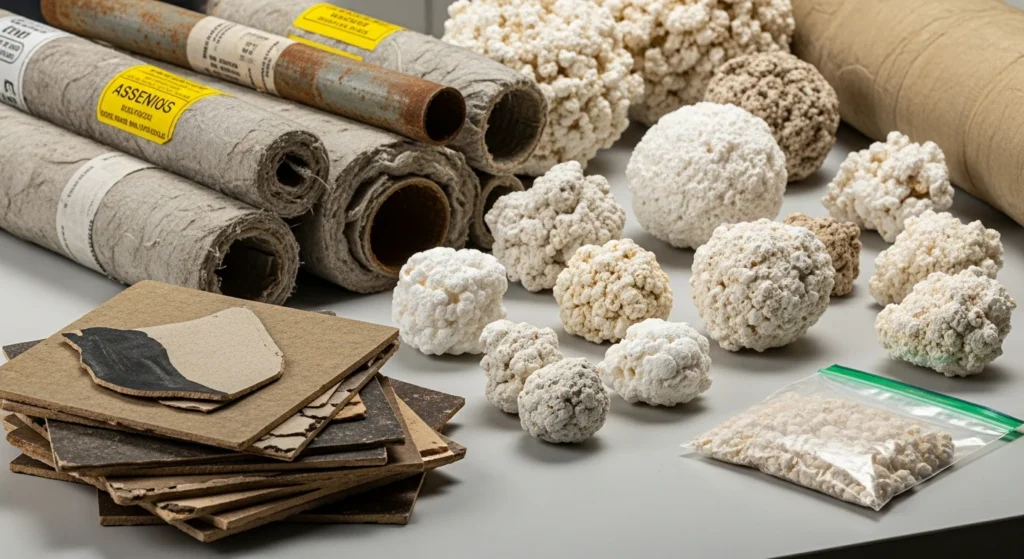
Long Island homes built before 1960 — the Levittown originals, the pre-war Valley Stream and Freeport stock, the early Hempstead Colonials — carry the full range of mid-20th-century asbestos applications. The materials most likely to be present include: Pipe insulation on oil-fired steam or hot water systems: High-concentration chrysotile in plaster matrix, the characteristic white-plaster-coated pipe wrap visible in pre-1960 basements. This is among the highest-risk ACM types for fiber release on disturbance. Asbestos-cement board (transite): Used for exterior siding, chimney flues, and some interior wallboard in 1940s-1950s construction. Original 9-inch vinyl asbestos floor tiles: Present in virtually all pre-1960 Long Island kitchens, bathrooms, and utility areas. Roof shingles: Asbestos-cement roof shingles were used on some pre-1960 construction. Spray-applied or troweled-on insulation: Some pre-1960 commercial and multi-family construction used spray-applied asbestos insulation on structural steel and concrete — extremely high fiber release potential on disturbance.
The 1960-1980 Profile: Joint Compound Dominates
Long Island homes built between 1960 and 1980 — the split-level and Colonial wave that fills Huntington, Smithtown, Babylon, and Brookhaven — shifted from plaster to drywall construction. This shift introduced the defining ACM of the era: asbestos-containing joint compound (drywall finishing compound). Joint compound containing chrysotile was used widely from the early 1960s through 1977, when voluntary industry elimination of the material began. In drywalled rooms finished between 1960 and 1978, every taped joint, screw dimple, and smooth-finish surface is a potential ACM location. This material is classified as non-friable when intact but becomes friable during demolition — sanding or cutting releases fibers readily. The 1960-1980 profile also includes 9-inch vinyl asbestos floor tiles (a continuous application through this era) and pipe insulation on oil-fired forced-air duct systems (duct wrap), but the joint compound is quantitatively the dominant material in square footage terms.
Practical Implications for Renovation Planning
For a pre-1960 Long Island home: the pre-renovation survey must include sampling of pipe insulation (prioritized as highest risk), floor tiles, and any suspicious ceiling or wall materials. For a 1960-1978 Long Island home: the pre-renovation survey must prioritize joint compound sampling of all drywalled surfaces in the renovation area, plus floor tiles. For a 1979-1986 home: joint compound risk is reduced but not eliminated (some manufacturers continued through 1980-1981), and floor tile sampling should still be included. Upper Restoration’s asbestos survey approach is era-specific — the sampling plan is designed for the construction period of the specific structure.