By: Certified Asbestos Handler | Environmental Safety Officer, Upper Restoration
The Hidden Danger in Pre-1980 Walls
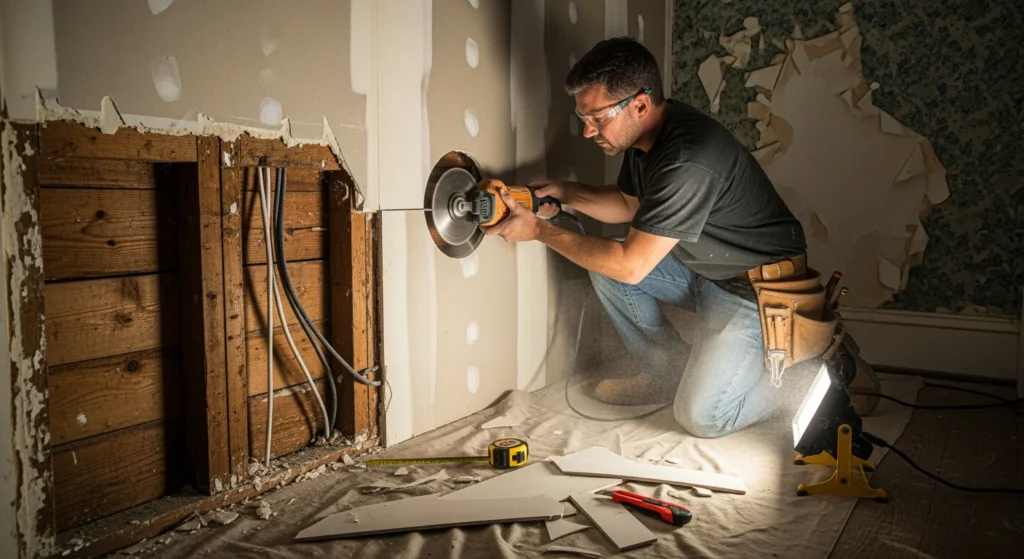
For homeowners across Long Island — from the historic neighborhoods of Garden City to the brownstones of Brooklyn and Queens — a home renovation can quickly become a hazmat scenario if the walls predate 1980. Whether you are tearing down a wall for an open-concept kitchen or patching a ceiling after a pipe leak in your Nassau County colonial, there is a microscopic hazard that is easy to overlook: asbestos in drywall joint compound.
Asbestos was a prized construction material for decades — heat resistant, strong, and versatile. It was woven into American suburban construction at scale. While most homeowners know about asbestos in pipe insulation or vinyl floor tiles, the drywall system is consistently overlooked, and that oversight causes preventable exposures every year.
The reason this matters: asbestos fibers are approximately 1,200 times thinner than a human hair. When you sand, drill, or demolish pre-1980 walls without testing, you can aerosolize millions of friable fibers that remain suspended in the air for days before settling into carpets, upholstery — and lungs. Mesothelioma and asbestos-related lung cancer have latency periods of 20 to 50 years, meaning the exposure you create today may not surface as a diagnosis until 2045 or later.
Why Joint Compound Is the Real Risk — Not the Drywall Board
There is a persistent misconception that “asbestos drywall” means the gypsum board itself is contaminated. In standard residential construction, the gypsum board is rarely the issue. The primary threat is the joint compound — the “mud” used to tape, smooth, and finish every seam, corner, and nail head in the room.
Before the late 1970s, manufacturers routinely added chrysotile asbestos fibers to joint compound as a binder. The asbestos prevented cracking during drying and added fire resistance that builders valued. Because joint compound was applied across every surface — and in many homes skim-coated over entire walls and ceilings for texture — even if the gypsum board is clean, the wall surface itself is potentially contaminated throughout.
The compounding risk: joint compound is inherently friable. It was sanded during original installation to create a smooth finish, and it can be reduced to powder with hand pressure alone. That friability is what makes asbestos in drywall joint compound one of the highest inhalation risks in renovation work.
| Component | Asbestos Probability | Friability Risk | Exposure Trigger |
|---|---|---|---|
| Gypsum Board | Low | Low (unless crushed) | Major demolition only |
| Joint Compound | High | High (when sanded) | Any sanding, drilling, or cutting |
| Texture / Popcorn Ceiling | Very High | High (easily airborne) | Any disturbance, even scraping |
| Drywall Tape | Medium | Medium | Wet removal or tearing |
Visual Inspection Is Not Enough: What Lab Testing Actually Tells You
One of the most dangerous assumptions homeowners make is relying on visual inspection to rule out asbestos. “The mud looks white and smooth, not gray” is not evidence of safety. Asbestos fibers are invisible to the naked eye. The color, texture, age stamp on the board, or contractor brand offer no definitive safety information.
Even finding a date stamp of 1979 on the back of a drywall sheet does not clear the joint compound. The EPA began phasing out asbestos-containing materials in the late 1970s, but manufacturers were permitted to exhaust existing stockpiles. Homes built as late as 1981 or 1982 can still contain asbestos-laden joint compound that was sitting in a warehouse when the walls were finished.
The only scientifically valid method of identification is Polarized Light Microscopy (PLM). This requires a physical sample — including a cross-section of the board, tape, and joint compound — sent to a certified laboratory for analysis under high-powered microscopy. In New York, both the sampling process and the laboratory analysis are regulated by the NYS Department of Health to protect occupants and the surrounding community.
The Professional Sampling Process
When asbestos is suspected, the first step is professional sampling — not a DIY test kit from a hardware store. Those kits require you to scrape the material yourself, which is exactly the action that releases fibers. Their results are also legally inadmissible and unreliable under NYS standards.
A certified asbestos inspector follows a strict protocol:
- Isolation. The sample area is misted with amended water (a soapy solution) to suppress dust during sampling.
- Core Sampling. A small section is cut through the full wall thickness — gypsum board, tape, and joint compound. Testing only the gypsum core risks a false negative.
- Immediate Sealing. The sample site is sealed with plastic or encapsulant to prevent further fiber release.
- Chain of Custody. Samples are logged and sent to a NYS Department of Health ELAP-certified laboratory for PLM analysis.
If laboratory results show more than 1% asbestos content, the entire wall system is legally classified as Asbestos-Containing Material (ACM). From that point forward, any work that disturbs the material must be performed by NYS-licensed contractors under regulatory oversight.
NYS Industrial Code Rule 56: What Long Island and NYC Homeowners Must Know
New York State Industrial Code Rule 56 (CR56) governs all aspects of asbestos handling in the state. Whether you are in a Manhattan high-rise or a Levittown ranch, any renovation that disturbs ACM must comply with these rules. This is not advisory — it is law with enforceable penalties.
A common mistake: homeowners believe they can do the demolition themselves and dispose of the debris in a standard dumpster. If a neighbor reports visible dust, or if a waste management company discovers ACM in the load, fines can reach tens of thousands of dollars per day. The legal exposure alone far exceeds the cost of professional abatement.
CR56 mandates:
- Project Notification. Large-scale asbestos projects must be reported to the NYS Department of Labor before work begins.
- Independent Air Monitoring. Third-party air testing is required to verify that fibers are not escaping the containment zone during abatement.
- Licensed Contractors Only. Only contractors holding a current NYS Department of Labor asbestos abatement license may legally perform removal work.
- Regulated Disposal. ACM waste must be double-bagged in labeled asbestos waste bags and transported to a licensed hazardous waste facility.
What Professional Asbestos Abatement Looks Like
If sampling confirms asbestos in your drywall joint compound, removal is a manageable, well-defined process when performed by licensed professionals. The goal is total containment — zero fiber migration outside the work zone.
The standard Upper Restoration abatement process for drywall ACM:
- Negative Air Pressure Environment. HEPA-filtered air machines exhaust air out of the work zone through sealed ducts, so any air movement is inward — no dust can migrate to the rest of the home.
- Double-Layer Poly Containment. The work area is lined with two layers of 6-mil fire-retardant polyethylene sheeting across all surfaces, seams, and openings.
- Decontamination Chamber. Workers enter and exit through a multi-stage decon unit. Full Tyvek suits and P100 respirators are required throughout.
- Wet Methods. Walls are continuously misted during removal to prevent dust from becoming airborne in the first place.
- Regulated Disposal. All debris is double-bagged in certified asbestos waste bags, labeled, and transported to a licensed hazardous waste facility.
- Post-Abatement Air Clearance. An independent laboratory air test is conducted after cleanup. The work area is not released until the lab confirms fiber levels are within safe limits.
Upper Restoration holds current NYS DOL asbestos abatement licenses and serves residential and commercial properties throughout Nassau County, Suffolk County, and all five NYC boroughs. See our Asbestos Abatement Services page for full scope details.
Frequently Asked Questions About Asbestos in Drywall
Can I paint over asbestos walls instead of removing them?
Encapsulation — sealing asbestos-containing joint compound under a solid layer of paint — is a legally recognized temporary management strategy under NYS CR56, provided the wall is in good, undamaged condition and will not be sanded, drilled, or disturbed. However, if you ever plan to renovate, or if the wall sustains water damage or physical damage, professional removal will eventually be required. Encapsulation does not eliminate the hazard; it stabilizes it temporarily.
My house was built in 1985. Am I safe from asbestos in the drywall?
The risk is significantly lower for post-1980 construction, but it is not zero. Contractors used existing material stockpiles for years after the EPA began phasing out asbestos-containing joint compound. Homes built as late as 1981 or 1982 have tested positive. If you are planning a major renovation in a home built between 1975 and 1985, professional testing is still the only way to confirm safety — the cost of a test is a fraction of the cost of a cleanup or a legal fine.
How much does asbestos testing cost in Long Island or NYC?
Professional asbestos sampling in the Nassau County, Suffolk County, and NYC market typically ranges from $300 to $600 for a standard residential assessment, depending on the number of samples required. Lab analysis fees are separate and vary by laboratory. The cost of testing is minor compared to the liability of an improper DIY disturbance — regulatory fines, medical monitoring, and remediation of a contaminated living space can cost tens of thousands of dollars.
What happens if I accidentally disturb asbestos during a DIY renovation?
Stop work immediately, leave the area, and close off the space. Do not use fans or HVAC in that area, as this will spread fibers through the home. Call a licensed asbestos abatement contractor for an emergency assessment. Depending on the extent of disturbance, a professional air quality test and decontamination of the affected area may be required. Do not re-enter the space until a licensed professional has assessed it.
How long does asbestos abatement take for a drywall project?
A single room with standard drywall joint compound contamination typically takes one to two days for abatement, plus time for post-abatement air clearance lab results (usually 24 to 48 hours for standard turnaround). Larger projects — full gut renovations, multi-room abatement, or commercial properties — may take several days to a week. Upper Restoration provides a project timeline estimate during the initial assessment. Call 516-715-3385 for a same-day response throughout Long Island and NYC.
If your home was built before 1980 and you are planning any renovation work, testing is not optional — it is the only responsible first step. Do not guess. The cost of a test is a small fraction of the cost of a medical bill, a remediation project, or a regulatory fine for improper disposal.
Schedule your professional asbestos assessment with Upper Restoration →
Related: Asbestos Abatement Services | Long Island Asbestos Abatement | Asbestos Safety: Removing 9×9 Floor Tiles