If you’re planning a renovation on a Long Island home built before 1980—or you’ve just discovered suspicious materials during a project—asbestos testing should be your first call, not an afterthought. As a licensed asbestos contractor serving Nassau and Suffolk County, we walk homeowners through this process every week. Here’s exactly what testing involves, what it costs, and what happens next.
What Does Asbestos Testing Actually Involve?
There are three types of asbestos testing, and the right one depends on your situation:
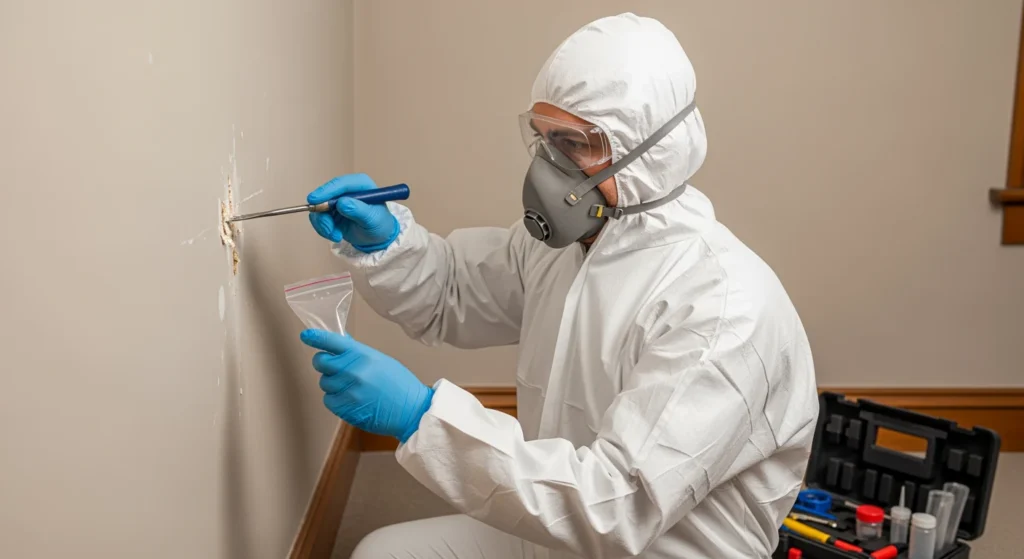
Bulk/Surface Sampling
A technician physically collects a small sample of the suspected material—floor tile, ceiling texture, pipe insulation, drywall compound—and sends it to an accredited laboratory. This is the most common type for pre-renovation inspections. Results confirm whether asbestos fibers are present and at what percentage.
Air Sampling (PCM or TEM)
Used when disturbance has already occurred or post-abatement clearance is required. A pump draws air through a filter cassette over several hours. Phase Contrast Microscopy (PCM) gives a quick fiber count; Transmission Electron Microscopy (TEM) gives the most precise identification. Air sampling is required by NYC DEP to clear a site after abatement.
Polarized Light Microscopy (PLM) Lab Analysis
The standard lab method for analyzing bulk samples. Results show asbestos type (chrysotile, amosite, crocidolite) and percentage. Under EPA standards, materials containing more than 1% asbestos are regulated as asbestos-containing material (ACM).
When Is Asbestos Testing Required in New York?
Under the New York City Department of Environmental Protection (NYC DEP) and EPA NESHAP regulations, an asbestos survey is legally required before any renovation or demolition that disturbs building materials in structures built before 1987. This applies to:
- Any demolition of a structure or portion of a structure
- Renovation affecting more than 160 square feet of friable material
- Disturbance of pipe insulation, boiler insulation, or floor tiles
- Commercial buildings undergoing tenant improvement work
For residential homeowners doing smaller work—scraping a popcorn ceiling, removing floor tiles, opening walls—testing is strongly recommended even when not legally mandated. The cost of testing is a fraction of the cost of an emergency abatement if you accidentally disturb ACM.
How Much Does Asbestos Testing Cost on Long Island?
| Test Type | Typical Cost (LI/NYC) | Turnaround |
|---|---|---|
| Bulk sample (1–3 samples) | $200–$500 | 24–72 hours |
| Bulk sample (4–10 samples) | $400–$900 | 24–72 hours |
| Air sampling (PCM) | $400–$700 | 24–48 hours |
| Air sampling (TEM) | $600–$1,200 | 48–96 hours |
| Full pre-renovation survey | $800–$2,500 | 2–5 business days |
| Post-abatement clearance testing | $600–$1,500 | 24–48 hours |
Prices vary based on the number of samples, building size, accessibility, and whether rush processing is needed. Laboratory fees are usually included in contractor quotes, but confirm this before hiring.
DIY Test Kits vs. Certified Lab Testing: The Real Difference
Home Depot sells asbestos test kits for around $30–$50. You collect the sample yourself and mail it to a lab. The lab analysis is legitimate—but the process has real limitations:
- Sample collection matters. Improper collection (disturbing friable material without containment) can release fibers into your living space. A certified inspector knows how to collect samples with minimal disturbance using wet techniques and containment.
- DIY kits don’t cover all materials. You may not know which materials to sample. A professional surveys the entire property and identifies all suspect materials.
- Results don’t satisfy regulatory requirements. If you need to pull a permit or satisfy a buyer’s home inspection, DIY kit results are not accepted. A certified inspector’s report is required.
For simple curiosity—does this floor tile contain asbestos?—a DIY kit is reasonable. For any permitted work or real estate transaction, use a certified inspector.
What Happens After a Positive Asbestos Test?
A positive result doesn’t mean your home is unlivable. It means you have asbestos-containing material (ACM) and you need to decide: leave it alone, encapsulate it, or remove it.
- Leave it alone: ACM in good condition that won’t be disturbed is often best left in place. Intact floor tiles under new flooring, pipe insulation in an unfinished basement—these can stay if undisturbed.
- Encapsulation: A sealant applied to the ACM to prevent fiber release. Works for materials in good condition that can’t be safely removed.
- Abatement (removal): Required when material is damaged, friable, or in an area that will be renovated. Under New York law, abatement must be performed by a licensed and certified contractor.
Why Your Inspector and Your Abatement Contractor Must Be Separate in New York
This is a detail that catches many homeowners off guard: New York State mold Law and NYC DEP regulations require that the company performing the asbestos inspection cannot be the same company performing the abatement. This separation exists to eliminate conflicts of interest—an inspector who profits from finding asbestos is not independent.
Upper Restoration is a licensed abatement contractor. We do not perform inspections on projects we will also remediate. We can refer you to certified independent inspectors throughout Nassau and Suffolk County, and we’ll coordinate with them to ensure the process runs smoothly.
Upper Restoration is NYS-licensed and NYC DEP-certified for asbestos abatement across Long Island and the five boroughs. We’ll connect you with a certified independent inspector and provide a free abatement consultation once testing is complete.
Call us: | Request a Free Consultation
Frequently Asked Questions: Asbestos Testing on Long Island
How long does asbestos testing take?
Standard bulk sample testing takes 24–72 hours for lab results once samples are collected. Rush processing (12–24 hours) is available at additional cost. A full pre-renovation survey including the inspection visit, sample collection, and lab report typically takes 2–5 business days.
Can I stay in my home during asbestos testing?
Yes. During a standard inspection and sample collection, the sampling is done with minimal disturbance using wet methods and containment. You do not need to leave your home. If air sampling follows a suspected disturbance event, the inspector will advise based on conditions.
Is asbestos testing required before buying or selling a house in New York?
New York does not require asbestos disclosure for residential real estate sales, but buyers frequently request asbestos inspections as part of due diligence on pre-1980 homes. Some mortgage lenders require asbestos inspections for certain property types. It’s increasingly standard practice for Long Island homes built before 1980.
What if only one or two floor tiles test positive?
If tiles are intact and undisturbed, they can often be encapsulated by installing new flooring over them. If they are damaged, cracked, or in an area that will be renovated, licensed removal is required. A licensed abatement contractor can advise on the least invasive compliant option.
Who performs asbestos inspections on Long Island?
Asbestos inspections in New York must be performed by a NYS-certified asbestos inspector. Certification is issued by the New York State Department of Labor. Always verify your inspector’s certification number before hiring.
Need professional asbestos abatement on Long Island? Upper Restoration provides licensed asbestos abatement and removal services across NYC and Long Island. Contact us for a free assessment.