Mold Remediation on Long Island: What Nassau and Suffolk County Homeowners Need to Know in 2026
Mold remediation on Long Island is not the same as mold remediation anywhere else. The combination of Atlantic coastal humidity, aging post-war housing stock, a high water table across the South Shore, and New York State’s strict Article 32 licensing law creates a set of conditions — and legal requirements — that most national guides simply don’t address. This guide covers all of it: how mold behaves in Long Island homes, what the law requires before anyone touches it, what the process actually looks like, and what you should expect to pay in 2026.
Why Long Island Homes Are Especially Vulnerable to Mold
Long Island sits between two bodies of water — the Atlantic Ocean to the south and Long Island Sound to the north — and its climate reflects that geography. Average summer relative humidity runs above 70 percent, and coastal communities from Long Beach to Bay Shore to Hampton Bays can see sustained humidity above that threshold from June through September. In those conditions, any moisture that penetrates a wall cavity, soaks into attic sheathing, or pools under a crawlspace has essentially no chance of drying naturally. It will grow mold.
But the climate is only part of the problem. The housing stock is the other half.
The bulk of Long Island’s residential construction happened in two waves: the post-WWII boom of the late 1940s through the 1960s, which produced the Cape Cods, split-levels, and raised ranches of Levittown, Hicksville, Babylon, Brentwood, and dozens of other communities; and a second wave in the 1970s through 1980s that added Colonials across much of central Nassau and western Suffolk. Homes built before 1980 were constructed without modern vapor barriers, and many Cape Cods have knee-wall attic spaces with inadequate ventilation — a structural feature that traps warm, moist air against the roof sheathing every winter and summer.
Township Mold Risk Profiles
Not every part of Long Island carries the same mold risk. Here is how mold vulnerability breaks down across the major townships:
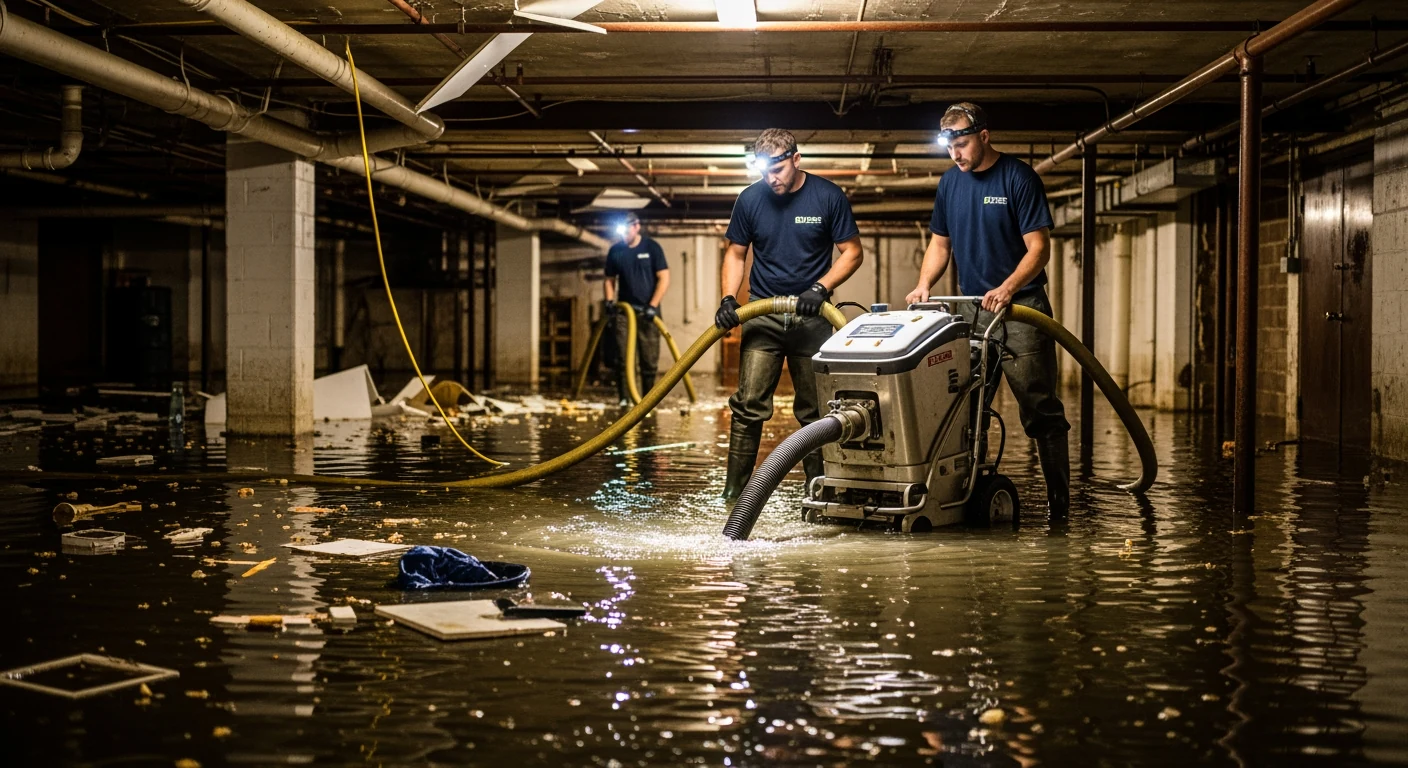
Town of Hempstead (Nassau) — The South Shore communities — Long Beach, Oceanside, Freeport, Baldwin, Merrick, Bellmore, Wantagh, Seaford, and Massapequa — sit on low-lying barrier island and near-barrier terrain with water tables that are at or near surface level in many neighborhoods. These areas were among the hardest hit by Hurricane Sandy in 2012, and homes that were flooded but not fully remediated often carry hidden mold colonies in wall cavities, under subfloors, and in crawlspaces to this day. Basement and crawlspace mold is the dominant pattern here.
Town of North Hempstead (Nassau) — Communities including Great Neck, Port Washington, Manhasset, and Roslyn sit on hillier North Shore terrain with somewhat better drainage, but older estate-era homes and pre-war construction present their own moisture challenges: plaster walls that absorb water slowly, original single-pane windows that produce heavy condensation in winter, and basements that were never designed to be dry living spaces.
Town of Oyster Bay (Nassau) — A mix of North Shore estates and mid-century subdivisions. Ice dams during nor’easters are a recurring issue in Cape Cods throughout Syosset, Plainview, Bethpage, and Hicksville — when an ice dam forms at the eave, meltwater backs up under shingles and soaks the top plate and attic floor, creating mold that isn’t visible until the homeowner notices staining on upstairs ceilings months later.
Town of Babylon (Suffolk) — South Shore exposure along Babylon, Amityville, Lindenhurst, and Copiague puts these communities squarely in the coastal flooding and high-humidity zone. Many homes here were built in the 1950s and 1960s on small lots close to canals and bays. Sump pump failures during heavy rain events are a leading cause of basement mold in this township.
Town of Islip (Suffolk) — The Great South Bay communities — Islip, Bay Shore, Brentwood, Central Islip, East Islip, and West Islip — span from canal-front South Shore neighborhoods to inland areas with heavier post-war Cape Cod concentrations. Attic mold from inadequate ridge ventilation is extremely common in the Cape Cod belt that runs through this township.
Town of Huntington (Suffolk) — The North Shore waterfront communities of Cold Spring Harbor, Lloyd Harbor, and Centerport face coastal humidity, while the inland areas of Melville, Dix Hills, and Commack deal primarily with basement moisture from the local topography. Huntington also has a significant concentration of 1970s-era construction where the original bathroom fan venting was routed into the attic rather than out through the roof — a code violation that continues to produce chronic attic mold in these homes today.
Town of Brookhaven (Suffolk) — The largest township on Long Island by area, Brookhaven spans from the North Shore (Port Jefferson, Setauket, Stony Brook) to the South Shore (Patchogue, Bellport, Mastic Beach). The South Shore portions sit in some of the higher FEMA flood zone concentrations on Long Island. Post-Sandy mold issues remain unresolved in Mastic Beach and portions of Shirley. The North Shore has its own pattern: wooded terrain with heavy leaf fall blocks gutters and causes water infiltration at the roofline.
Town of Smithtown (Suffolk) — Smithtown, Kings Park, Nesconset, and Saint James are dominated by 1960s–1980s construction on moderate ground elevations. Basement humidity is the primary driver here, often from a combination of exterior grade problems (soil sloping toward the foundation rather than away from it) and undersized dehumidification.
Town of Riverhead and East End townships — The East End’s agricultural and coastal character — plus an aging housing stock in communities like Riverhead, Wading River, and the Hamptons — presents mold risk from a different angle: older homes with crawlspaces rather than basements, and ocean-facing properties where salt air accelerates the degradation of building materials and complicates the drying process after water intrusion.
What NYS Article 32 Requires — and Why It Protects You
New York State’s Article 32 of the Labor Law, which took effect in 2016 and is enforced by the NYS Department of Labor, established the most comprehensive mold licensing framework in the northeast. Understanding it before you hire anyone is not optional — it is the law that protects your money and your health.
The core rule is straightforward: the company that assesses your mold problem cannot be the same company that remediates it on the same project. This separation-of-assessor-and-remediator requirement exists specifically to prevent a contractor from inflating the scope of a mold problem in order to sell you a larger remediation job. When an independent assessor writes the Mold Remediation Plan and then a separate remediator executes it, you get an honest scope of work and the ability to get competitive bids on it.
Here is the complete Article 32 process as it applies to a Long Island homeowner:
Step 1: Hire a licensed NYS Mold Assessor. This individual or company inspects your property, identifies the mold and its moisture source, conducts air sampling or surface testing if warranted, and produces a written Mold Remediation Plan (MRP). The MRP specifies exactly what work is required: which materials are to be removed, what containment protocols are needed, what clearance testing standard must be met at the end. You must receive the MRP before any remediation work begins.
Step 2: Hire a separate licensed NYS Mold Remediator. With the MRP in hand, you can obtain bids from licensed remediation contractors. Because all bidders are pricing against the same scope of work, price comparisons are apples-to-apples. The remediator you hire must follow the MRP precisely and must display a copy of their valid license at the job site.
Step 3: Post-remediation clearance by the original assessor. Once remediation is complete, the assessor who wrote the original MRP must return to conduct a post-remediation assessment. This involves visual inspection and air sampling to verify that spore counts are within acceptable limits. Only after the assessor issues a written clearance report is the project legally and procedurally complete.
Article 32 also requires that any mold project involving 10 or more square feet use licensed professionals throughout. Individual workers performing abatement within containment must hold a valid NYS Mold Abatement Worker license. Supervisors must hold a higher-tier license requiring 40 hours of NYSDOH-accredited training. All licenses must be renewed every two years. The NYSDOL has stepped up audits and enforcement in 2025, particularly on larger projects and school renovations.
If a contractor cannot show you a valid NYS Mold Assessor or Mold Remediator license, do not hire them. The fine for a contractor working without a license can reach $10,000, and an unlicensed remediation may not qualify for insurance coverage or satisfy future buyer due diligence requirements when you sell your home.
The Mold Remediation Process: What Actually Happens
Once you have your Mold Remediation Plan from a licensed assessor and have selected a licensed remediator, the work follows a defined sequence that reflects the IICRC S520 Standard for Professional Mold Remediation — the industry standard that governs what “done right” actually means.
Containment setup. Before any mold is disturbed, the remediator establishes containment. For limited mold projects (under roughly 30 square feet), a mini-containment using 6-mil polyethylene sheeting and negative air pressure relative to adjacent spaces is standard. For larger projects — a full basement, an attic, or multiple rooms — full containment with an airlock entry and a dedicated HEPA-filtered air scrubber exhausting to the exterior is required. Negative pressure ensures that any mold spores dislodged during work flow toward the scrubber’s intake rather than into the rest of your home.
Moisture source correction. A professional remediator will not start removing mold if the moisture source is still active. Remediating mold in a basement that still has a seeping foundation, or in a bathroom that still has an active leak, is money wasted. The source — roof leak, plumbing failure, HVAC condensation problem, failed waterproofing — must be repaired or addressed before or concurrent with remediation.
HEPA vacuuming and material removal. Porous materials with significant mold growth — drywall, insulation, saturated wood framing — are removed and double-bagged in 6-mil poly for disposal. Non-porous and semi-porous surfaces (concrete, wood structural members) are HEPA-vacuumed to remove surface spore loads before cleaning.
Antimicrobial treatment. EPA-registered antimicrobial agents are applied to all cleaned surfaces. This is not bleach. Professional remediation uses biocides formulated for mold, applied by licensed technicians following label requirements. In Long Island attic remediations — one of the most common project types here — this typically involves applying a borate-based preservative to cleaned roof sheathing after HEPA vacuuming and before the assessor’s clearance test.
Post-remediation verification. After the containment comes down and the space is cleaned up, the original assessor returns. Air samples are collected inside the remediated area and compared to an outdoor control sample. Clearance is passed when indoor spore counts and species profiles are equivalent to or better than outdoor baseline — not zero (mold spores exist everywhere in the environment), but at levels that do not indicate an ongoing indoor mold condition.
Mold Remediation Costs on Long Island: 2026 Price Guide
Long Island mold remediation costs run higher than national averages for three reasons: the NYS Article 32 licensing requirement adds compliance overhead, the density of Nassau County’s suburban grid can complicate equipment access, and the coastal labor market sets wage floors above what contractors charge in less expensive regions. Here is what to expect in 2026 (see also our detailed mold remediation cost guide for NYC and Long Island):
Mold inspection and assessment (the assessor’s fee): $350–$900. This covers the site visit, moisture mapping, air or surface sampling, laboratory analysis, and the written Mold Remediation Plan. The range reflects the number of rooms sampled and the number of lab samples taken. If you are buying a home and want a full mold inspection, budget toward the higher end of this range.
Small projects (under 10 square feet): $800–$2,000. A single bathroom wall patch, a small area behind a toilet, or minor window sill mold in one room. Mini-containment, HEPA vacuuming, surface treatment, and verification.
Medium projects (10–100 square feet): $2,500–$7,500. A basement wall section, a crawlspace with mold on joists, a bathroom and adjacent bedroom with a connected moisture issue, or a kitchen soffit above a slow-leaking dishwasher. This tier typically involves limited containment with negative air pressure, partial material removal, and post-remediation air testing.
Large projects (100+ square feet or whole-system): $7,500–$30,000+. Full basement remediation, full attic remediation (one of the most common large-scale jobs on Long Island), HVAC system contamination, or multi-room flood aftermath. Attic remediations in Long Island Cape Cods and Colonials frequently run $8,000–$15,000 because the square footage of contaminated sheathing is large, access is physically demanding, and the roof ventilation correction that caused the problem in the first place adds scope. HVAC mold affecting ductwork throughout a house can reach $10,000 or more depending on system complexity.
Post-remediation clearance testing: $300–$600. This is the assessor’s return visit. It is not optional — it is required under Article 32 and is the only way to confirm the work was successful. Some assessors bundle this into their initial fee; many charge separately. Clarify this before you hire.
Rate by the square foot: contractors typically price between $15 and $30 per square foot for the remediation work itself, excluding assessor fees, structural repairs, and clearance testing. On Long Island, expect to be at the upper half of that range. The total project cost depends heavily on whether structural materials must be removed and replaced — drywall replacement adds $1.50–$3.50 per square foot on top of the remediation rate.
One firm number to keep in mind: untreated mold that spreads through structural framing over two to five years can cost $50,000–$200,000 to remediate and repair. The $3,000 job you defer becomes the $40,000 job you cannot avoid.
Insurance Coverage for Mold on Long Island
Whether your homeowners insurance covers mold remediation depends entirely on what caused the mold. The rule is consistent across virtually all standard policies: mold that results from a sudden, accidental covered event — a burst pipe, a storm-driven roof leak, a dishwasher supply line failure — is covered, typically after your deductible, often with coverage limits on the mold remediation itself (many policies cap mold at $10,000 even if the underlying water damage is fully covered). Mold that results from a slow leak, long-term moisture, deferred maintenance, or gradual water infiltration is almost universally excluded.
This distinction has a practical consequence for Long Island homeowners: if you discover mold and can trace it to a specific event — last winter’s nor’easter, the pipe that froze in February, the washing machine that overflowed last spring — document that connection thoroughly before calling the adjuster. Photographs of the damage, the repair records for the underlying event, and the assessor’s written report connecting the mold to that specific moisture source are all part of making a successful claim.
Flood insurance (NFIP or private flood) is separate from homeowners insurance and covers mold that results from flooding. Given that significant portions of Nassau’s South Shore and Suffolk’s coastal communities sit in FEMA Special Flood Hazard Areas, Long Island homeowners with flood insurance should review their mold coverage provisions before assuming they are uncovered.
Common Mold Species Found in Long Island Homes
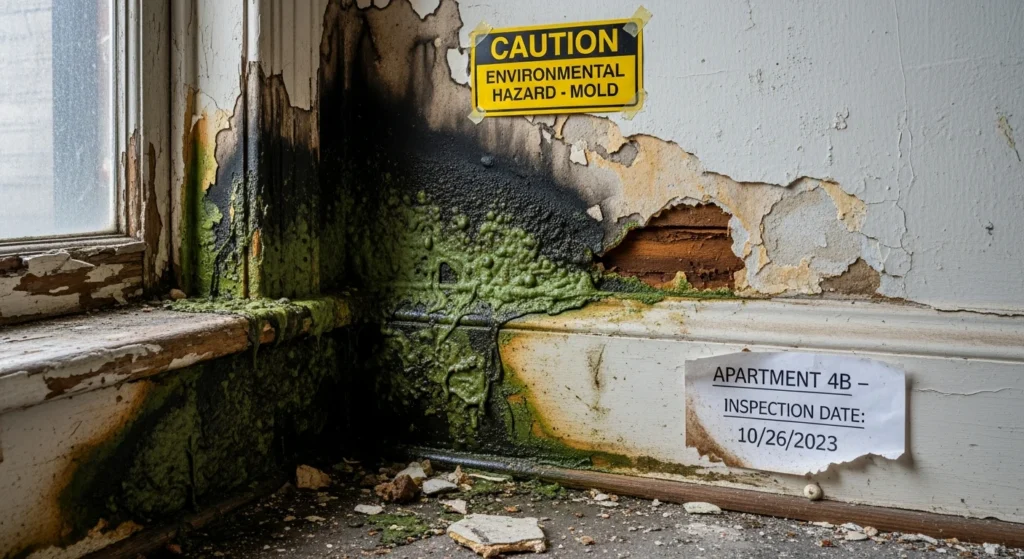
Stachybotrys chartarum (black mold) is the species most people have heard of and the one that most frequently requires professional remediation with full containment protocols. It grows on cellulose-rich materials — drywall paper, wood sheathing, ceiling tiles — that have been wet for extended periods (typically more than 72 hours). It is not uncommon in Long Island basements and crawlspaces that have experienced repeated flooding or chronic seepage.
Cladosporium and Penicillium/Aspergillus species are far more common in the region and appear in attics, bathrooms, and HVAC systems. They grow at lower moisture levels than Stachybotrys and can establish on surfaces that were only briefly wet. Cladosporium is the classic attic mold in Long Island Cape Cods — olive-green to black, spreading across roof sheathing from ridge to eave when there is inadequate soffit-to-ridge ventilation.
Chaetomium appears on drywall paper and is often found alongside or after Stachybotrys in sustained water damage situations. Its presence in air sampling results can be a signal that drywall has been wet for a long time, even if the surface appears dry at the time of inspection.
How to Verify a Contractor’s NYS Article 32 License
The NYS Department of Labor maintains a searchable database of licensed mold assessors and mold remediation contractors. Before signing any contract, search your contractor’s name at the NYSDOL’s Licensed Mold Contractors Search Tool. Verify that the license is active, that the license type matches what the contractor is being hired to do (assessor or remediator — not both on the same project), and that the license has not expired. Licenses must be renewed every two years, and a contractor who has not renewed is working illegally regardless of how long they have been in business.
Additionally, ask for the following before work begins: a copy of the contractor’s pollution liability insurance certificate (standard commercial general liability does not cover mold work), the Mold Remediation Plan in writing before any work starts, and the name and license number of the individual supervisor who will be on-site during remediation.
Frequently Asked Questions: Mold Remediation on Long Island
How much does mold remediation cost on Long Island?
Mold remediation on Long Island costs $800–$2,000 for small projects under 10 square feet, $2,500–$7,500 for medium projects (10–100 square feet), and $7,500–$30,000 or more for large projects including full basement or attic remediations. Per-square-foot rates typically run $15–$30. These figures are for the remediation work only; the required NYS Article 32 assessment adds $350–$900 and post-remediation clearance testing adds $300–$600.
Does New York State law require separate mold inspectors and remediators?
Yes. Under Article 32 of the NYS Labor Law, the company that performs the mold assessment and writes the Mold Remediation Plan cannot be the same company that performs the remediation on that project. Both must hold valid NYS Department of Labor licenses. Projects involving 10 or more square feet require licensed professionals throughout. This separation requirement protects homeowners from inflated scopes of work.
How long does mold remediation take on Long Island?
Small to medium mold projects typically take one to three days for the remediation work itself. Large projects — full attic remediations, basement systems, or multi-room flood aftermath — commonly take three to seven days. Post-remediation clearance testing usually occurs 24–48 hours after work is complete, once dust has settled and the air has cleared. The full project timeline from initial assessment to clearance report is typically one to two weeks.
Does homeowners insurance cover mold remediation on Long Island?
Homeowners insurance covers mold remediation when the mold resulted from a sudden, accidental covered event such as a burst pipe, storm-driven roof leak, or appliance failure. Mold from slow leaks, chronic moisture, or deferred maintenance is typically excluded. Many policies also have specific mold sublimits — commonly $10,000 — even when the underlying water damage is fully covered. Flood-related mold is covered under flood insurance (NFIP or private), not standard homeowners policies.
Why is attic mold so common on Long Island?
Attic mold is extremely prevalent (read our deep dive: attic mold causes, identification, and removal on Long Island). It is in Long Island’s Cape Cod and Colonial housing stock for two structural reasons. First, many Cape Cods have knee-wall attic spaces with inadequate soffit-to-ridge ventilation, which traps warm humid air against the roof sheathing year-round. Second, a large proportion of 1970s construction in Nassau and Suffolk County had bathroom exhaust fans vented into the attic rather than through the roof — a code violation that introduced warm, moisture-laden air directly into the attic cavity every time someone showered. Ice dams from nor’easters cause a third attic mold pathway: when meltwater backs up under shingles and soaks the top plate, mold typically appears within weeks.
Can I clean mold myself on Long Island?
The EPA recommends DIY cleanup only for mold areas smaller than 10 square feet using appropriate PPE. In New York State, any mold project of 10 square feet or more requires a licensed professional under Article 32. Beyond the legal threshold, DIY remediation in Long Island’s humid climate rarely succeeds because the underlying moisture source — which requires professional moisture mapping to locate — is almost never fully addressed. A patch that dries visibly but retains moisture in the wall cavity will grow back within weeks.
What is a Mold Remediation Plan and do I need one?
A Mold Remediation Plan (MRP) is a written document produced by a licensed NYS Mold Assessor that specifies exactly what work is required to remediate a mold problem: which materials are to be removed, what containment protocols are required, what antimicrobial treatments will be used, and what clearance standard must be achieved at the end. Under Article 32, an MRP is legally required for any project of 10 square feet or more, and the licensed remediator must follow it precisely. You must receive it in writing before any work begins.
How do I find a licensed mold remediator on Long Island?
The NYS Department of Labor maintains a Licensed Mold Contractors Search Tool at dol.ny.gov where you can search by contractor name, license number, or location. Verify that the contractor holds an active license (not expired), that the license type matches the work being performed, and that they carry pollution liability insurance. Ask for the license number of the on-site supervisor specifically, as site supervisors must be individually licensed in addition to the company holding a contractor license.