HVAC systems in Long Island homes built before 1975 are among the most commonly overlooked asbestos sources in pre-demolition surveys — and among the most dangerous in terms of disturbance potential, because HVAC work by definition involves the air distribution system that carries particles throughout the entire conditioned space. A heating contractor who removes or cuts asbestos-containing duct wrap without recognition of the material type can distribute asbestos fibers through every room in the home in a single service visit.
Where Asbestos Appears in Long Island HVAC Systems
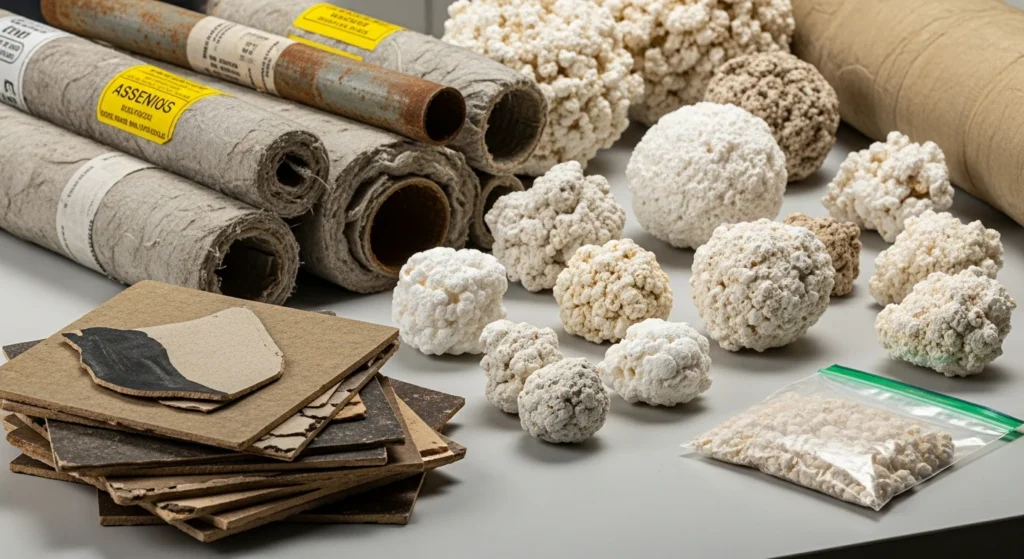
Duct insulation (duct wrap): The most common HVAC asbestos in Long Island homes is corrugated cardboard-like insulation wrapped around warm-air supply ducts — particularly on sheet metal trunk ducts in basement ceiling applications. This material, often called “air cell” or “cementite” insulation, is a chrysotile asbestos-containing product used extensively in oil-fired forced-air heating systems through the mid-1970s. It is visually distinctive — gray-white corrugated material wrapped around rectangular or round sheet metal ductwork — but is frequently confused with standard fiberglass duct wrap by contractors unfamiliar with the material. In damaged or deteriorated condition, it releases fibers with any disturbance.
Plenum board: Air handler plenums and transitions in pre-1975 HVAC systems were sometimes lined with asbestos-containing millboard (a rigid asbestos-cement product) for thermal and fire protection. This material is harder and more rigid than duct wrap, gray to off-white in color, and present at the connection between the furnace/air handler and the duct system.
Pipe insulation on steam and hot water systems: Pre-1970 oil-fired steam or hot water heating systems in Long Island Colonials and earlier construction types carry original pipe insulation that is frequently chrysotile asbestos in a plaster matrix (the characteristic 3 to 6-inch diameter white-plaster-coated elbow wraps visible in Long Island basements built before 1965).
When HVAC Asbestos Is Dangerous
Asbestos-containing HVAC materials in good condition — intact, undamaged, and not being disturbed — do not release fibers at hazardous concentrations. The risk is disturbance. Any HVAC contractor who cuts, removes, or handles asbestos-containing duct wrap without proper asbestos work practices is creating a disturbance event that requires Code Rule 56 notification and may require licensed abatement depending on the quantity involved. Code Rule 56 requires abatement for HVAC asbestos removal projects of 260 linear feet or more — but even below this threshold, proper work practices apply.
Code Rule 56 Requirements for HVAC Asbestos
Before any HVAC renovation, repair, or replacement project in pre-1975 Long Island construction, the HVAC contractor or building owner should commission an asbestos survey of the HVAC system components to be disturbed. If asbestos is confirmed, a licensed NYS DEC asbestos abatement contractor must remove the ACM under Code Rule 56 protocols before the HVAC contractor proceeds. Upper Restoration coordinates HVAC asbestos abatement as part of integrated restoration scopes involving heating system work in pre-1975 Long Island construction.