Finding or suspecting asbestos in your home triggers a specific sequence of actions — and the order matters as much as the actions themselves. The single most important rule: do not disturb it. Asbestos is inert and poses minimal risk when undisturbed. It becomes dangerous only when fibers are released into the air through drilling, cutting, scraping, or improper removal. Here are the 6 steps to take, in the correct sequence.
Where Asbestos Is Most Commonly Found in NYC and Long Island Homes
Before the steps, it helps to know what you’re looking for. Asbestos-containing materials (ACMs) were used in construction from the 1930s through the late 1970s. In NYC and Long Island housing stock, the most common locations are floor tiles (9×9 inch vinyl floor tiles, especially in kitchens and basements), pipe insulation (gray or white wrap on steam and hot water pipes), ceiling tiles (especially in pre-1980 drop ceilings), joint compound and textured coatings (on walls and ceilings in homes built before 1980), roofing materials (especially on flat-roof sections), and boiler and furnace insulation in older mechanical rooms.
Step 1: Do Not Disturb It
This is the most important step and the one most homeowners get wrong. If you suspect a material contains asbestos — stop. Do not drill into it, sand it, scrape it, break it, or disturb it in any way. Intact, undisturbed asbestos is called “non-friable” and poses negligible health risk. It becomes dangerous when it becomes “friable” — crumbled, broken, or powdered — releasing microscopic fibers that can remain airborne for hours and lodge permanently in lung tissue. If a material is already damaged or deteriorating (crumbling pipe insulation, broken ceiling tiles), limit foot traffic near the area and avoid touching it until a professional assesses it.
Step 2: Hire a Certified Asbestos Inspector — Not a General Contractor
In New York State, asbestos inspection must be performed by a licensed asbestos inspector — a separate credential from the contractor who performs removal. The inspector’s role is to identify suspect materials, collect samples using proper containment protocols, and submit those samples to an accredited laboratory for analysis. Do not rely on visual identification alone — many non-asbestos materials look identical to ACMs, and many ACMs look benign. The only way to confirm asbestos presence is laboratory analysis using polarized light microscopy (PLM) or transmission electron microscopy (TEM).
In NYC, the NYC Department of Environmental Protection (DEP) maintains licensing requirements for asbestos inspectors working in the five boroughs. Nassau and Suffolk County projects are governed by NYS DEC and DOL licensing. Upper Restoration works with licensed inspectors and can coordinate the inspection phase as part of a full-service project.
Step 3: Understand Your Options — Removal vs. Encapsulation
Not all confirmed asbestos requires removal. In many cases, encapsulation — applying a sealant that binds asbestos fibers and prevents release — is a safer and less expensive option. The choice between removal and encapsulation depends on the condition and location of the material. Removal is required when the material is severely damaged or friable, when you are planning renovation work that will disturb the material, or when the material is in a high-traffic area where ongoing disturbance is likely. Encapsulation is appropriate for intact, non-friable materials in low-traffic areas where future disturbance is unlikely.
| Material Condition | Recommended Approach | NYC/NY Regulatory Note |
|---|---|---|
| Intact, undamaged, low-traffic area | Encapsulation or leave in place with monitoring | No permit required if left in place |
| Intact but renovation planned | Removal before renovation begins | ACP-5 form required for NYC DOB permit applications |
| Damaged or friable | Removal required | Licensed remediator + NYS/NYC notification required |
| Any material in NYC pre-demolition | Inspection + removal if present | NYC DEP ACP-5 required before any demolition permit |
Step 4: Choose a Licensed Asbestos Abatement Contractor
Asbestos removal in New York requires a licensed asbestos abatement contractor — not a general contractor, not a handyman, and not the same person who did the inspection. The inspector and the remediator must be different entities under NYS regulations. Verify that your contractor holds a current NYS DOL Asbestos Handling License and carries the required liability and pollution insurance. For NYC projects, the contractor must also file an ACP-7 asbestos project notification with the NYC DEP before work begins. Upper Restoration is fully licensed for asbestos abatement in Nassau County, Suffolk County, and all five NYC boroughs.
Step 5: Prepare for the Abatement Process
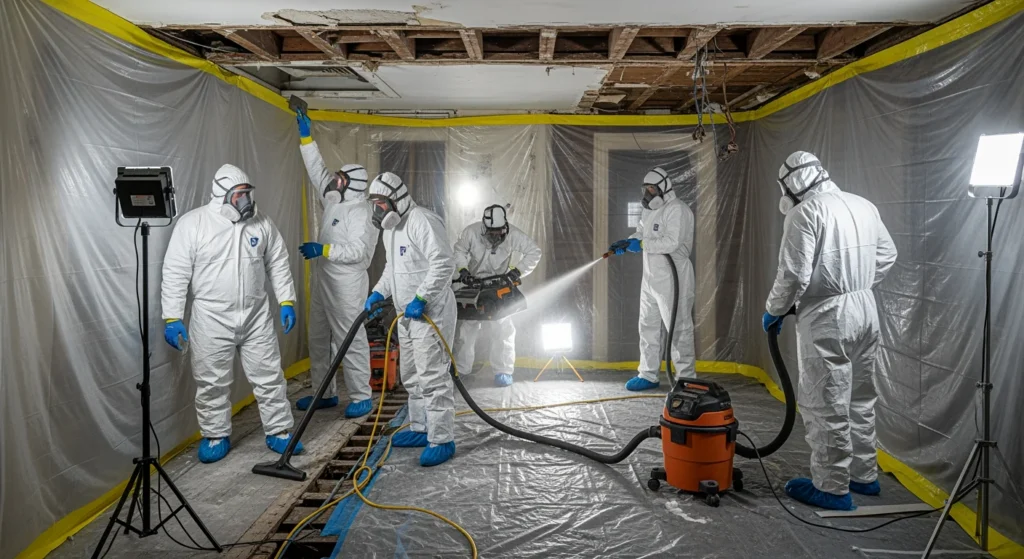
Before removal begins, the abatement contractor will establish a regulated work area: polyethylene containment barriers isolate the work zone, negative air pressure machines with HEPA filtration exhaust air to the outside (preventing fiber migration to adjacent spaces), and decontamination units are set up for workers to safely remove protective gear. You and your family — including pets — will need to vacate the affected area for the duration of the work. In most residential projects, this is a single day; larger projects may require 2–3 days. Emergency board-up and temporary relocation are typically covered under your homeowners policy if asbestos was disturbed by a covered event.
Step 6: Require Post-Abatement Air Clearance Testing
Do not allow re-occupancy of the abated area until a third-party clearance test confirms that airborne fiber levels have returned to safe levels. This test must be performed by an independent inspector — not the same contractor who performed the removal. The clearance standard in New York is less than 0.01 fibers per cubic centimeter (f/cc) measured by phase contrast microscopy (PCM). The abatement contractor is required to provide you with a waste manifest confirming proper disposal of all asbestos-containing materials at an approved NYS disposal facility. Keep this documentation — it is required for property disclosure in New York real estate transactions and for any future renovation permits.
For more on asbestos identification, see our guides on identifying asbestos in home insulation and what asbestos looks like in ceiling tiles.
Upper Restoration provides professional licensed asbestos abatement services across Nassau County, Suffolk County, and all five NYC boroughs — available 24/7.
Frequently Asked Questions About Asbestos in Your Home
Do I have to disclose known asbestos when selling my home in New York?
Yes. New York’s Property Condition Disclosure Act requires sellers to disclose known environmental hazards including asbestos. Failure to disclose can result in a $500 credit to the buyer at closing — but more importantly, it creates significant liability if the buyer later discovers undisclosed ACMs. A pre-listing asbestos inspection and documentation of any abatement work protects you at closing.
What does asbestos abatement cost in NYC and Long Island?
Cost depends primarily on the type and volume of material. Floor tile removal: $3–$8 per square foot. Pipe insulation removal: $15–$30 per linear foot. Ceiling tile removal: $4–$10 per square foot. Whole-room or whole-home projects with multiple material types can run $5,000–$30,000+. NYC projects carry a premium due to permitting and notification requirements. Upper Restoration provides free on-site estimates with no obligation.
Can I test for asbestos myself with a home test kit?
Home test kits that allow you to collect a sample and mail it to a lab are available and can provide preliminary information. However, they require you to disturb the material to collect a sample — the exact thing you should avoid. A licensed inspector collects samples using containment protocols that prevent fiber release. For peace of mind and legal protection, professional inspection is strongly recommended over DIY sampling.
Is asbestos in 9×9 inch vinyl floor tiles dangerous?
Not if the tiles are intact and will remain undisturbed. Intact vinyl floor tiles are non-friable — they do not release fibers under normal use. They become hazardous if you sand, grind, or mechanically remove them without proper abatement protocols. The most common exposure scenario is homeowners who sand or grind old floor tiles as part of a DIY renovation. If your home has pre-1980 9×9 tiles and you’re planning any floor work, have them tested first.
How long does residential asbestos abatement take?
Most single-material residential projects (one room of floor tiles, one section of pipe insulation) complete in one day. Multi-material or whole-home projects typically run 2–5 days. Post-abatement clearance testing adds 24–48 hours for lab results before re-occupancy is permitted.
Need professional asbestos abatement on Long Island? Upper Restoration provides licensed asbestos abatement and removal services across NYC and Long Island. Contact us for a free assessment.