
IICRC S500 Standard: What It Means for Your Long Island Water Damage Claim
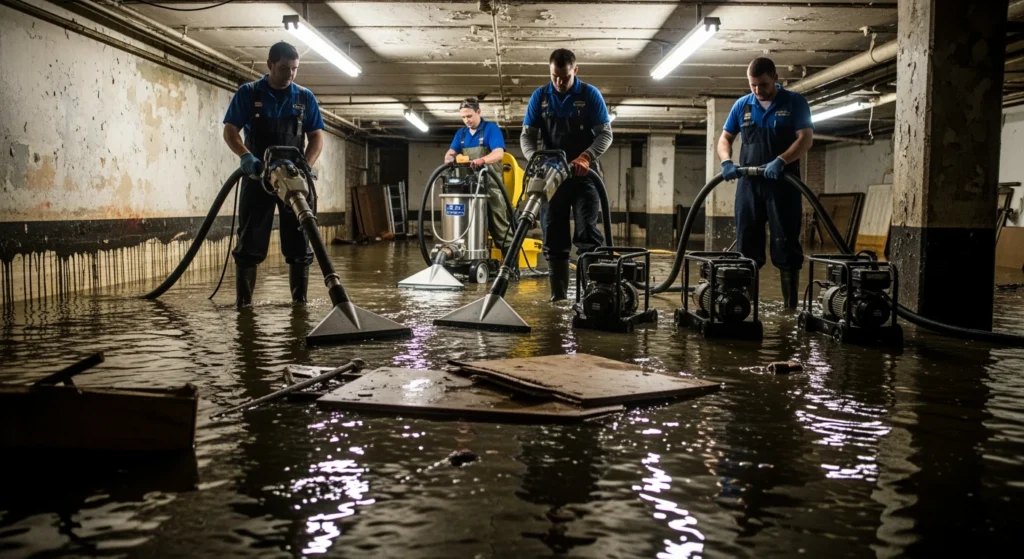
The IICRC S500 is the professional standard that defines how water damage restoration must be performed — understanding its key provisions helps Long Island homeowners verify their contractor’s work and support their insurance claims.
Structural Drying Science: How LGR Dehumidifiers Work and Why 72 Hours Matters
LGR dehumidifiers, psychrometrics, and the 72-hour drying window are the technical foundation of water damage restoration — understanding them helps Long Island homeowners evaluate whether their contractor is doing the job correctly.
Category 1, 2, and 3 Water Damage: The Long Island Classification Guide
The IICRC S500 Category classification system determines every decision in water damage restoration — what gets demolished, what gets dried, how long it takes, and what your insurance covers. On Long Island, Category 3 is far more common than most homeowners expect.
Water Damage Restoration in Stony Brook, NY
Stony Brook — home to Stony Brook University and approximately 14,174 residents — sits on the north shore of Brookhaven with Stony Brook Harbor providing Sound tidal exposure, while the university campus creates institutional water damage demand that operates under different response frameworks than standard residential restoration.
Water Damage Restoration in Sayville, NY
Sayville is one of the South Shore’s most historically significant communities — a Victorian and early 20th-century shore town that serves as the ferry gateway to Fire Island’s cherry grove and ocean beach communities — where water damage restoration in the village’s historic housing stock requires approaches adapted to original Victorian-era construction alongside the standard Great South Bay tidal flooding risk.
Water Damage Restoration in Farmingdale, NY
Farmingdale — 8,189 residents in the Town of Oyster Bay and partially in the Town of Babylon — is a small incorporated village with a historic downtown, older residential housing stock from the early to mid-20th century, and the Nassau-Suffolk border location that creates a distinctive mix of Nassau’s older Cape Cod stock and western Suffolk’s younger Colonial and split-level development.
Water Damage Restoration in Huntington Station, NY
Huntington Station’s 33,029 residents in one of Huntington’s most densely developed communities face water damage primarily from aging split-level and Colonial infrastructure — galvanized supply lines failing in the 1960s-1980s housing stock, split-level below-grade family rooms flooding from foundation moisture, and municipal sewer laterals producing backup during heavy spring rainfall.
Water Damage Restoration in Patchogue, NY
Patchogue — the commercial hub of Brookhaven’s south shore — sits at the mouth of the Patchogue River where it meets Great South Bay, producing a distinctive tidal flooding dynamic in the village’s historic downtown and bay-front neighborhoods alongside the standard interior Suffolk water damage profile in its residential communities.
Water Damage Restoration in Lindenhurst, NY
Lindenhurst’s canal community — built on Great South Bay’s northern shore with homes on Venetian-style canals at one to two feet above sea level — experiences two to three tidal flooding events per year. The hamlet is the clearest example on Long Island of a community where water damage is not an emergency but a documented seasonal condition.
Water Damage Restoration in Dix Hills, NY
Dix Hills — 23,991 residents in the Town of Huntington — is one of Suffolk County’s most affluent hamlets, its 1960s-1990s higher-end Colonial and split-level construction on large wooded lots carrying water damage risk from aging plumbing in older sections, mature tree canopy that produces above-average tree-impact storm damage, and interior flooding from the Huntington Creek watershed.
