
Mold Remediation in Stony Brook, NY
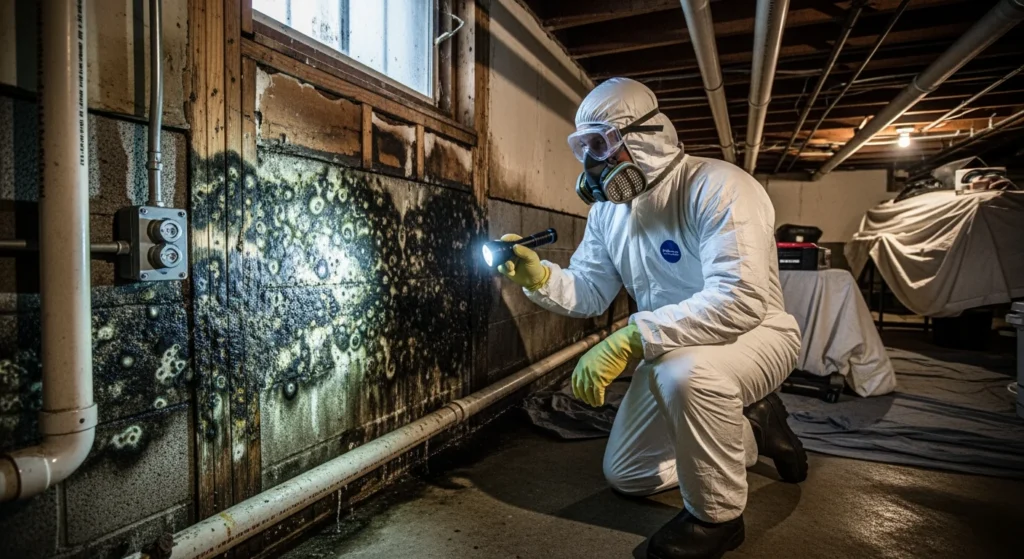
Stony Brook’s mold profile spans its residential community — standard 1960s-1990s Brookhaven suburban mold in attics and below-grade spaces — and Stony Brook University’s institutional mold concerns, where federal AHERA requirements govern mold assessment in academic buildings alongside NYS Article 32.
Mold Remediation in Sayville, NY
Sayville’s Victorian and early 20th-century housing stock carries the historic assembly mold risk common to Long Island’s older shore communities — original plaster-on-lath absorbing moisture slowly, fieldstone and brick foundations without vapor management, and the south shore’s summer ambient humidity driving mold initiation in poorly ventilated below-grade and attic spaces.
Mold Remediation in Farmingdale, NY
Farmingdale’s mix of pre-war and post-war residential construction creates a dual mold risk profile — pre-war homes with plaster walls and fieldstone basements that absorb and hold moisture from original building systems, and post-war Cape Cods and Colonials with the standard Nassau County attic and basement mold pattern.
Mold Remediation in Huntington Station, NY
Huntington Station’s dense split-level stock carries endemic below-grade family room condensation mold — the most common residential mold scenario in Huntington’s interior — where fiberglass batts against uninsulated block produce reliable summer mold colonization that recurs without assembly correction.
Mold Remediation in Patchogue, NY
Patchogue’s historic commercial district and bay-front residential communities carry mold risk from tidal flooding, while the village’s older masonry commercial buildings present mold remediation challenges specific to brick and stone construction that absorbs and releases moisture on different timescales than modern drywall assemblies.
Mold Remediation in Lindenhurst, NY
Lindenhurst’s canal community carries the most severe recurring flood mold profile on Long Island outside of Mastic Beach — two to three Category 3 bay water flooding events per year, each re-wetting assemblies that were incompletely dried from the previous event, producing multi-generation mold accumulation in the same wall cavities.
Mold Remediation in Dix Hills, NY
Dix Hills’ wooded, large-lot character creates mold risk from tree canopy shade that reduces exterior drying on north-facing building surfaces, combined with the standard 1960s-1980s below-grade family room condensation mold pattern that defines Huntington’s interior communities.
Mold Remediation in Deer Park, NY
Deer Park’s split-level and Colonial housing stock from the 1960s-1970s carries the standard western Suffolk below-grade mold pattern — condensation against uninsulated block foundation walls producing seasonal Penicillium and Cladosporium colonization that recurs without assembly correction.
Mold Remediation in Coram, NY
Coram’s shallow water table drives a persistent basement mold pattern — hydrostatic seepage through foundation walls and floor slabs creates chronic moisture that initiates mold on concrete surfaces, wood framing, and finished basement materials each spring, producing a recurring mold cycle that requires both remediation and drainage correction to break.
Mold Remediation in Commack, NY
Commack’s 1960s-1980s split-level stock carries endemic below-grade family room condensation mold — fiberglass batts against uninsulated block producing seasonal mold that recurs without assembly correction — alongside Cape Cod attic mold in the hamlet’s older housing.
