
Fire & Smoke Damage Restoration in Patchogue, NY
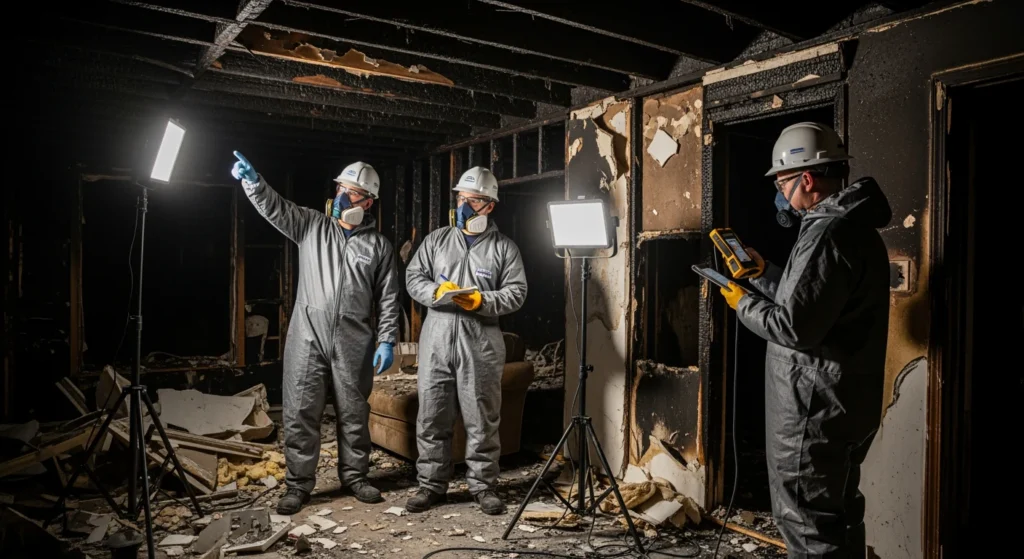
Patchogue’s historic commercial district creates a specific fire restoration context where commercial building fires in brick and masonry structures require different cleaning protocols than frame construction, and where preservation of original historic commercial character alongside complete smoke and soot removal are competing restoration priorities.
Fire & Smoke Damage Restoration in Lindenhurst, NY
Lindenhurst’s most dramatic fire restoration scenario is documented history: during Sandy, a home burned continuously in flooded streets and had to be demolished by a payloader because fire apparatus could not reach it. This is not an abstract risk — it is the consequence of fire in a community where storm surge regularly makes streets impassable.
Fire & Smoke Damage Restoration in Dix Hills, NY
Dix Hills’ higher-end Colonial stock elevates fire restoration costs above western Suffolk averages — quality finishes, larger floor plans, and better construction materials mean fire and smoke damage restoration in Dix Hills involves more complex contents restoration and higher-quality reconstruction than standard residential scopes.
Fire & Smoke Damage Restoration in Deer Park, NY
Deer Park’s fire restoration profile is standard western Suffolk — oil-heat puffback in 1960s-1970s residential stock, mandatory pre-1980 asbestos assessment for structural fires with joint compound and floor tile ACM throughout the hamlet’s predominantly pre-1980 construction.
Fire & Smoke Damage Restoration in Coram, NY
Coram’s fire profile follows Brookhaven’s interior suburban standard — oil-heat puffback in 1970s-1990s residential stock, mandatory pre-1980 asbestos assessment for structural fires, and the standard pre-demolition protocol that applies across Long Island’s pre-1980 construction.
Fire & Smoke Damage Restoration in Commack, NY
Commack’s fire profile reflects western Suffolk’s oil-heat puffback pattern and the mandatory pre-1980 asbestos assessment for structural fires in the hamlet’s predominantly pre-1980 residential stock.
Fire & Smoke Damage Restoration in Central Islip, NY
Central Islip’s fire restoration profile follows western Suffolk’s standard pattern — oil-heat puffback in aging residential stock, mandatory pre-1980 asbestos assessment for structural fires, and multi-unit smoke distribution considerations in the community’s significant rental housing inventory.
Fire & Smoke Damage Restoration in Brentwood, NY
Brentwood’s multi-family and single-family housing density creates fire spread risk and complex multi-unit smoke damage scenarios when fires in shared-wall structures produce smoke that distributes through common attic spaces and shared mechanical systems to affect multiple occupancies from a single ignition event.
Fire & Smoke Damage Restoration in Bay Shore, NY
Bay Shore’s fire restoration profile combines oil-fired heating puffback in its 1950s-1970s residential stock with the full pre-1980 asbestos protocol requirement, while the community’s proximity to the Great South Bay creates marine-adjacent fire scenarios at waterfront properties that differ from standard interior residential fire losses.
Fire & Smoke Damage Restoration in Glen Cove, NY
Glen Cove’s fire restoration market encompasses oil-fired heating puffback in post-war stock, historic estate structural fires requiring preservation-sensitive demolition sequencing, and the unique asbestos risk profile of Gold Coast estate construction where steam pipe insulation and renovation-era ACM coexist with original 19th-century building materials.
