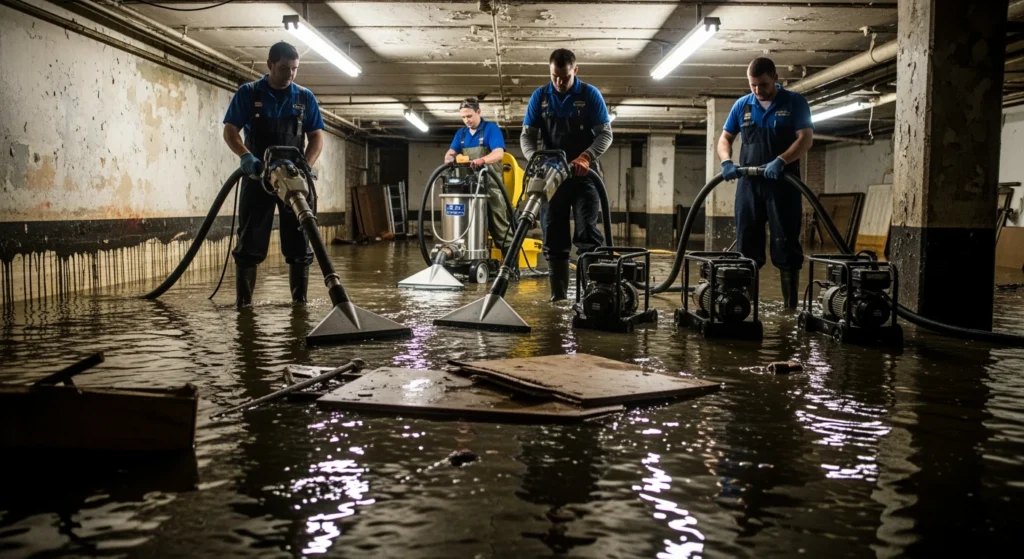
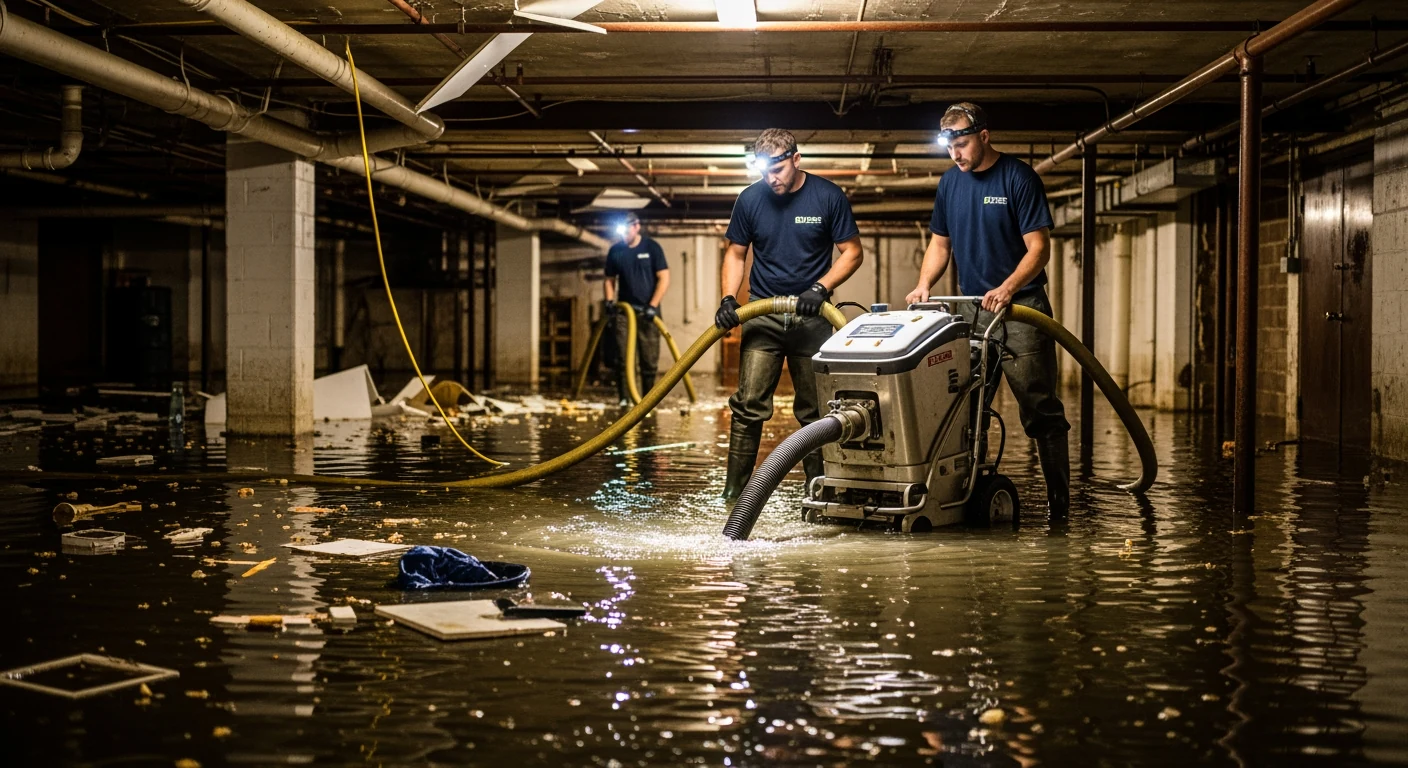
When Upper Restoration deploys commercial LGR dehumidifiers and high-velocity air movers to a Long Island water damage job, the equipment arrangement is not arbitrary. Structural drying is applied psychrometrics — the science of managing moisture in air and building materials — and the placement of each piece of equipment follows from measurements of temperature, relative humidity, and moisture content that determine the vapor pressure gradient driving evaporation from wet materials.
How LGR Dehumidifiers Work
LGR (Low Grain Refrigerant) dehumidifiers are the workhorses of structural drying. Standard refrigerant dehumidifiers lose efficiency as the air temperature drops below 65°F because the refrigerant coils cannot maintain adequate condensation. LGR technology uses a two-stage cooling system that pre-cools incoming air before the main cooling coil, maintaining efficient moisture removal at temperatures as low as 35°F. In a Long Island basement in November — where temperatures may be in the 50s — an LGR dehumidifier continues removing moisture from the air while a standard unit would cycle off repeatedly or produce minimal output.
Commercial LGR dehumidifiers used in structural drying are rated in pints per day of moisture removal — typically 100 to 200 pints per day for the commercial units Upper Restoration deploys. The number of units required for a space is calculated from the volume of air, the starting grain depression (the difference between current and target dew point), and the rate of evaporation from affected materials.
The 72-Hour Window
IICRC S500 structural drying protocols target 3 to 5 days for complete structural drying in Category 1 losses under standard conditions. The 72-hour threshold is not arbitrary — it is the point at which the probability of mold colonization on paper-faced drywall transitions from low to significant under normal conditions. In Long Island’s summer humidity environment (70%+ ambient RH), this window compresses. Upper Restoration monitors structural drying progress with daily psychrometric readings and moisture meter measurements, adjusting equipment placement as the drying profile changes.
What Your Contractor’s Drying Logs Should Show
A contractor performing IICRC S500-compliant structural drying should be providing you with daily drying logs showing temperature, relative humidity, grain depression, and moisture content readings at standardized measurement points. These logs are your evidence that drying progressed correctly — they are required for insurance claims and they demonstrate that the contractor tracked the process scientifically rather than guessing. If your contractor cannot produce psychrometric data from your Long Island water damage project, the drying was not performed to S500 standards.