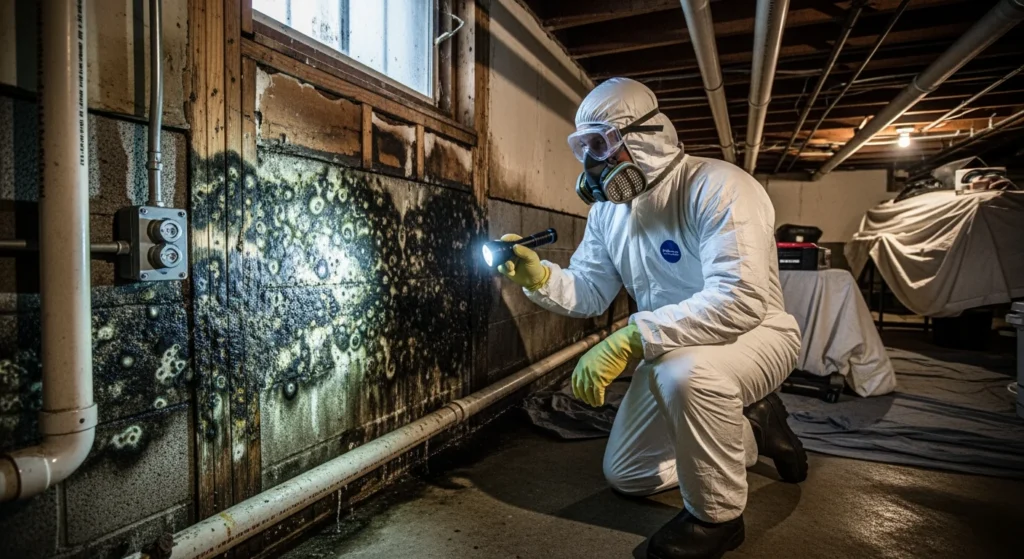
No mold species generates more fear — or more misinformation — than Stachybotrys chartarum, the species colloquially called black mold. Long Island homeowners call Upper Restoration’s assessment line every week describing “black mold” in their basements, attics, and crawl spaces. The reality is that the overwhelming majority of dark-colored mold growth on Long Island is not Stachybotrys chartarum — it is Cladosporium, which is ubiquitous, dark-colored, and essentially universal in Long Island attics and damp basements. This article addresses what is actually known about Stachybotrys, where it genuinely grows on Long Island, and how its health implications are accurately described versus exaggerated.
What Stachybotrys Actually Requires to Grow
Stachybotrys chartarum is a hydrophilic (water-loving) mold that requires consistently wet cellulose-containing material to colonize and grow. It does not grow on surfaces that cycle between wet and dry. It does not grow on concrete, metal, or plastic. It requires paper-faced drywall, wood framing, or similar cellulose material that has been continuously wet — not just humid, but genuinely wet — for an extended period. The key distinction is chronicity: Stachybotrys grows behind assemblies that have been wet for weeks or months, not behind assemblies that were wet once and dried. In Long Island’s context, this means Stachybotrys is most likely to be present in post-Sandy wall assemblies that were incompletely remediated and remained intermittently wet through subsequent flooding cycles, or in chronic roof leak areas where water has been infiltrating the same framing members for seasons.
What the Research Actually Shows About Health Effects
The CDC and EPA both acknowledge that Stachybotrys produces mycotoxins (trichothecenes) and that mycotoxin exposure in laboratory settings causes measurable health effects. What the research does not support — and this is important — is a dose-response relationship that demonstrates routine residential Stachybotrys exposure at typical indoor concentrations causes the severe neurological symptoms sometimes claimed in litigation or popular media. The 1994 Cleveland infant pulmonary hemorrhage cases that generated initial Stachybotrys concern were subsequently reviewed by the CDC and the original causal relationship was found to be unsupported by the evidence. Upper Restoration presents the established science accurately: Stachybotrys is a legitimate health concern, all mold should be remediated, but the catastrophic framing common in mold scare content overstates the documented dose-response evidence.
Identification Requires Laboratory Analysis
Black color is not a reliable indicator of Stachybotrys. Most dark mold on Long Island is Cladosporium. Aspergillus niger is also black. Stachybotrys can occasionally appear greenish rather than pure black. Accurate species identification requires laboratory analysis of a sample collected by a licensed NYS Article 32 mold assessor — visual identification is not adequate for species determination. Upper Restoration’s assessors collect bulk or tape-lift samples from suspected Stachybotrys growth for laboratory analysis before specifying remediation scope based on species-specific assumptions.
Remediation Is the Same Regardless of Species
NYS Article 32 requires licensed remediation for all mold growth of 10 square feet or more, regardless of species. The remediation protocol — source control, containment, demolition of affected materials, HEPA vacuuming, antimicrobial treatment, clearance testing — applies equally to Cladosporium and Stachybotrys. The species identification matters for health communication and insurance documentation, not for the remediation scope itself.