April nor’easters are different from their February and March counterparts in one specific way that matters enormously for NYC and Long Island building owners: they hit structures that have already been weakened by a full winter of freeze-thaw cycling, snow loading, and thermal stress. A storm that would have caused manageable damage to a building in October can cause catastrophic damage to the same building in April — not because the storm is more severe, but because the building’s accumulated winter fatigue has reduced its margin. After the Blizzard of 2026 and two significant coastal storms this winter, understanding where your building’s spring vulnerabilities are concentrated is not optional. It’s the difference between a $3,000 repair and a $50,000 claim.
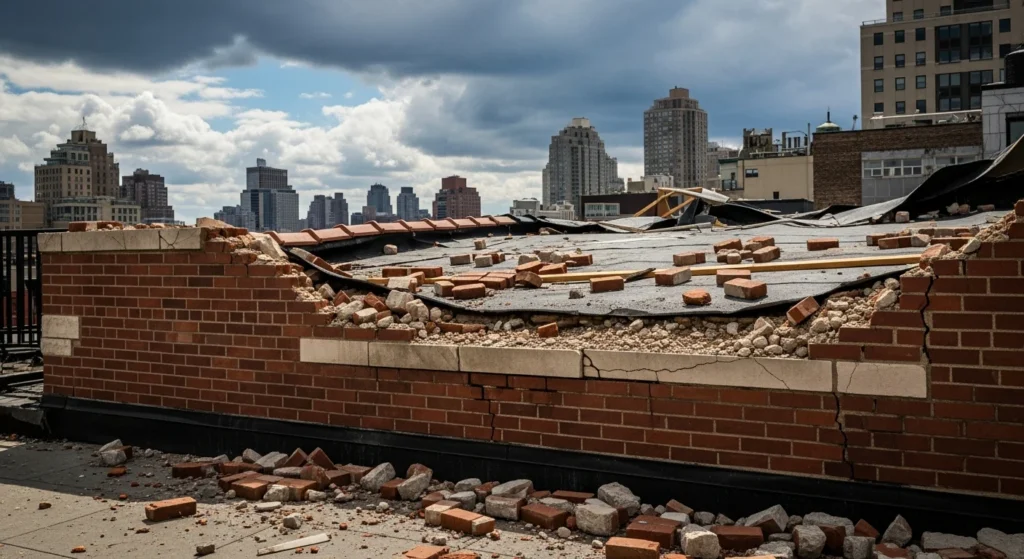
Parapet Wall Failure: NYC’s Highest-Risk Spring Scenario
A parapet wall is the section of exterior wall that extends above the roof line. On NYC’s flat-roof brick buildings — the vast majority of pre-war and mid-century construction — the parapet is simultaneously the building’s most exposed structural element and the one that has received the least maintenance attention over the building’s lifetime.
The freeze-thaw failure mechanism is well documented: water infiltrates cracks in the parapet masonry and mortar joints during fall and early winter. That water freezes and expands approximately 9% by volume, widening the existing cracks. During thaw cycles, the crack closes slightly but not fully. Each cycle advances the deterioration. After a winter with 30 or more freeze-thaw cycles — typical for NYC — parapet walls that were marginal in September may be approaching instability by April.
A sustained April nor’easter with horizontal wind-driven rain accelerates this deterioration to failure in a specific pattern: water penetrates the already-widened mortar joints at the back face of the parapet (the face that doesn’t receive routine inspection from the roof), saturates the brick and mortar, and when wind pressure exceeds the remaining structural capacity of the damaged section, the parapet fails outward. Parapet failures in NYC during major wind events are not unusual — the risk is real, measurable, and preventable with inspection and maintenance.
The inspection standard: a parapet wall that cannot be rocked by hand pressure at the cap stones, shows no horizontal cracking at the base (which indicates foundation movement or differential settlement), has intact and continuous mortar at all joints with no gaps larger than ¼ inch, and has functional cap flashing that directs water off the top surface rather than into the masonry. Any parapet that fails these standards before the April storm season is a liability.
HVAC Curb Flashing: The Failure Nobody Sees Coming
Rooftop HVAC equipment sits on raised curbs that penetrate the roof membrane. The flashing and caulking that seals the joint between the curb and the roof surface is one of the least-inspected components in NYC building maintenance. It is also one of the most common sources of significant interior water damage after spring storms.
HVAC curb flashing fails through two mechanisms specific to NYC’s thermal environment: thermal cycling of the HVAC unit itself (the unit runs in winter for ventilation and heat, creating heat differential against a cold roof surface) and the vibration of the HVAC compressor and fan, which gradually works caulking and flexible flashing seals loose from their adhesive bond. A curb that was adequately sealed in October may have failed its flashing by April after a winter of operation in cold conditions.
The failure is invisible from the roof surface and from inside the building until a sustained heavy rain drives water through the compromised seal. At that point, water enters through the curb penetration and follows the structural framing to ceiling surfaces below — often in the center of a floor plan where the source is least intuitive. HVAC curb flashing inspection requires getting on the roof and physically inspecting the perimeter caulking and flashing of every curb — not something that can be done from ground level or from inside.
Tree Root Infiltration of Drain Lines in Spring
Root growth in NYC’s urban tree canopy accelerates dramatically in April and May as soil temperatures rise above the 40°F threshold for root growth activity. Tree roots are opportunistic — they follow moisture gradients and can infiltrate drain line cracks that are too small to cause immediate problems during winter’s slow root growth period. The same crack that allowed minimal root intrusion in February may be bridged by a root mass by late April that partially or fully obstructs the drain line.
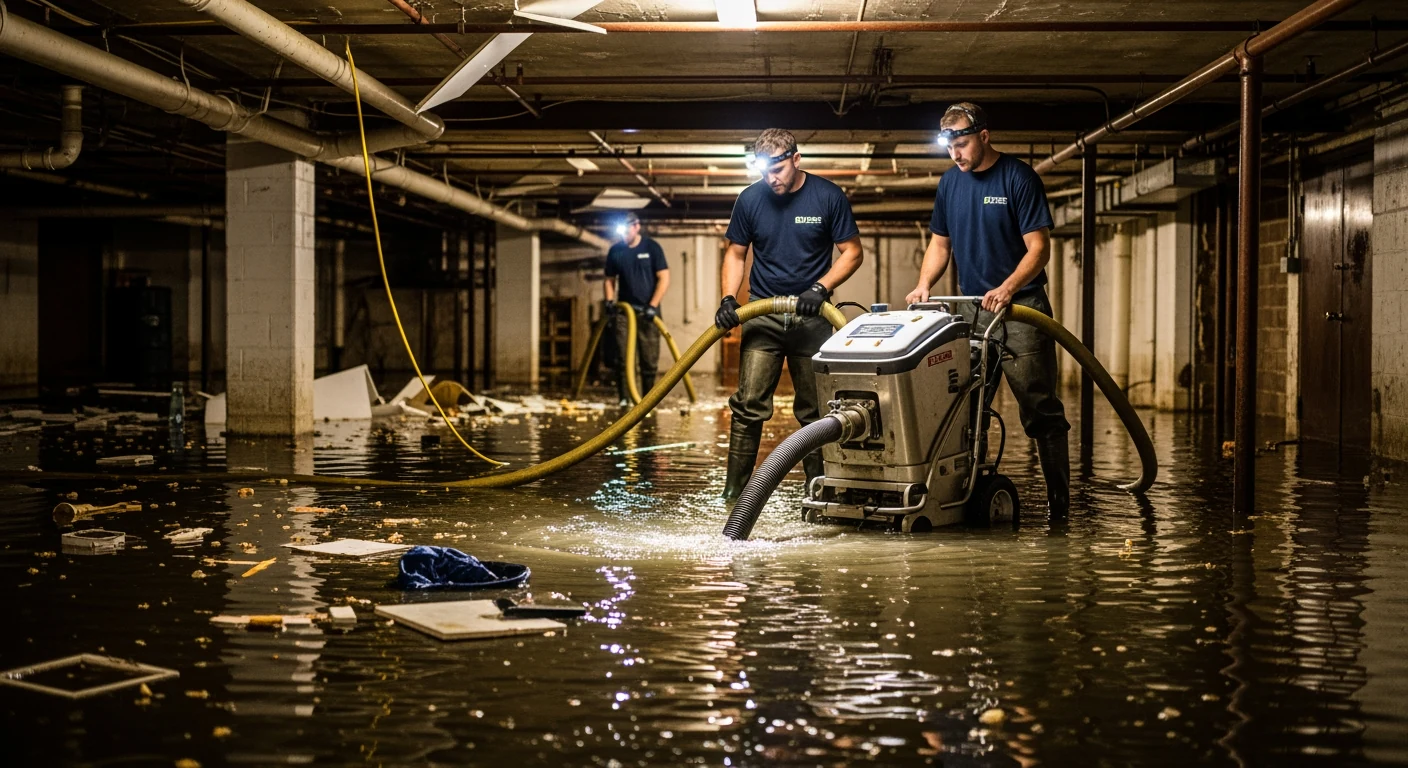
For NYC and Long Island properties with mature street trees adjacent to the building, slow-draining fixtures and intermittent sewer backup during spring rain events often indicate root infiltration rather than the blockages they’re mistaken for. A CCTV camera inspection of the main drain line between the building and the street main is the only definitive diagnosis — and a tree root obstruction found before a major storm event costs $400–$800 to clear with mechanical auguring or hydro-jetting. The same obstruction discovered when combined with a storm surge sewage backup is a Category 3 water damage event.
Sump Pump Capacity During Sustained Spring Rainfall
Long Island residential sump pumps are sized for a specific peak inflow rate based on the soil percolation rate and the drainage area they serve. This sizing calculation is typically performed for normal seasonal rainfall conditions — not for a major spring storm event following a saturated-soil snowmelt. When soil around a Long Island foundation is already at field capacity from snowmelt and a major nor’easter adds 2 to 4 inches of rain in 24 hours, inflow rates can exceed the pump’s rated capacity.
Signs of undersized or overloaded pump capacity: the pit fills faster than the pump can discharge during heavy rain, the pump runs continuously without the pit level dropping, or the pump fails thermally from continuous operation and allows the pit to overflow. Backup sump pumps (battery-operated or water-powered) are not luxury items for Long Island basements — they are the difference between a manageable maintenance event and a finished basement catastrophe during a major spring storm.
What Storm Damage Documentation Requirements Actually Look Like
When April storm damage occurs, the documentation you create in the first 24 to 48 hours determines the outcome of your insurance claim. Insurance carriers routinely dispute storm damage claims on grounds of pre-existing condition — asserting that the damage existed before the storm event and was not caused by it. Countering this requires dated documentation that shows the pre-storm condition.
The best pre-storm documentation is a dated photographic inspection record from April (or earlier in the spring), showing the condition of the roof, parapet, flashings, and exterior walls before any storm event. The post-storm documentation then shows the new damage in comparison. Without the pre-storm baseline, an adjuster can dispute causation for any deficiency found during claim investigation.
Emergency board-up and tarping performed immediately after storm damage should be documented with contractor invoices, photographs before and after installation, and a written scope description. These emergency protection costs are typically covered under your policy’s mitigation of damages provisions — but only if properly documented. Keeping damaged materials on-site until the adjuster inspects is standard practice; disposing of storm-damaged materials before inspection eliminates evidence and can result in claim denial.
Frequently Asked Questions About Spring Storm Damage in NYC
What storm damage is covered by homeowners insurance? Wind damage to roofs, siding, windows, and structures is covered under standard homeowners policies (subject to deductible). Water damage resulting from storm-created openings (wind-damaged roof or broken window allowing rain intrusion) is typically covered. Flood damage from surface water or storm surge is not covered without a separate flood policy.
How do I know if my building’s parapet wall is safe? A safe parapet wall has intact mortar at all joints, no horizontal cracking at the base, no outward lean or movement when hand pressure is applied to cap stones, and functional cap flashing. If any of these conditions are not met, engage a licensed architect or structural engineer for assessment before April storm season.
What should I do immediately after storm damage? Document the damage with photographs before moving or covering anything. Call your insurance carrier to report the claim. Arrange emergency board-up or tarping to prevent further water intrusion — this is covered under your policy’s mitigation of damages provision. Do not dispose of damaged materials until an adjuster has inspected.
Does storm damage require a building permit to repair in NYC? Structural repairs — including parapet reconstruction, roof replacement, and facade work — require NYC Department of Buildings permits. Emergency stabilization work (temporary shoring, board-up) can proceed without a permit, but permanent repairs require licensed contractors and DOB permits in all five boroughs.
Related reading: The April Property Assessment for NYC and Long Island Owners | Why March Is the Most Dangerous Month for NYC Properties | Water Leaking from the Ceiling After Rain — NYC Diagnosis Guide | Sewage Backup in NYC — Category 3 Water Damage Explained