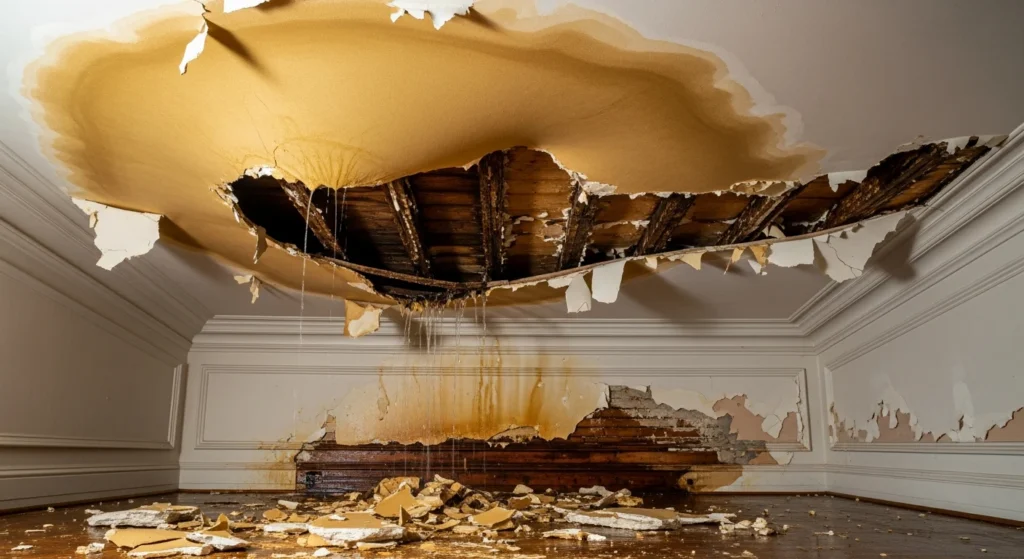
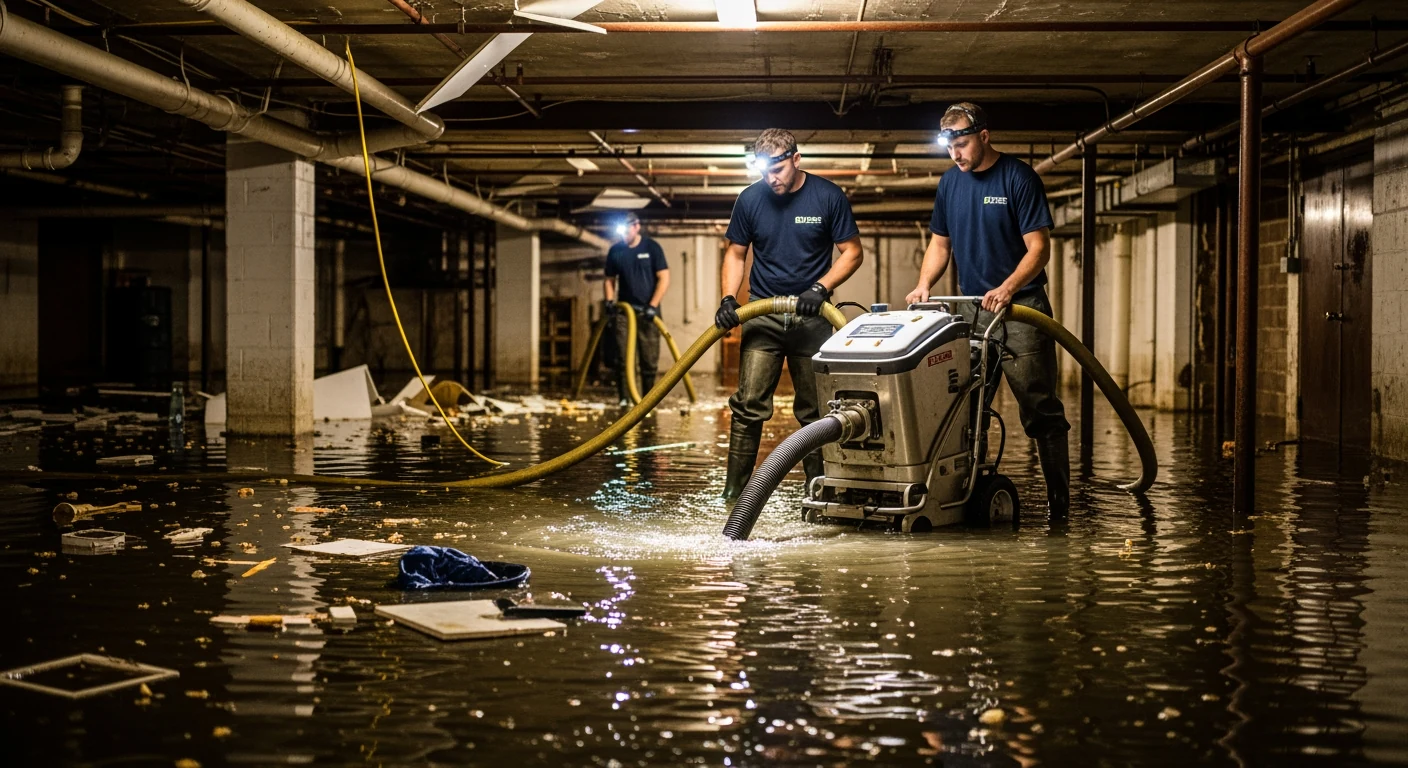
A ceiling water stain after rain is one of the most misdiagnosed problems in New York City and Long Island residential buildings. The instinct is to look directly above the stain for the source. That’s almost always wrong. Water that enters a building through a roof, parapet, or facade defect travels horizontally through roof assemblies, along structural members, and through wall cavities before appearing as a ceiling stain — often 3 to 8 feet from the actual point of entry. March 2026 is producing a high volume of these calls because the Blizzard of 2026 and subsequent nor’easters have stressed NYC and Long Island building envelopes that were already compromised by a full winter of freeze-thaw cycling.
Why the Stain Is Never Directly Below the Leak
Water follows the path of least resistance through a building assembly, and that path is almost never straight down. On a flat NYC roof, water that enters through a failed flashing joint or membrane breach travels along the roof deck or insulation layer until it finds a penetration — a pipe sleeve, conduit, or structural fastener — and then follows that element through the assembly. The stain appears where the water exits at a ceiling surface, which correlates to the lowest point of the interior migration path, not the entry point.
On pitched Long Island roofs, water entering under a shingle or through a failed valley runs along the roof sheathing and rafters, sometimes traveling 6 to 10 feet before appearing at a ceiling or interior wall. In buildings with attic spaces, it may pool on the attic floor for an extended period before the volume exceeds the attic floor’s absorption capacity and begins appearing at ceiling level below.
This migration rule — stain appears 3 to 8 feet from entry — is why professional leak investigation begins with the roof assembly and works downward, not with the ceiling and works upward.
NYC Building Envelope Failure Taxonomy: The 4 Sources
In NYC’s urban building stock, virtually all roof leak and ceiling water damage traces back to one of four failure categories, each of which has a specific visual signature and March risk profile:
1. Parapet wall flashing failure. The metal flashing that seals the joint between the parapet wall and the roof membrane is the most common failure point in NYC flat-roof buildings. Freeze-thaw cycling moves the flashing slightly each cycle — through a full New York winter of 30+ freeze-thaw cycles, even properly installed flashing accumulates fatigue. After the Blizzard of 2026’s heavy snow load and rapid melt, parapet flashing across the city is failing at an elevated rate. Visual signature: ceiling stain along the interior perimeter of the top-floor unit, often near exterior walls or corners.
2. HVAC curb flashing failure. Rooftop HVAC units sit on curbs that penetrate the roof membrane. The caulking and flashing around these curbs degrades with UV exposure and thermal cycling. Heavy snow loading and the vibration of HVAC operation accelerate this degradation. Visual signature: ceiling stain near the center of a room in a top-floor unit, or in a commercial space directly below rooftop mechanical equipment.
3. Roof drain and scupper blockage. NYC flat roofs drain through internal drains or exterior scuppers. When these are blocked — by debris, ice, or accumulated sediment — standing water builds up and begins finding alternative migration paths through the roof assembly. After a 20-inch snowfall, drains that were marginally functional are typically fully blocked by snow and ice consolidation. Visual signature: widespread ceiling staining across a broad area rather than concentrated near a wall or penetration.
4. Facade crack and window frame infiltration. NYC’s brick facade buildings develop hairline cracks at mortar joints and window frame perimeters over time. These cracks are typically not significant sources of water intrusion during normal rainfall — the angle of rain relative to the wall is insufficient to drive water through a hairline crack. But a March nor’easter with sustained 40–60 mph winds driving rain horizontally against the facade is a different scenario entirely. Visual signature: water staining on interior wall surfaces below windows or at the juncture of wall and ceiling on exterior walls, not just on ceiling faces.
How Thermal Imaging Changes Leak Investigation
Infrared thermal imaging cameras detect temperature differentials at building surfaces — wet building materials cool faster and hold lower temperatures than dry materials, creating a detectable contrast on a thermal image. A calibrated thermal scan of a top-floor ceiling and exterior walls after a rain event can identify wet areas that are not yet visibly stained, map the full extent of moisture migration, and locate entry points that would require destructive investigation to find visually.
For NYC building owners and property managers, thermal imaging has a specific practical value: it provides documented evidence of moisture extent before remediation begins, which is essential for insurance claims and contractor scope-of-work verification. It also allows identification of water migration paths that wouldn’t be visible until drywall was opened — in many cases allowing non-destructive drying in areas that would otherwise require full demolition.
Thermal imaging scans for residential units in NYC run $300–$600. For multi-story commercial or multi-family buildings, $800–$2,500 depending on scope. The scan results in a thermal map showing all areas of moisture involvement and a written report locating probable entry points.
Structural vs. Cosmetic Water Damage: How to Tell the Difference
Not all ceiling water damage is structurally significant, but misidentifying cosmetic damage as structural — or vice versa — has serious consequences for both remediation cost and safety. The key indicators:
Cosmetic (surface) damage indicators: Dry stain with clearly defined edges, no soft or spongy texture when pressed, paint intact or peeling at edges only, no odor. This indicates a past moisture event that has already dried. It requires monitoring for recurrence and cosmetic repair, but not structural remediation.
Structural damage indicators: Soft, spongy, or bulging ceiling surface (indicates water pooling above the ceiling plane), active dripping or staining that grows during or after rain events, visible sagging or deflection of ceiling plane, cracks radiating from the stain, musty odor near the stain (indicates mold colonization of structural components above). Any of these requires immediate professional assessment — a bulging ceiling is a fall hazard and represents a structural load event that can fail suddenly.
HPD Implications for Tenant Buildings in NYC
For owners of tenant-occupied buildings in New York City, ceiling water damage and roof leaks carry specific enforcement implications. NYC’s Department of Housing Preservation and Development (HPD) classifies water intrusion violations by severity:
A water leak from a roof or exterior wall in a residential unit is classified as a Class B (hazardous) violation — one of HPD’s highest-priority violation categories. Class B violations carry a $50/day civil penalty and an escalating fine schedule. HPD expects landlords to repair Class B violations within 30 days of notice and to certify correction within 45 days. If a tenant files a complaint about ceiling water damage after the Blizzard of 2026 and HPD sends an inspector, the 30-day repair clock starts immediately.
Documenting the repair with a professional drying report, contractor invoices, and post-repair moisture readings is essential for HPD certification and for defeating any subsequent warranty of habitability claim in Housing Court.
Frequently Asked Questions About Ceiling Water Damage in NYC
Why is my ceiling leaking when it rains but I can’t find a roof problem? Water migration through building assemblies means the leak source is almost always some distance from where the stain appears. The source is most likely parapet flashing, an HVAC curb, a blocked drain, or a facade crack — all of which are not visible from inside the apartment. A professional with moisture meters and thermal imaging can locate the entry point non-destructively.
Does a ceiling water stain mean I have mold? A dry, old stain without odor may not indicate active mold growth. A fresh stain, a stain that appeared or grew following recent rain or snowmelt, or a stain accompanied by musty odor should be treated as a potential mold event — the 24–48 hour colonization window means that if the stain is active, mold is either present or will be shortly.
How do I find where a roof leak is coming from? Homeowners can perform a basic investigation by going to the attic or roof (safely) during dry conditions and looking for staining, debris accumulation around drains and flashings, and gaps in flashing or membrane. For a definitive diagnosis, engage a roofing contractor or building envelope consultant. Thermal imaging after a rain event is the most accurate non-destructive method.
How long does it take to repair a roof leak in NYC? Emergency temporary repairs (tarping, sealant) can be done within 24–48 hours. Permanent repairs — flashing replacement, membrane patching, or structural repairs — typically require 1–5 days of contractor work depending on scope. Interior remediation (drying, drywall replacement, painting) follows after the building envelope is confirmed weathertight.
Is roof leak damage covered by homeowners or renters insurance? Sudden and accidental roof leak damage is typically covered under standard homeowners policies. Long-term slow leaks caused by deferred maintenance are typically excluded. For co-op and condo owners, the building’s master policy typically covers structural elements (roof membrane, parapet); the unit owner’s policy covers interior finishes. Document the event date and report promptly.
Related reading: Why March Is the Most Dangerous Month for NYC Properties (March 2026) | The March Mold Discovery Problem — What Grew Over Winter | Spring Storm Season in NYC — Structural Vulnerabilities That Create $50,000 Claims | The April Property Assessment for NYC and Long Island Owners