The question “can mold spread through HVAC systems?” receives a definitive yes in Long Island’s humidity context — but the mechanism is more specific than most homeowners expect. Mold in Long Island HVAC ductwork does not primarily result from spores being carried from an existing mold colony through the duct system. It results from condensation forming on inadequately insulated supply ducts when cold supply air (55-60°F from the cooling coil) flows through humid attic or basement spaces where ambient relative humidity is 70 to 80 percent. The cold duct surface’s temperature drops below the dew point of the surrounding air, condensation forms on the duct exterior, and mold colonizes the duct exterior insulation — or, if condensation penetrates to the interior metal, on the interior duct walls where it can be distributed by airflow to occupied spaces.
How to Detect HVAC Mold on Long Island
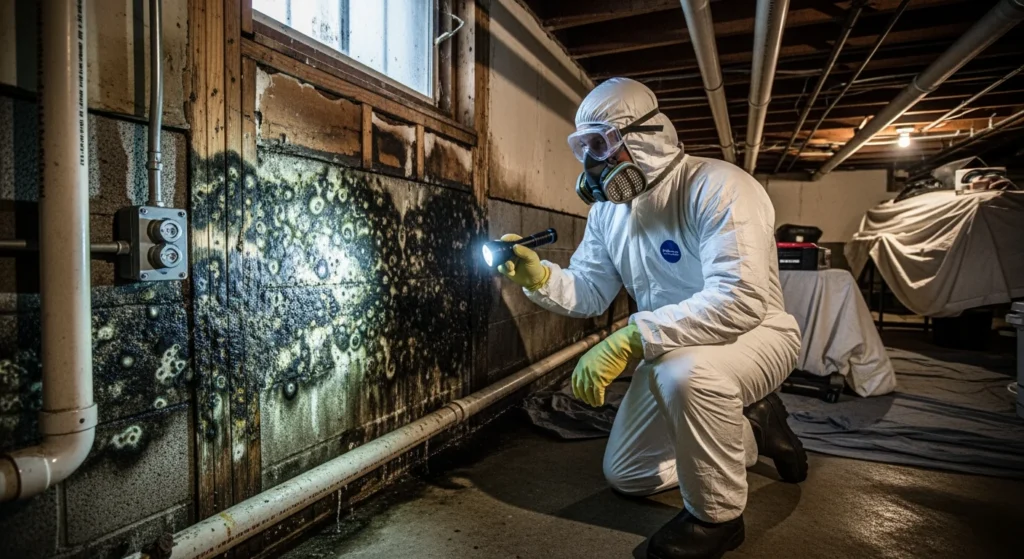
The first indicator is often musty odor that correlates with HVAC operation — the system runs, occupants smell mold, the system shuts off, the smell diminishes. This pattern indicates that the air distribution system itself is the source, not a room-based mold colony. Visual inspection of accessible ductwork — flex duct connections, plenums, and air handler housings — may reveal visible growth on insulation or metal surfaces. HVAC mold can also be identified through air sampling: elevated Cladosporium or Pen/Asp counts in supply air registers compared to return air samples or outdoor reference samples indicate duct-origin mold. Upper Restoration’s Article 32 assessors collect supply register samples as part of comprehensive HVAC mold assessment protocols.
Remediation Approach
HVAC duct mold remediation ranges from antimicrobial treatment of accessible duct surfaces (appropriate for exterior insulation mold where the duct interior is unaffected) to complete duct replacement (required when interior metal surfaces are colonized throughout the system). Flex duct with mold on the interior mylar surface cannot be effectively cleaned — it must be replaced. Hard-pipe metal ductwork with interior mold can be treated with EPA-registered antimicrobial products applied by professional duct cleaning equipment. The air handler coil and drain pan must be inspected and treated as part of any HVAC mold remediation scope, since these are the highest-humidity surfaces in the system and the most common mold initiation points.
Prevention: The Duct Insulation Standard
The permanent prevention for HVAC duct condensation mold on Long Island is properly installed and maintained duct insulation meeting current Long Island residential standards: minimum R-6 insulation on all supply ducts in unconditioned spaces (attics, basements, crawl spaces), with vapor barrier facing continuous and sealed at all seams. Duct insulation that has been compressed, punctured, or improperly spliced loses its thermal performance and creates condensation points. Annual fall HVAC inspection should include duct insulation condition assessment, particularly in attic systems.