March 2026 has already proven the point. Following the Blizzard of 2026 on February 22 — which buried NYC and Long Island under more than 20 inches of heavy, wet snow and prompted Governor Hochul to declare a State Disaster Emergency across all five boroughs, Nassau, Suffolk, Westchester, and surrounding counties — restoration contractors across the region are handling the highest volume of water damage, burst pipe, and mold discovery calls in years. If you’re dealing with the aftermath right now, or noticing something that didn’t exist two weeks ago, this guide is for you.
Why March Hits NYC and Long Island Properties Harder Than Any Other Month
Water damage doesn’t peak in March by accident. Three distinct weather forces converge in a way that overwhelms building systems that handle each force individually just fine.
Force 1: Snowmelt. The Blizzard of 2026 deposited an enormous volume of water across every roof, yard, and impervious surface in the metro area. Heavy, wet snow at 20+ inches depth weighs roughly 20 pounds per square foot on flat roofs — NYC’s most common roof type. As temperatures climb above freezing, that mass converts to liquid simultaneously and searches for a path. NYC’s aging drainage infrastructure, designed for steady rainfall, is not designed for a simultaneous melt event of this scale.
Force 2: Nor’easter rain on frozen or saturated ground. March nor’easters follow snowstorms because the same atmospheric conditions — cold Canadian air colliding with warming Atlantic moisture — continue producing storm systems through mid-April. When rain falls on ground still frozen or at 100% saturation from snowmelt, it has nowhere to go. Runoff concentrates against foundations, into window wells, through aging parapet flashing, and through any building envelope breach that freeze-thaw cycling opened over winter.
Force 3: Frozen infrastructure thawing under pressure. Pipes that survived winter by remaining consistently cold are most vulnerable during the warm-cold oscillation of March, not during the coldest weeks of January. A pipe that chilled to near-freezing and expanded slightly over winter now thaws rapidly when temperatures spike, and the stress from that thermal cycling — plus restored water pressure pushing through a compromised section — is what produces burst pipes across thousands of NYC and Long Island buildings every spring.
The 24–48 Hour Window That Determines Your Total Damage Cost
The single most important number in water damage response: mold colonization begins within 24 to 48 hours of a moisture event under typical indoor temperature conditions. Once mold colonies establish in drywall, insulation, or wood framing, the remediation scope expands dramatically. A water event that costs $8,000 to remediate when addressed in 24 hours can cost $35,000 or more if left five to seven days.
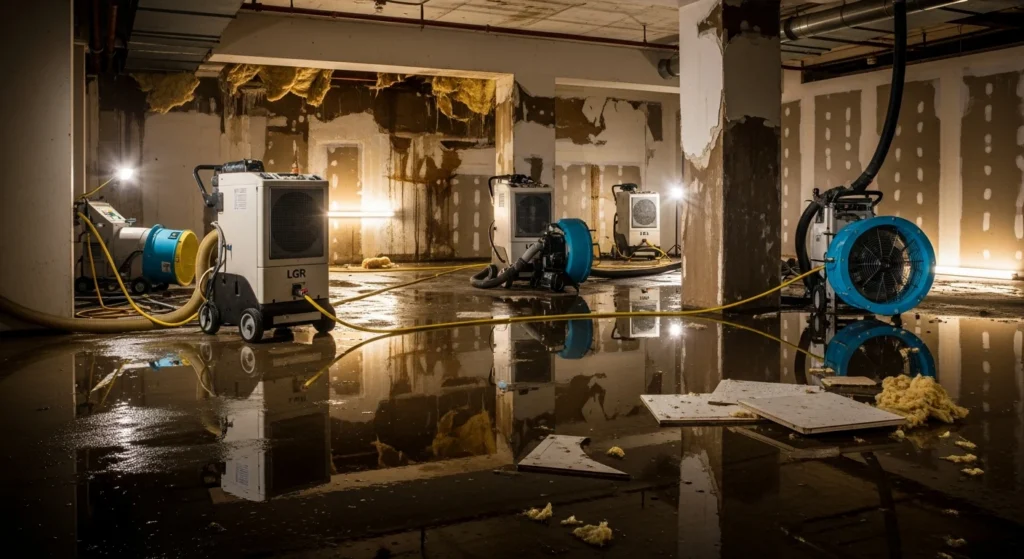
This is established by the IICRC S500 Standard for Professional Water Damage Restoration — the industry standard used by every certified restoration contractor, adjuster, and insurance carrier in the country. The S500 classifies water damage by contamination level (Categories 1–3) and drying difficulty (Classes 1–4). The combination determines required response protocol and timeline. A typical NYC Class 2 or Class 3 event — water migrated into wall cavities, under flooring, or into structural framing — requires mechanical dehumidification (commercial LGR units capable of extracting 80–120 pints per day), air movers creating turbulent airflow, and supplemental heat below 70°F, because evaporation rate drops sharply at lower temperatures.
March psychrometrics make drying significantly harder than summer. Outdoor air averages 35–50°F with 60–80% relative humidity. Ventilation-based drying doesn’t work — it adds moisture. Everything must be mechanical.
What to Do in the First Hour After Discovering Water Damage
Do not enter a heavily flooded area if electrical circuits serving that space are not confirmed de-energized. Water and live electrical systems are the most common fatality scenario in residential flood response.
If the source is a burst pipe: shut the main water supply valve. In NYC apartments, this is typically in the basement mechanical room or under the kitchen sink. On Long Island, usually at the meter or in the crawlspace.
If the source is exterior infiltration — roof, foundation, or stormwater — limit spread immediately. Pull area rugs off saturated flooring. Place aluminum foil or plastic sheeting under furniture legs on wet carpet. Document everything with photos and video before moving anything — required for insurance claims. Report to your carrier within 24 hours. Standard homeowners policies cover burst pipe damage and roof leak infiltration. They do not cover external flood damage without a separate NFIP or private flood policy.
What Professional Drying Assessment Actually Looks Like
The first step is moisture mapping — penetrating moisture meters measuring moisture content in wood and drywall by contact, plus non-penetrating RF meters detecting moisture behind surfaces. Acceptable moisture content for structural wood framing is below 19%. For gypsum drywall, below 1%. Drywall absorbs water readily and dries slowly, which is why wall cavities are often opened during professional restoration.
Drying logs are maintained daily — moisture readings at the same measurement points each day tracking the drying curve. A documented drying log is required by most insurance carriers for Category 2 or Class 3+ claims. Ask to see it; any reputable contractor provides it.
The Mold Discovery That Follows the Water Event
In the weeks following the Blizzard of 2026 aftermath, many NYC and Long Island property owners will discover mold that seems unrelated to the recent storm. It isn’t. Mold starting in wall cavities during a moisture event takes two to four weeks to reach visible or olfactory detection — appearing as musty smell or discoloration at baseboards, ceiling joints, or behind furniture moved during cleanup.
Under New York State law (Article 32 of the Labor Law), mold remediation affecting more than 10 square feet requires a licensed mold assessor and a licensed mold remediator — and these must be separate, independent entities. The assessor writes the remediation protocol. The remediator executes it. The assessor then performs post-remediation clearance testing. If a contractor offers to both assess and remediate without separate entities, that violates New York State law.
Long Island-Specific Risks After a Major Snow Event
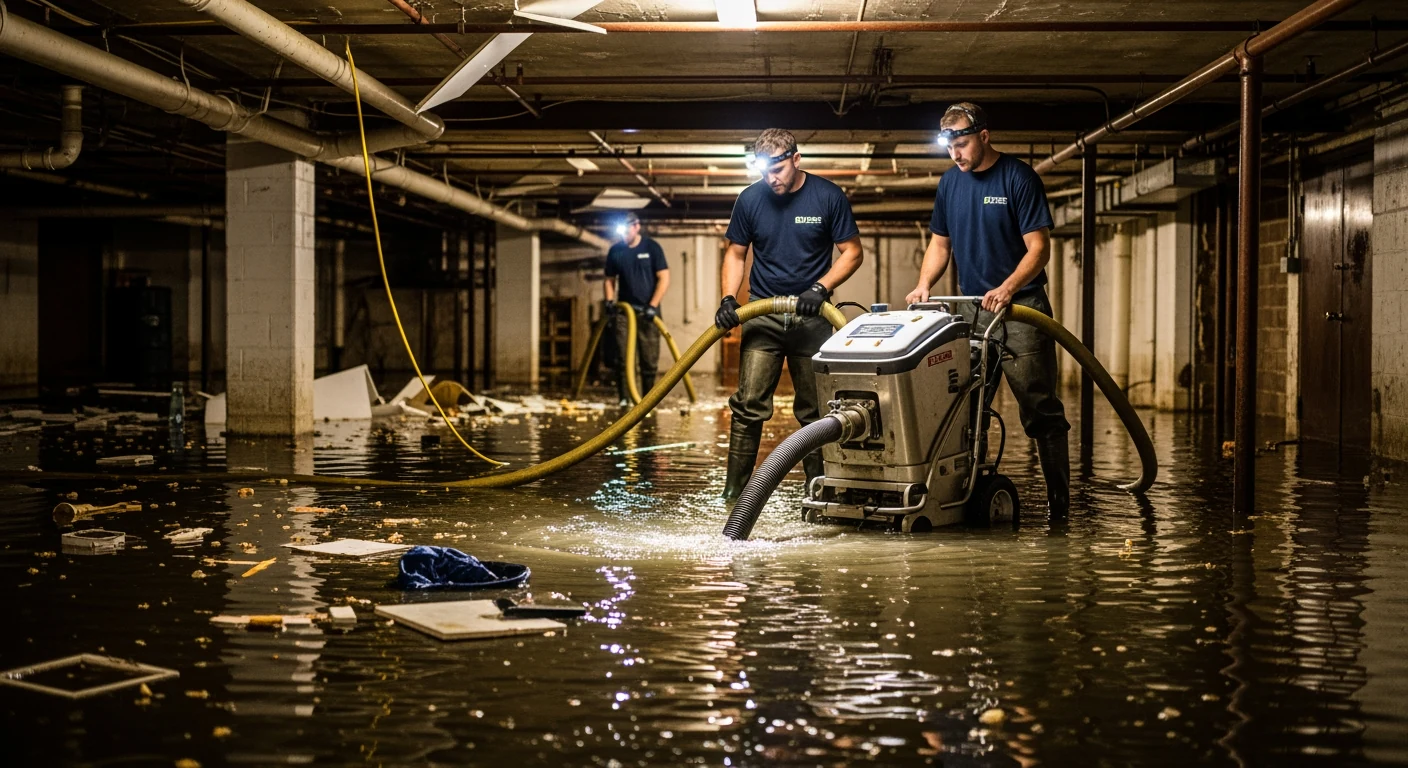
Crawlspace construction is far more common on Long Island than in NYC — and crawlspaces that accumulated ground moisture during snowmelt are exactly the warm, humid, dark environments where mold colonizes most aggressively. Sump pumps that failed during power outages from the February 2026 storm left standing water in basements across Nassau and Suffolk counties; if that was not professionally dried, mold is almost certainly present by now.
Long Island septic systems also behave differently during saturated-soil conditions. When drain field soils reach saturation, effluent cannot percolate — and backpressure can push Category 3 contaminated water back into building plumbing. This is a documented failure pattern Long Island restoration contractors see every March and April following significant snowfall winters.
Frequently Asked Questions About March Water Damage in NYC and Long Island
How long does water damage take to dry professionally? A typical Class 2 water event in NYC takes 3 to 5 days of continuous mechanical drying. Class 3 events affecting structural framing can take 7 to 10 days. March weather requires additional drying capacity.
When does water damage become a mold problem? Mold can begin colonizing porous materials within 24 to 48 hours at normal indoor temperatures. If a water event occurred more than 48 hours ago and has not been professionally dried, treat it as a potential mold situation and request testing as part of assessment.
Is Blizzard of 2026 aftermath covered by homeowners insurance? Burst pipe damage and roof leak infiltration from the storm are typically covered under standard homeowners policies. Flood damage from exterior stormwater is not covered without a separate flood policy.
Do I need to leave my home during water damage restoration? Not necessarily for contained events. If sewage contamination is present or mold remediation is underway with containment and negative air pressure, temporary relocation is typically required — your policy’s additional living expenses coverage applies.
What does a water damage assessment cost in NYC? Initial assessments from certified contractors are typically provided at no charge. Independent moisture assessments run $300–$800. Post-remediation clearance testing runs $400–$1,200 for standard NYC and Long Island residential properties.
How do I find a licensed water damage contractor in NYC? Look for IICRC-certified firms. For mold work, verify the contractor holds a New York State mold contractor license through the NYS Department of Labor. For pre-1978 construction, verify NYS Rule 56 asbestos contractor certification before any demolition.
Related reading from Upper Restoration: The March Mold Discovery Problem — What Grew Over Winter in Your NYC Home | Water Leaking from the Ceiling After Rain — NYC Diagnosis Guide | Sewage Backup in NYC — Category 3 Water Damage Explained | The April Property Assessment for NYC and Long Island Owners | New York State Mold Law 2026: Inspector vs. Remediator