Flood Damage Restoration on Long Island: What to Expect, What It Costs, and Who to Call
When floodwater enters a Long Island home — whether from a nor’easter pushing Great South Bay over its banks, a backed-up storm drain in a South Shore canal community, or a tropical storm hitting the Atlantic-facing coast — the clock starts immediately. Category 3 floodwater contains sewage, chemicals, pathogens, and sediment. Every hour it sits, it migrates deeper into flooring, wall assemblies, and subfloor materials. And in Long Island’s humidity, mold growth begins within 24–48 hours of saturation.
This page covers exactly what professional flood damage restoration involves on Long Island, what it costs in 2026, how the process works from first call to final reconstruction, and what separates a properly completed job from one that causes problems months later.
Why Flood Damage on Long Island Is a Category 3 Event — Every Time
The IICRC S500 Standard — the technical framework all professional restoration contractors follow — classifies water damage into three categories based on contamination level. Exterior floodwater is always Category 3, regardless of how clear it looks.
Long Island floodwater specifically carries:
- Sewage contamination — Nassau and Suffolk County’s combined sewer and stormwater systems overflow during heavy rain events, introducing raw sewage into floodwater. This is why your flooded basement smells the way it does.
- Agricultural and lawn chemical runoff — Suffolk County’s North Fork and inland areas contribute fertilizer nitrates and pesticide residue to runoff that enters homes during flood events.
- Marine sediment and salt — Coastal communities from Long Beach to the Hamptons deal with saltwater intrusion that accelerates structural corrosion and requires specialized treatment protocols not used on freshwater jobs.
- Petroleum and chemical contamination — Floodwater that crosses roads, parking lots, or industrial areas picks up petroleum products and chemical runoff before entering residential properties.
This is why a homeowner with a wet/dry vac and a fan cannot safely remediate flood damage. Category 3 contamination requires licensed disposal of affected materials, EPA-registered antimicrobials, and documentation that the property has been decontaminated to safe levels. For the full regulatory and FEMA zone context behind Long Island flooding, see our comprehensive flood damage restoration guide covering FEMA zones, Sandy data, and NFIP coverage.
The Flood Damage Restoration Process on Long Island
Step 1: Emergency Response and Water Extraction (Hours 1–12)
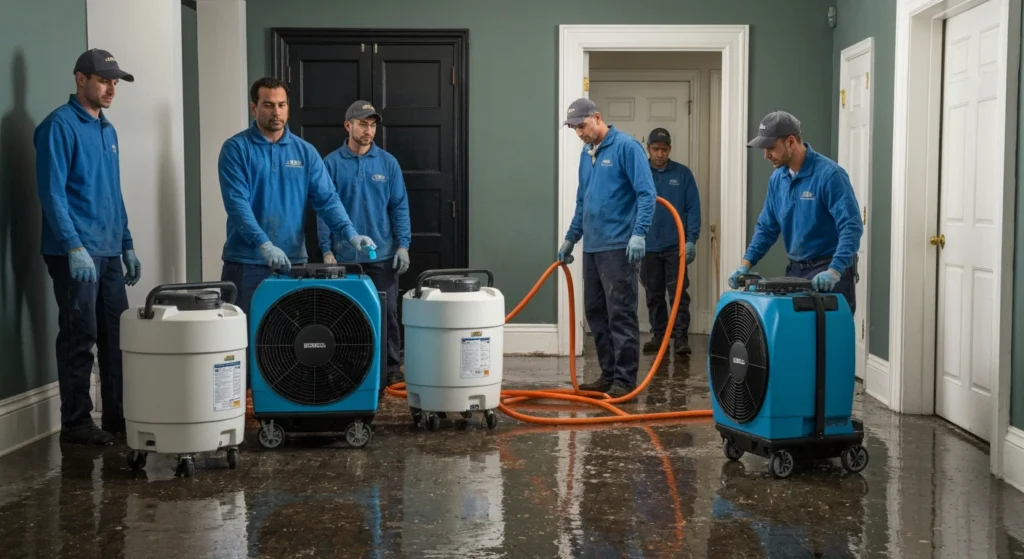
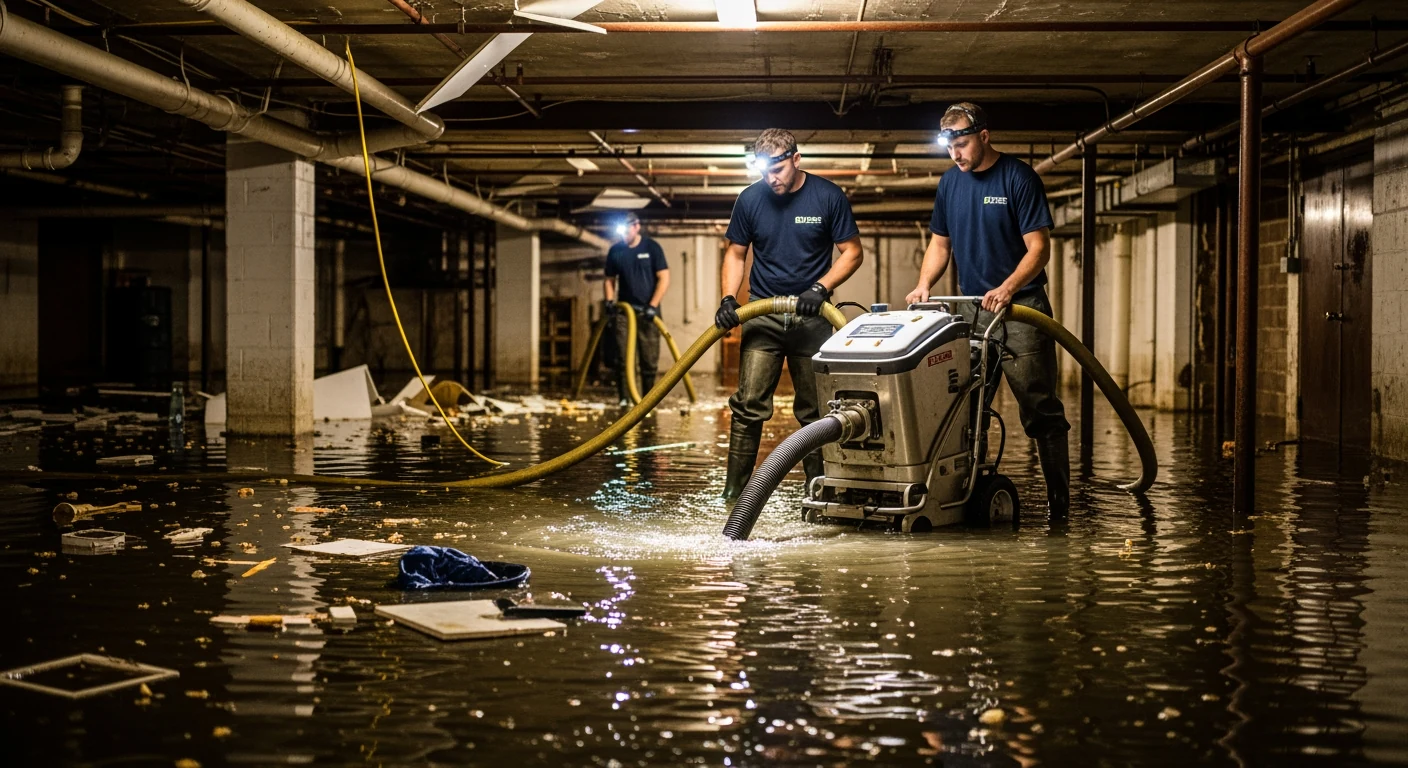
The faster water is extracted, the less structural material needs to come out. Upper Restoration deploys truck-mounted extraction units that move hundreds of gallons per hour — dramatically faster than portable units. Our first-response crews simultaneously begin moisture mapping with thermal imaging cameras to identify where water has migrated beyond the visible flood line, including inside wall cavities and under flooring.
In active flood conditions — when water is still rising or the storm is ongoing — we coordinate with you on timing. Deploying into an actively flooding property is unsafe and counterproductive. We stage locally and respond the moment conditions allow safe access.
Step 2: Contaminated Material Removal
Category 3 floodwater contaminates every porous material it contacts. These materials cannot be dried and kept — they must come out:
- Drywall to at least 12 inches above the flood line (the standard for Long Island flood jobs is often higher given saltwater and sewage contamination levels)
- All carpet, carpet pad, and vinyl flooring
- Fiberglass batt insulation (absorbs contamination completely)
- Kitchen and bathroom cabinetry if contact occurred at base level
- Wood subfloor in severe cases where saturation depth and contamination level require it
All removed material is bagged as regulated biohazard waste and disposed of under New York State DEC guidelines. This is not standard construction debris — improper disposal creates liability. Your contractor should provide waste disposal manifests as part of your documentation package.
Step 3: Structural Decontamination
Once porous materials are removed, the remaining structural shell — concrete slab, masonry block, wood framing, joists — is treated with two-pass antimicrobial application using EPA-registered products rated for Category 3 contamination. For saltwater flood events, this includes treatments specifically formulated for salt-accelerated corrosion on metal fasteners, hangers, and HVAC components.
HVAC systems require particular attention in Long Island flood jobs. If floodwater reached the air handler, coils, or ductwork, the system requires full decontamination or replacement. Running a contaminated HVAC system after a flood is one of the most common sources of post-remediation mold and odor complaints.
Step 4: Structural Drying
Commercial desiccant dehumidifiers and high-velocity air movers run continuously until all structural assemblies reach IICRC S500 target moisture levels. In Long Island’s coastal humidity, drying timelines run longer than inland markets — typically 4–7 days for moderate flood events with a full commercial equipment deployment. Daily moisture readings are recorded in drying logs, which are required documentation for insurance claims and for the post-remediation clearance process.
Attempting to reconstruct before structural drying is complete is the most common reason flood restoration jobs fail. Drywall installed over wet framing traps moisture and produces mold within weeks.
Step 5: Mold Assessment and Remediation (If Required)
On Long Island, where ambient humidity is elevated year-round, mold growth after a flood event is nearly universal if response time exceeded 24–48 hours. Mold remediation is conducted under a separate licensed scope in New York — NYS Article 32 requires that mold remediation contractors hold a specific state license, distinct from general contractor licensing.
Upper Restoration holds the required Article 32 license and handles mold remediation as a concurrent scope with flood restoration — one crew, one project, one documentation package. This matters for your insurance claim: separate scopes from separate contractors create gaps that adjusters exploit to reduce settlements. See our full guide on mold remediation on Long Island for NYS law details and cost ranges.
Step 6: Reconstruction
Once the structure is dry, decontaminated, and cleared, reconstruction returns the property to pre-loss condition. On Long Island flood jobs, reconstruction scope commonly includes: drywall, insulation, flooring, base cabinetry, painting, and mechanical system restoration. For coastal properties, reconstruction materials are selected for humidity and salt resistance — standard interior drywall is not appropriate for below-grade or coastal applications that remain at flood risk.
Flood Damage Restoration Cost on Long Island: 2026 Pricing
| Flood Scenario | Typical Cost Range | Key Variables |
|---|---|---|
| Minor — under 2 inches, single room | $4,000–$8,000 | Rapid response, limited material removal |
| Moderate — 2–12 inches, multiple rooms | $8,000–$18,000 | Full drywall removal, flooring, drying |
| Major — 12+ inches, full basement or first floor | $18,000–$35,000 | Structural involvement, mold remediation likely |
| Coastal / saltwater event | Add 20–35% | Salt decontamination, corrosion treatment, specialized materials |
| Reconstruction (after remediation) | $8,000–$40,000+ | Separate from remediation; depends on finish level |
Long Island labor rates run 15–25% above national restoration averages. Nassau County generally tracks slightly higher than Suffolk due to proximity to NYC labor markets.
Does Insurance Cover Flood Damage on Long Island?
This is the question behind most calls we receive — and the answer is more nuanced than most homeowners expect.
Standard homeowners insurance does not cover flooding. If exterior floodwater entered your home — water that rose from a storm surge, overflowing bay or canal, or overwhelmed storm drain — that is flood damage, not water damage. It is covered only by flood insurance, typically through the NFIP (National Flood Insurance Program) or a private flood carrier.
What your homeowners policy may cover: If a separate water event occurred during the same storm — a pipe broke, the roof failed, or an appliance malfunctioned — that component of the damage may be covered under your HO-3. Separating flood damage from non-flood water damage in a single loss event is a common and contested insurance issue. A professional restoration contractor who documents each damage source separately gives you the strongest position.
NFIP coverage limits: Standard NFIP policies cover up to $250,000 for the building and $100,000 for personal property. Many Long Island homeowners — particularly in South Shore communities with high-value homes — carry excess flood coverage from private insurers above the NFIP limit. Confirm your coverage structure before a loss occurs.
Upper Restoration provides complete insurance documentation for flood claims — source identification, moisture mapping, scope of loss, drying logs, waste manifests, and clearance testing. We work directly with NFIP adjusters and have experience with the specific documentation requirements for NFIP claims, which differ from standard homeowners claims. Learn more about how to file a flood insurance claim in New York and how Upper Restoration works with insurance adjusters.
Long Island Communities We Serve
Upper Restoration responds to flood damage across Nassau and Suffolk County, including the highest-risk coastal communities:
Nassau County: Long Beach, Island Park, Freeport, Baldwin, Merrick, Wantagh, Seaford, Massapequa, Oceanside, Lawrence, Hewlett, Valley Stream, and all inland Nassau communities.
Suffolk County: Lindenhurst, Babylon, Bay Shore, Islip, Sayville, Patchogue, Moriches, Hampton Bays, Southampton, East Hampton, Montauk, Riverhead, Smithtown, Huntington, and all North Fork and South Shore communities.
For water damage restoration across Nassau County generally, see our Nassau County water damage guide. For Suffolk County, see our Suffolk County water damage guide. For storm damage specifically, our Nassau storm damage guide and Suffolk storm damage guide cover nor’easter and hurricane response in detail.
What to Do Immediately After a Flood on Long Island
- Do not enter standing floodwater indoors without rubber boots and gloves. Category 3 water carries pathogens. Do not let children or pets enter flooded areas.
- Confirm utilities are off before entering. Electrical panels in flooded basements are an electrocution risk. Call PSEG Long Island or your utility provider if you cannot safely confirm the panel is de-energized.
- Call a licensed restoration contractor immediately — not after cleanup, not the next morning. Every hour increases material loss and mold risk. Upper Restoration is available 24/7.
- Photograph and video everything before any water is removed. Document water depth markers, flood source, all affected rooms and contents. This is your insurance claim foundation.
- Call your flood insurance carrier to open a claim. If you have an NFIP policy, the claims process has specific timelines — proof of loss must be filed within 60 days of the loss date.
- Do not discard damaged items before the adjuster or restoration contractor has documented them. Premature disposal of damaged contents reduces your claim settlement.
Frequently Asked Questions — Flood Damage Restoration Long Island
How much does flood damage restoration cost on Long Island?
Flood damage restoration on Long Island costs $4,000–$8,000 for minor events, $8,000–$18,000 for moderate multi-room flooding, and $18,000–$35,000+ for major events with structural involvement. Coastal and saltwater flood events add 20–35% due to specialized decontamination requirements. Reconstruction costs are separate and run $8,000–$40,000+ depending on finish level and scope.
Does homeowners insurance cover flood damage on Long Island?
No — standard homeowners insurance does not cover flooding from exterior water sources. Flood damage is covered only by a separate flood insurance policy, typically through the NFIP or a private flood carrier. Some storm-related damage that isn’t technically flooding (roof failure, burst pipes) may be covered under your homeowners policy even during the same storm event.
How long does flood damage restoration take on Long Island?
Most Long Island flood restoration jobs take 1–3 weeks for remediation and drying, plus additional time for reconstruction. Long Island’s coastal humidity extends drying timelines beyond national averages — typically 4–7 days of commercial equipment operation for moderate events. Reconstruction timelines depend on permit requirements and scope.
Is floodwater dangerous to clean up yourself?
Yes. All exterior floodwater on Long Island is classified as Category 3 — grossly contaminated — containing sewage, pathogens, agricultural chemicals, petroleum residue, and in coastal areas, marine contamination. DIY cleanup without proper PPE, EPA-registered disinfectants, and licensed waste disposal creates health risk and typically voids flood insurance claims.
How quickly does mold grow after flooding on Long Island?
In Long Island’s coastal humidity, mold can begin growing within 24–48 hours of saturation. If floodwater was present for more than a day before professional remediation began, mold assessment is standard protocol. Upper Restoration holds the NYS Article 32 mold remediation license required to treat mold discovered during flood restoration.
What is the difference between water damage and flood damage for insurance purposes?
For insurance, the distinction is the water source. Internal water sources — burst pipes, appliance failures, roof leaks — are water damage covered by homeowners insurance. External water sources — storm surge, overflowing waterways, surface flooding — are flood damage covered only by flood insurance. When both occur in the same storm event, the damage must be documented by source for each coverage to apply correctly.
Do you work with NFIP flood insurance adjusters?
Yes. Upper Restoration has direct experience with NFIP claims documentation requirements, which differ from standard homeowners claims. We provide source identification, scope of loss, drying logs, and clearance testing in formats that NFIP adjusters require, and we can meet the adjuster on-site to walk through our scope.