What Does Black Mold Actually Look Like?
The term “black mold” is used loosely to describe any dark-colored mold, but true black mold — Stachybotrys chartarum — has specific visual characteristics that distinguish it from other common species. The problem is that visual identification is unreliable, and several other mold species look nearly identical to the untrained eye.
Visual Characteristics of Stachybotrys chartarum
- Color: Greenish-black to jet black. Not grey, not brown — distinctly dark with a greenish undertone when actively growing.
- Texture: Slimy or wet-looking when actively growing in high moisture. Dry and powdery when dormant or dried out.
- Pattern: Tends to grow in irregular patches that spread outward from the moisture source. Often appears in circular or amoeba-like patterns on drywall.
- Location: Found where chronic moisture exists — not just surface dampness. Typically on the paper facing of drywall, ceiling tile backing, wood framing behind walls, and under flooring near persistent leaks.
- Odor: Strong, musty, earthy smell — often described as rotting wood or wet dirt. More pungent than typical household mold.
Mold Species That Look Like Black Mold
| Species | Appearance | How Common | Mycotoxin Producer? |
|---|---|---|---|
| Stachybotrys chartarum | Greenish-black, slimy | Uncommon | Yes (trichothecenes) |
| Cladosporium | Olive-green to black, powdery | Very common | No |
| Aspergillus niger | Black with white edges | Common | Some strains |
| Alternaria | Dark brown to black, velvety | Common | Some strains |
| Aureobasidium | Pink to black, smooth | Common (bathrooms) | No |
Cladosporium — the most common indoor mold in NYC homes — is black to dark olive and is frequently mistaken for Stachybotrys. The CDC explicitly states that color-based identification is not reliable and that only laboratory analysis can confirm mold species. This matters because Stachybotrys requires sustained water damage to develop — if the growth appeared quickly after a minor moisture event, it is almost certainly a more common species.
Where Black Mold Grows in NYC and Long Island Buildings
Stachybotrys requires two specific conditions: a cellulose-rich material substrate and sustained moisture — not just occasional dampness but chronic wet conditions lasting weeks. In New York’s housing stock, the most common locations:
- Behind drywall after prolonged leaks: A slow pipe leak inside a wall cavity, active for months, creates ideal Stachybotrys conditions on the paper face of drywall. The mold is invisible until the wall is opened.
- Under flooring after flooding: Subfloor wood and the paper backing of vinyl flooring that sat wet for more than 72 hours. Common after basement flooding in Long Island homes.
- Ceiling tiles in chronically damp spaces: Dropped ceiling tiles above bathroom pipes or below roof leaks in older NYC buildings. The cellulose content of acoustic tiles is a preferred substrate.
- Crawl spaces and basement rim joists: Consistently high humidity in unconditioned crawl spaces or rim joist areas around foundation walls creates chronic moisture on wood framing.
Black Mold Symptoms: What Exposure Actually Causes
Black mold exposure symptoms have been dramatically overstated in popular media. The scientific consensus — reflected in guidance from the CDC, National Institute of Environmental Health Sciences (NIEHS), and the American Academy of Allergy, Asthma and Immunology (AAAAI) — is that mold exposure, including Stachybotrys, causes respiratory and allergic symptoms primarily in sensitive individuals. The dramatic “toxic mold syndrome” claims widely circulated online are not supported by current medical evidence.
Documented Symptoms of Mold Exposure
- Nasal and sinus congestion
- Eye irritation — redness, tearing, itching
- Coughing and wheezing
- Throat irritation
- Skin irritation in direct contact cases
- Asthma exacerbation in people with existing asthma
Higher-Risk Populations
The following groups experience more severe reactions to mold exposure at lower concentrations:
- People with asthma — the NIEHS identifies mold as a significant asthma trigger
- People with allergic rhinitis or mold allergies
- Immunocompromised individuals — organ transplant recipients, chemotherapy patients, HIV-positive individuals
- Infants and young children
- Elderly individuals
The Mycotoxin Question
Stachybotrys produces trichothecene mycotoxins. High-dose mycotoxin exposure in occupational settings has documented health effects. Whether typical residential exposure to Stachybotrys-contaminated building materials produces clinically significant mycotoxin exposure is scientifically contested. The AAAAI and CDC both note that the evidence for serious systemic illness from residential mold exposure is not established. This doesn’t mean ignore mold — it means the remediation priority is the same for all mold species above 10 square feet, regardless of color.
Black Mold vs. Other Dark Molds: Does Species Matter for Remediation?
From a remediation standpoint in New York: not much. NYS Labor Law Chapter 32 and the IICRC S520 Standard for Professional Mold Remediation require the same licensed contractor, written remediation plan, containment protocols, and post-clearance testing for any mold project over 10 square feet — regardless of species.
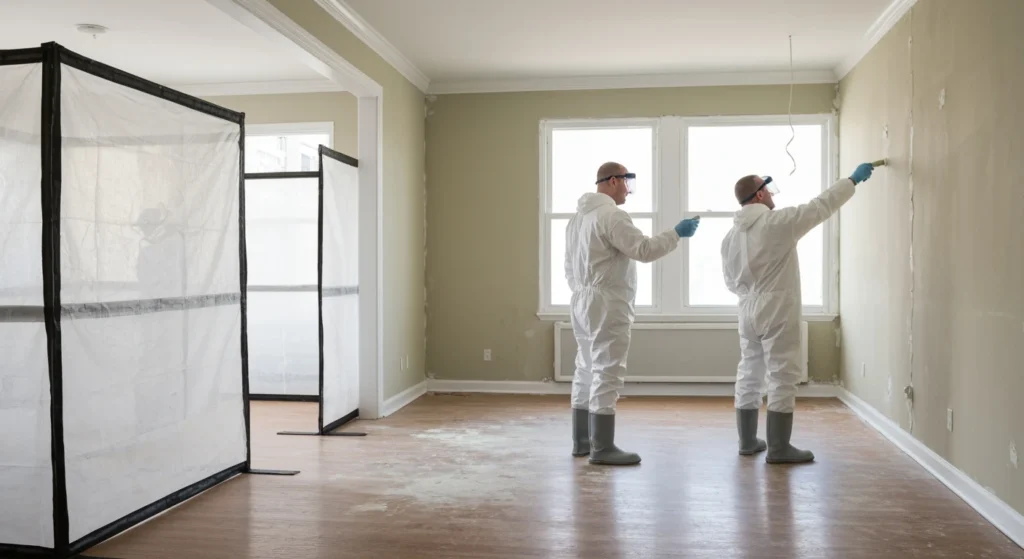
The containment level may vary: Stachybotrys and other high-toxicity producers typically warrant full containment with negative air pressure. But the fundamental process — assessment, containment, HEPA vacuuming, physical removal of contaminated materials, antimicrobial treatment, clearance testing — is the same.
What changes with confirmed Stachybotrys: insurance documentation, the remediation contractor’s PPE requirements, and the urgency of relocation for sensitive household members during remediation.
How to Test for Black Mold in Your NYC or Long Island Home
Visible dark mold warrants professional assessment — not a DIY test kit from a hardware store. Consumer mold test kits produce unreliable results and cannot identify species. A licensed NYS mold assessor will:
- Perform a visual inspection and moisture mapping to identify all affected areas
- Collect air samples using calibrated spore trap equipment analyzed by an AIHA-accredited laboratory
- Collect surface tape-lift or swab samples from suspect growth for species identification
- Produce a written report identifying species, spore concentrations, and moisture sources
- Write a remediation plan if results warrant professional intervention
Under NYS Chapter 32, the assessor who writes the remediation plan must be a different company from the contractor who performs the work — protecting you from conflicts of interest.
Upper Restoration’s licensed mold assessors serve NYC and Long Island with full assessment services including species identification. We do not perform remediation on properties we assess, ensuring full compliance with New York’s regulatory separation requirement.
Frequently Asked Questions About Black Mold
What does black mold look like on walls?
True black mold (Stachybotrys chartarum) appears as irregular greenish-black patches, slimy or wet-looking when actively growing, on drywall, ceiling tiles, and wood surfaces with sustained moisture. It tends to spread outward from the water source in irregular patterns. However, Cladosporium — a far more common black-colored mold — looks nearly identical. Only laboratory analysis can confirm species. Any dark mold on walls after water damage warrants professional assessment.
How dangerous is black mold?
The danger of black mold is overstated in popular media. The CDC, NIEHS, and AAAAI all indicate that mold exposure causes respiratory and allergic symptoms primarily in sensitive individuals — people with asthma, allergies, or compromised immune systems. The “toxic mold syndrome” narrative circulating online is not supported by current scientific consensus. That said, any mold growth above 10 square feet warrants professional remediation regardless of species.
Can I test for black mold myself?
Consumer mold test kits sold in hardware stores are unreliable and cannot identify species. Professional assessment requires calibrated air sampling equipment and AIHA-accredited laboratory analysis. In New York, professional mold assessment in commercial buildings must be performed by a licensed NYS mold assessor. The cost of professional assessment — $300–$900 — is worth it for confirmed identification before committing to remediation.
What are the symptoms of black mold exposure?
Documented symptoms include nasal and sinus congestion, eye irritation, coughing, wheezing, throat irritation, and asthma exacerbation. These symptoms are similar to general mold allergy reactions and are not specific to Stachybotrys. Higher-risk individuals include those with asthma, mold allergies, immunocompromised conditions, infants, and the elderly. If symptoms improve significantly when leaving the building and return upon reentry, mold exposure is worth investigating.
How do I get rid of black mold in my NYC apartment?
For any mold growth over 10 square feet, NYS Labor Law Chapter 32 requires a licensed mold remediator and a licensed assessor must write a remediation plan first — they must be different companies. For smaller areas, you may clean yourself using N95 respirator, gloves, and eye protection. The moisture source must be fixed first or mold returns. In NYC rentals, notify your landlord in writing — under the NYC Housing Maintenance Code, landlords are responsible for conditions causing mold growth.
Does black mold always look black?
No. Stachybotrys chartarum is greenish-black, not pure black. When dormant or dried out it can appear grey or dark brown. Conversely, several other mold species — Cladosporium, Aspergillus niger, Alternaria — are also black or dark-colored. The color alone tells you nothing definitive about species. Laboratory analysis of a physical sample is the only reliable identification method.