Water Mitigation vs. Water Damage Restoration: What’s the Difference?
These two terms are used interchangeably by homeowners but describe fundamentally different scopes of work — and the distinction matters for your insurance claim, your timeline, and who you hire.
| Phase | What It Covers | Timeline | Goal |
|---|---|---|---|
| Water Mitigation | Source control, extraction, drying, containment | Hours to days | Stop damage from spreading |
| Water Restoration | Demo, rebuild, finishing, contents restoration | Weeks to months | Return property to pre-loss condition |
Mitigation is emergency medicine. Restoration is surgery. You cannot skip to restoration without completing mitigation — wet materials that haven’t been properly dried will fail structurally and produce mold regardless of how well they’re rebuilt around.
The Water Mitigation Process: Step by Step
Step 1: Source Control (Hour 0)
Nothing else matters until the water source is stopped. Burst pipe — shut off the water supply. Roof leak — emergency tarping. Appliance failure — isolate the appliance. Sewer backup — contact your municipality. A mitigation contractor who arrives before the source is controlled will help locate and stop it as the first task. In NYC, this sometimes means coordinating with building management or Con Edison for basement flooding from main line failures.
Step 2: Water Extraction (Hours 1–6)
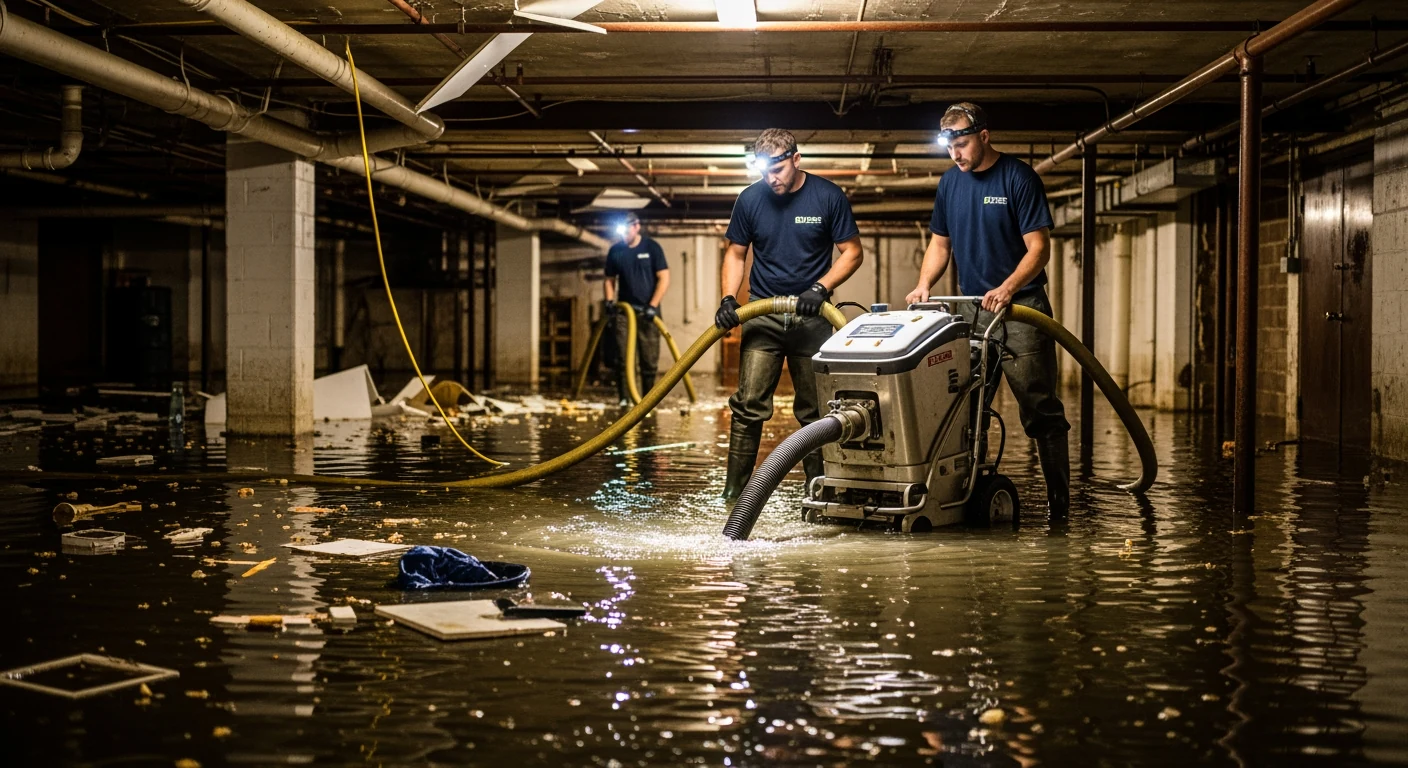
Truck-mounted and portable extraction units remove standing water from floors, carpet, and subfloor assemblies. The IICRC S500 Standard for Professional Water Damage Restoration categorizes extraction equipment by extraction rate — proper equipment matters for deep subfloor saturation common in older NYC and Long Island construction. Carpet and pad are typically removed at this stage; they cannot be dried effectively in place once heavily saturated.
Step 3: Structural Drying (Days 1–5)
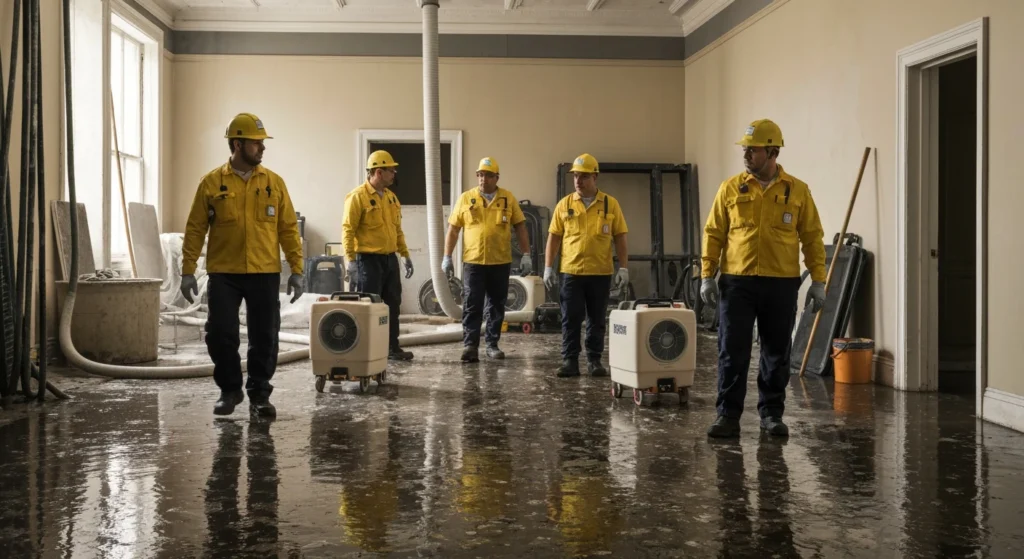
Industrial dehumidifiers and high-velocity air movers create airflow patterns that pull moisture from building materials. Certified technicians take daily moisture readings using calibrated pin and pinless meters to track drying progress against the IICRC S500 drying goals. Materials must reach acceptable moisture content levels before any reconstruction begins — typically below 16% for wood framing and below 1% for concrete slabs.
In NYC apartments and co-ops, structural drying in shared wall and floor assemblies requires coordination with adjacent units. A leak in a 10th-floor apartment can saturate walls in three units below it — mitigation contractors need access to all affected spaces to dry properly.
Step 4: Controlled Demolition (Days 1–3)
Materials that cannot be dried to acceptable levels are removed — typically drywall up to 12–24 inches above the flood line, wet insulation, saturated flooring, and compromised subfloor sections. This is called flood cutting or controlled demo. Removing wet materials exposes the structure for drying and prevents mold colonization in inaccessible cavities.
In pre-1980 NYC and Long Island buildings, flood cutting must be preceded by asbestos testing of drywall, joint compound, and floor materials. NYC Local Law 76 applies even to emergency work — the testing requirement does not have an emergency exception for demolition activities.
Step 5: Antimicrobial Treatment
After extraction and before drying equipment is set, affected surfaces are treated with EPA-registered antimicrobial solutions to suppress mold growth during the drying period. The EPA’s mold remediation guidance identifies the 24–72 hour window after water intrusion as the critical period for mold prevention. Antimicrobial treatment during mitigation is a standard step under IICRC protocols — contractors who skip it are cutting corners.
Step 6: Documentation and Monitoring
Daily moisture logs documenting meter readings, equipment placement, and drying progress form the technical record your insurance adjuster needs. Photos of each stage — pre-mitigation, extraction, flood cut, drying equipment, daily readings — protect your claim. Insurance carriers increasingly require IICRC-compliant documentation for water mitigation claims; gaps in the record create leverage for claim reduction.
Water Mitigation Cost in NYC and Long Island
| Scope | NYC / LI Cost Range | Primary Driver |
|---|---|---|
| Single room (minor water event) | $1,500–$4,000 | Extraction + 3–5 day dry |
| Multi-room residential | $4,000–$12,000 | Equipment count, drying days |
| Full floor (apartment) | $8,000–$25,000 | Adjacent unit access, asbestos testing |
| Basement flooding | $3,000–$15,000 | Standing water volume, contents |
| Sewer backup | $5,000–$20,000 | Category 3 water, PPE, disposal |
Water is categorized by contamination level under IICRC S500: Category 1 (clean supply water), Category 2 (gray water from appliances or overflow), and Category 3 (black water from sewage, flooding, or standing water over 72 hours). Category 3 requires full PPE, more aggressive treatment protocols, and typically disposal of all porous materials that contacted the water — costs are substantially higher.
Insurance and Water Mitigation in New York
Most standard homeowners policies cover sudden and accidental water damage — burst pipes, appliance failures, storm-driven water intrusion through a compromised envelope. Flood damage requires a separate NFIP flood insurance policy through FEMA; standard homeowners policies explicitly exclude flood.
Critical steps to protect your claim:
- Report to your insurer before mitigation begins — most policies require prompt notice
- Document the source and extent before any extraction begins
- Request your insurer’s preferred vendor list — using a non-preferred vendor doesn’t void coverage but can complicate reimbursement
- Keep all mitigation invoices, equipment logs, and moisture reading documentation
Under New York State DFS regulations, your insurer must acknowledge your claim within 15 business days and either approve or deny within 15 business days of receiving proof of loss. Delays beyond these windows should be escalated.
Upper Restoration provides 24/7 emergency water mitigation response across NYC and Long Island. Our IICRC-certified technicians arrive within 2–4 hours of your call, document everything for your insurance claim, and carry all required New York State licenses for work in pre-1987 buildings.
Frequently Asked Questions About Water Mitigation
What is the difference between water mitigation and water damage restoration?
Water mitigation is the emergency phase — stopping the source, extracting water, and drying the structure. It must begin within 24–48 hours to prevent mold. Water damage restoration is the rebuild phase — demotion, reconstruction, finishing, and contents restoration. You cannot begin restoration until mitigation is complete and all materials have reached acceptable moisture levels.
How long does water mitigation take?
Extraction takes hours. Structural drying typically takes 3–5 days for standard water events and up to 7–10 days for heavily saturated assemblies or slab-on-grade construction. The IICRC S500 standard defines drying goals that must be met before equipment is removed — rushing the drying phase to save equipment rental cost is the leading cause of mold problems after water damage.
How much does water mitigation cost in NYC?
Water mitigation in NYC ranges from $1,500 for a minor single-room event to $25,000 or more for multi-floor or sewer backup scenarios. The most common residential scope — one to two rooms from a burst pipe — runs $3,000–$8,000. Category 3 water events involving sewage contamination cost substantially more due to PPE requirements, antimicrobial treatment, and full material disposal protocols.
Does homeowners insurance cover water mitigation?
Standard homeowners insurance covers water mitigation for sudden and accidental water damage — burst pipes, appliance failures, storm intrusion. Flood damage requires a separate NFIP policy. Gradual leaks or maintenance-related failures are typically excluded. Report to your insurer before mitigation begins, document everything, and keep all equipment logs and moisture readings for the adjuster.
What is Category 3 water damage?
Category 3 water is grossly contaminated water — sewage backup, rising floodwater, or water that has been standing for more than 72 hours and has become biologically hazardous. Category 3 events require full PPE for technicians, more aggressive antimicrobial protocols, and disposal of all porous materials that contacted the water. Drywall, insulation, carpet, and wood flooring that contact Category 3 water cannot be dried and reused — they must be removed and replaced.