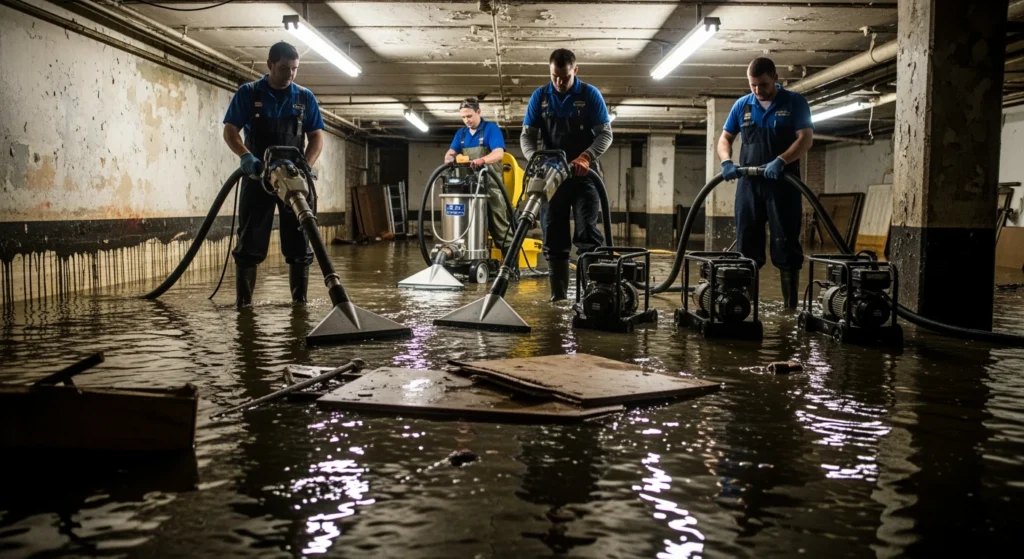
Water damage restoration in the Town of Hempstead operates in a context unlike any other township on Long Island. Hempstead is the largest township in New York State by population, home to more than 760,000 residents across its south shore barrier beach communities, interior suburban neighborhoods, and Five Towns corridor. Within its boundaries sit some of the most flood-vulnerable residential communities in the northeastern United States: Long Beach, Island Park, Freeport, Oceanside, Merrick, Bellmore, Wantagh, and the Five Towns. When Hurricane Sandy made landfall in October 2012, the Town of Hempstead’s south shore absorbed more structural damage than any other township in Nassau or Suffolk County — 74,736 structures flooded, damaged, or destroyed in Nassau County alone, with the overwhelming majority concentrated in Hempstead’s south shore communities.
This data file covers water damage restoration specific to the Town of Hempstead — its building stock profile, environmental risk conditions, the Sandy legacy that still shapes restoration decisions today, the town’s regulatory requirements, cost benchmarks, and the seasonal risk calendar. For the county-level framework governing all Long Island water damage restoration, see the Long Island Water Damage Restoration Master Guide.
Building Stock Profile: Hempstead’s Post-War Cape Cod Concentration
The Town of Hempstead contains one of the most extraordinary concentrations of post-war Cape Cod housing in the United States. Between 1947 and 1951, William Levitt built more than 17,000 homes in what became Levittown — the prototype American suburb — within the town’s borders. These original Levitt Cape Cods, selling for $7,990 with $90 closing costs in 1947, set the template for the Cape Cod explosion that filled central and south Nassau throughout the 1950s. By 1960, the Town of Hempstead was one of the most densely populated townships in America, its landscape defined by quarter-acre lots, compact Cape Cods and ranches, and a building stock that is now 65 to 80 years old.
For water damage restoration, this building stock profile translates into specific, predictable risk patterns:
- Pre-1978 construction is universal in south Hempstead communities: Lead paint is presumed present on all painted surfaces in Levittown, East Meadow, Uniondale, Franklin Square, Elmont, and the south shore communities from Long Beach to Wantagh. Any water damage repair requiring drywall removal or surface disruption triggers EPA RRP lead-safe work practice requirements.
- Pre-1960 pipe systems in original Cape Cods: Galvanized steel supply piping installed in Levittown-era Cape Cods has a standard service life of 40 to 70 years — meaning the oldest original piping in Hempstead’s 1947-1951 housing stock has been past replacement threshold for decades. Galvanized pipe failure is an active and recurring source of water damage claims across central and south Nassau.
- Basement sump pump dependency across south Hempstead: The water table in south Hempstead communities sits at 4 to 8 feet below grade in many neighborhoods — sump pumps are not optional in these homes, they are structural life support. Power outages during storm events (Sandy left 945,000 Long Island customers without power) are the leading cause of basement flooding across south Hempstead’s flood-zone communities.
Environmental Risk: The South Shore Flood Plain and the Sandy Legacy
The Town of Hempstead Building Department’s own data defines the scope of the town’s flood exposure: 65,000 homes in the FEMA-designated flood plain. This is not a subset of south shore communities — it is the baseline condition across a substantial portion of the entire township. Long Beach, which sits entirely on a barrier island, has virtually its entire housing stock in Zone AE, the FEMA high-risk designation requiring federally backed mortgage holders to carry flood insurance. Island Park, to Long Beach’s west, experienced 99 percent inundation during Sandy. Freeport’s Reynolds Channel-adjacent neighborhoods saw surge reaching waist height on major streets.
The Sandy legacy in Hempstead is still unresolved in important ways. Six years after the storm, the Town of Hempstead sent letters to 13,000 homeowners informing them their properties may have sustained damage — the first formal notification of what the building department had quietly recorded immediately after the storm. Fewer than 4,500 of those homes had filed Sandy repair permits, leaving thousands of properties with undocumented damage histories. The practical implication for restoration contractors: homes in Hempstead’s south shore flood zone that appear fully repaired may have building department records flagging them as yellow (damaged) or red (severely damaged) from Sandy, and any new permit application — for restoration work, renovation, or addition — can trigger a substantial damage determination requiring full FEMA-compliant elevation before a certificate of occupancy is issued.
South Shore vs. Interior: Two Different Risk Profiles
The Town of Hempstead’s water damage risk divides sharply between its south shore and interior communities:
South Shore (Long Beach, Island Park, Freeport, Oceanside, Baldwin, Merrick, Bellmore, Wantagh, Seaford): Storm surge, tidal flooding, and bay water intrusion define the water damage pattern here. Great South Bay, Reynolds Channel, and Jones Inlet are the primary flood pathways. These are Category 3 water losses — bay water contaminated with sewage discharge — that require the full IICRC S500 Category 3 protocol whenever storm surge enters a structure. A recent January 2024 nor’easter produced waist-high saltwater flooding in Freeport streets and flooded basements across the south shore corridor, consistent with the recurring pattern that characterizes this zone.
Interior (Levittown, East Meadow, Uniondale, Franklin Square, Elmont, Hempstead Village, Garden City): The interior communities are not in FEMA Zone AE but carry their own water damage risk driven by aging infrastructure, original plumbing, and the high water table that characterizes Nassau’s outwash plain. Levittown’s sewer laterals — original 1940s and 1950s vitrified clay pipe — are among the oldest residential sewer infrastructure in active use in the United States. Sewer backup events during heavy rain are a documented, recurring pattern in Levittown and adjacent communities throughout the interior township.
Regulatory Requirements: Town of Hempstead Building Department
The Town of Hempstead Building Department requires permits for all structural water damage restoration work. Key regulatory specifics for Hempstead restoration projects:
Substantial Damage Determination: The Town of Hempstead maintains preliminary damage assessments from Sandy for all properties in the flood plain that were inspected after the storm. Any permit application filed for a property with a red or yellow Sandy PDA on file will trigger a substantial damage review. If the cumulative cost of repairs (including the current project) exceeds 50 percent of the pre-Sandy market value, the town requires full FEMA-compliant flood zone construction — including foundation elevation to Base Flood Elevation plus two feet of freeboard, which is the town’s design flood elevation standard. The DFE in Hempstead is BFE plus two feet — more conservative than many other townships.
Building Department Contact: Town of Hempstead Building Department, 350 Front Street, Hempstead, NY 11550. Phone: (516) 489-5000. The Building Department has Certified Floodplain Managers on staff specifically to handle flood zone permit inquiries and substantial damage determinations.
Permit requirements for restoration work: Structural repairs (framing, sheathing, load-bearing elements) require permits. Electrical work performed during restoration requires permit and licensed electrician. Cosmetic work (drywall, painting, flooring replacement) may be performed without permit but should be confirmed with the Building Department if the property has a Sandy PDA on file.
Insurance Landscape in the Town of Hempstead
The Town of Hempstead’s flood insurance context is shaped by its concentrated Zone AE and Zone VE population. Long Beach participates in FEMA’s Community Rating System (CRS), which provides discounts on NFIP premiums for policyholders in the city — one of only a handful of Long Island communities enrolled in CRS. For the broader Town of Hempstead south shore, NFIP Risk Rating 2.0, implemented in 2021, has significantly increased flood insurance premiums for many south shore properties as individual property risk replaced flood zone map-based pricing. Homeowners in Island Park, Freeport, and Oceanside who had flat or declining premiums under the old system are now seeing premiums that more accurately reflect their storm surge exposure.
The standard homeowners policy coverage boundary is particularly contested in Hempstead’s south shore communities: the recurring nor’easter flooding pattern means that water entering a south shore home during a storm event may involve both wind-driven rain intrusion (potentially covered under the homeowners policy) and storm surge or tidal flooding (covered only under flood insurance). Upper Restoration documents both damage pathways separately on every south shore Hempstead project to support maximum claim recovery.
Cost Benchmarks: Water Damage Restoration in Hempstead
- Sump pump failure, finished basement (south shore Cape Cod, 400-600 sq ft): $8,500-$18,000 for extraction, Category 1 or Category 3 assessment, demolition of wet materials, drying, and antimicrobial treatment. Category classification depends on whether the water source is internal (sump failure with groundwater) or storm surge (Category 3 regardless).
- Storm surge flooding (Long Beach, Island Park, Freeport zone): $20,000-$48,000+ for typical residential Category 3 scope. Higher end applies when the Sandy PDA triggers substantial damage review and FEMA-compliant reconstruction is required.
- Pipe failure, interior Cape Cod (Levittown, East Meadow zone): $6,500-$16,000 for a typical galvanized pipe failure affecting one to two rooms, including lead-safe demolition protocol in pre-1978 construction.
- FEMA elevation add-on (substantially damaged structures): $45,000-$120,000 for foundation elevation to DFE (BFE + 2 feet) when substantial damage determination triggers full compliance reconstruction. This is an additional scope layered on top of standard restoration costs.
Seasonal Risk Calendar: Town of Hempstead
October-April (Storm Season): The most active water damage period for Hempstead’s south shore. Nor’easters in October-April drive the recurring south shore flooding pattern, with high tide coincidence producing the most damaging events. Sump pump demand peaks through this window — pump service and battery backup verification before November is the single most effective prevention measure for south shore Hempstead homeowners.
November-February (Pipe Failure Season): Levittown and interior Hempstead’s aging galvanized plumbing fails disproportionately during extended cold snaps when pipes in uninsulated exterior wall cavities and garage runs freeze. Cape Cods with original 1-inch galvanized supply runs to kitchen or bathroom additions added in the 1960s are the primary risk population.
June-September (Humidity and Hurricane Season): South shore Hempstead’s summer water damage risk combines hurricane season exposure (direct Atlantic and Reynolds Channel surge) with the interior basement mold initiation window driven by Long Island’s 70%+ summer relative humidity. Water damage events that occurred during the spring and were improperly dried are discovered as mold in July and August.
Frequently Asked Questions: Water Damage in the Town of Hempstead
My home in Freeport or Oceanside was flooded. Do I need to worry about the Sandy PDA?
Yes, if your home is in the Town of Hempstead south shore flood plain and was built before 2012. The town has preliminary damage assessments on file for properties inspected after Sandy. When you file any permit application — including for new restoration work — the Building Department will cross-reference your address against the PDA database. If your property was flagged yellow or red, the town will assess cumulative repair costs against your pre-Sandy market value. If total repairs exceed 50 percent of market value, you face a substantial damage determination requiring FEMA-compliant elevation. Upper Restoration can help you navigate this process before beginning any work.
Is water that entered my basement from Great South Bay or Reynolds Channel during a storm covered by my homeowners policy?
No. Water entering from external bay flooding is a flood peril excluded from standard homeowners policies. This type of damage requires flood insurance — either through NFIP or a private carrier. Your homeowners policy may cover concurrent wind-driven rain damage if those two damage streams can be documented separately. Upper Restoration separates storm surge and wind-driven rain documentation on every south shore loss to maximize claim recovery across both coverage pathways.
How long does water damage restoration take in Long Beach or Island Park?
A non-surge basement flood or pipe failure in Long Beach or Island Park typically requires 5-10 days for mitigation and drying, followed by 2-6 weeks for reconstruction depending on scope. Category 3 storm surge losses run 8-14 days for mitigation and up to 8-12 weeks for full reconstruction, extended further when substantial damage determinations require FEMA-compliant elevations. Upper Restoration coordinates directly with the Town of Hempstead Building Department and FEMA flood plain managers to keep reconstruction timelines on track.