Water Damage Restoration in Suffolk County, NY: A Homeowner’s Complete Guide for 2026
Suffolk County is Long Island east of Nassau — 912 square miles of territory that spans from the dense suburban belt of Babylon, Islip, and Huntington through the mid-island sprawl of Brentwood, Central Islip, and Hauppauge, and out to the East End’s Hamptons, North Fork wine country, and Montauk. With 1.54 million residents and 568,657 housing units built to a median construction year of 1970, Suffolk County presents a water damage restoration environment more geographically varied than Nassau but no less challenging. The South Shore townships face the same coastal flood exposure. The East End faces septic system limitations and aging construction on high-value oceanfront properties. The inland areas deal with aging infrastructure, a high water table in low-lying communities, and an oil-heat-dominated housing stock prone to furnace puffback.
This guide covers what every Suffolk County homeowner needs to know about water damage restoration — township flood risk, housing stock characteristics, insurance requirements, and 2026 cost benchmarks.
Suffolk County’s Water Damage Risk Landscape
Suffolk County’s size — it is the largest county in New York State by land area — means its restoration risk profile varies significantly from west to east and north to south. No single description covers the county. What ties it together is an aging housing stock, a coastal position that guarantees periodic major storm events, and a New York State regulatory environment that applies uniformly across all townships.
South Shore Flood Exposure: Babylon, Islip, and Brookhaven
The Great South Bay communities — Amityville, Copiague, and Lindenhurst in the Town of Babylon; Bay Shore, Islip, East Islip, West Islip, and Oakdale in the Town of Islip; Patchogue, Bellport, and Blue Point in the Town of Brookhaven — share Nassau County’s South Shore exposure, sitting on low-lying terrain adjacent to Great South Bay with FEMA Zone AE flood designations across the residential core. Fire Island, a barrier island protecting much of this coastline, provides some buffering, but storm surge from major events still pushes bay water inland.
During Hurricane Sandy, Suffolk County recorded 20,798 damaged or destroyed structures, with the heaviest damage concentrated in the South Shore townships. In Mastic Beach and Shirley (Town of Brookhaven), coastal damage was among the most severe in the county. These communities contain significant concentrations of NFIP repetitive loss properties — homes that have flooded multiple times and where unresolved moisture issues from prior events are a documented restoration challenge.
The water table in South Shore Suffolk communities mirrors Nassau’s South Shore condition: shallow, sensitive to tidal and storm influences, and capable of pushing groundwater through basement slabs during sustained wet periods even without active flooding. Sump pump failure during a power outage — common during nor’easters and coastal storms — is one of the most frequent causes of basement flooding across the South Shore belt.
North Shore: Huntington, Smithtown, and Brookhaven North
Suffolk County’s North Shore communities — Cold Spring Harbor, Lloyd Harbor, Centerport, Northport, Kings Park, and the Setaukets in Smithtown and Brookhaven — face different conditions. Coastal humidity from Long Island Sound drives chronic moisture problems in basements and crawlspaces. Many North Shore homes have crawlspaces rather than basements, and crawlspace mold is an endemic condition in properties that lack proper vapor barriers and ventilation. Wooded terrain produces roof and gutter debris accumulation that causes water intrusion at the roofline, a common cause of attic water damage that often goes undetected until structural staining appears on upper-floor ceilings.
The North Shore also contains some of Suffolk County’s oldest housing. Cold Spring Harbor, Lloyd Harbor, and Old Field include historic homes from the 18th and 19th centuries alongside 20th-century construction. These older structures can contain asbestos in materials not commonly found in post-war suburban homes — plaster lath coatings, original insulation, slate roofing with asbestos underlayment — and require more extensive pre-demolition survey work before any water damage demolition scope can proceed.
East End: Southampton, East Hampton, Riverhead, and Beyond
The East End presents Suffolk County’s highest-value water damage restoration market. Southampton and East Hampton Townships contain some of the most expensive residential real estate in the United States — median home values in Sagaponack, Bridgehampton, and East Hampton Village regularly rank among the top five nationally. A water damage event in a Hamptons property is a high-stakes restoration project in every dimension: the home’s value means insurance payouts can be substantial, the finish quality demands skilled tradespeople and premium materials, and proximity to the Atlantic creates a coastal humidity environment where drying timelines are extended and mold establishment is rapid.
The East End’s septic system dependency adds a restoration dimension absent in the sewer-connected western townships: Category 3 contamination events from failing cesspools and septic systems are more frequent here than in Nassau County’s largely sewered communities. Sewage backup restoration in a Hamptons property involves the same Category 3 decontamination protocols as any other black water event, plus navigation of Suffolk County Department of Health oversight for septic system repair or replacement.
Riverhead and the North Fork — Mattituck, Cutchogue, Southold, and the North Fork wine country — have an older housing stock in agricultural settings. Many homes here have crawlspaces, well water, and older electrical systems. Water intrusion events frequently involve well pump failures, agricultural runoff infiltrating basements, and HVAC systems that have been poorly maintained in seasonal-use properties that sit vacant for months at a time.
Central Suffolk: Brentwood, Central Islip, Hauppauge, and the Route 110 Corridor
Central Suffolk County’s densest population centers — Brentwood, Central Islip, Bay Shore, Deer Park, Wyandanch, and the communities along Route 347 — have Suffolk County’s highest concentration of pre-1980 housing outside the South Shore waterfront belt. These communities have median construction years in the 1960s and experienced significant deferred maintenance in aging housing stock. Plumbing failures — galvanized steel supply lines, deteriorated cast iron drain stacks, failing water heaters — are the leading cause of water damage events in this zone. Asbestos survey requirements apply broadly across this construction vintage.
Suffolk County’s Housing Stock and Restoration Implications
Suffolk County’s 568,657 housing units were built to a median construction year of 1970, with 80 percent being detached single-family homes and a homeownership rate of 82.2 percent — both above national averages. The 1970 median construction year is later than Nassau’s 1955, reflecting Suffolk’s second-wave suburban development that extended through the 1970s and 1980s as commuters pushed farther east. This means a higher proportion of Suffolk homes were built with early-generation aluminum wiring (a 1960s–1970s fire risk), and a lower but still substantial proportion contain asbestos-containing materials from the pre-1980 construction era.
Suffolk County’s median home value reached $578,400 in 2024, up 7.2 percent from the prior year. At these values, proper restoration matters. The Suffolk County restoration market spans a wide range — from modest ranch homes in central Suffolk where restoration costs may approach the structure’s insurable value, to oceanfront properties in the Hamptons where a single water damage event can require hundreds of thousands of dollars in high-end reconstruction.
Most Common Restoration Services in Suffolk County
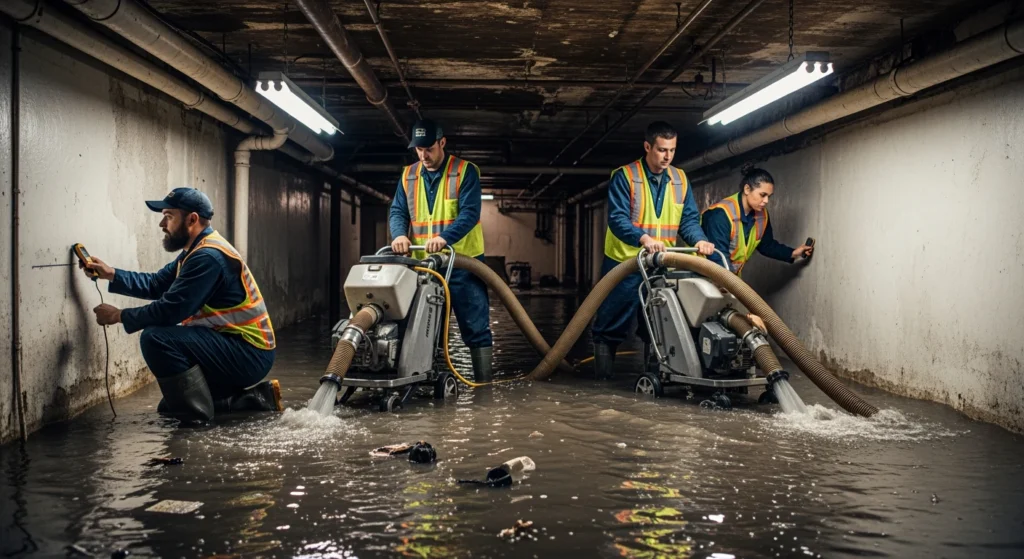
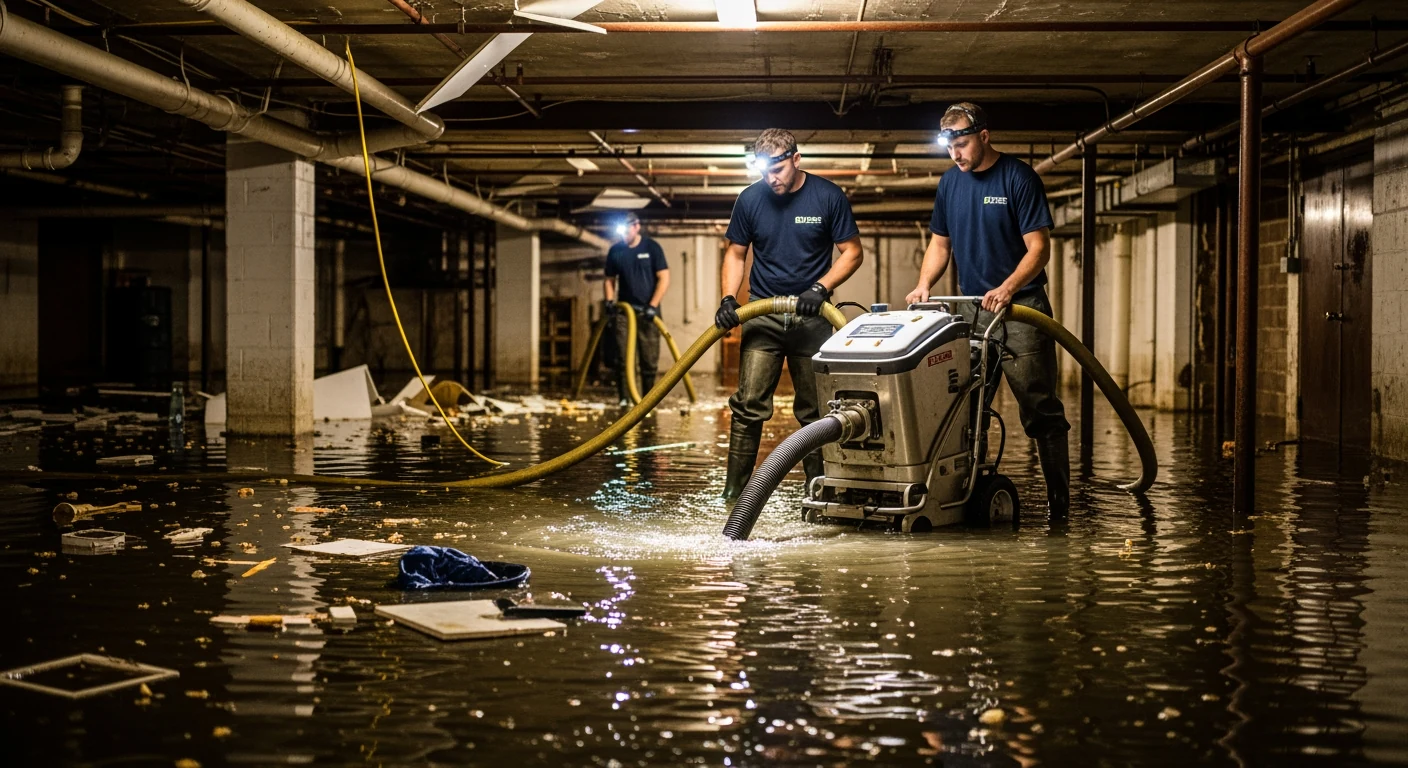
Emergency water extraction from pipe failures, appliance failures, and roof leaks is the most frequent residential restoration service across all Suffolk townships. The 24-to-48-hour mold development window applies here as in Nassau — coastal humidity throughout Suffolk’s summer season means rapid mold establishment in any inadequately dried space.
Basement and crawlspace flooding is the second most frequent category. South Shore sump pump failures during storms, crawlspace moisture in North Shore wooded properties, and high water table infiltration in low-lying central communities all generate basement and crawlspace restoration work year-round. Crawlspace restoration often includes vapor barrier installation as a permanent mitigation measure — a service not required in Nassau’s predominantly full-basement housing stock.
Flood damage restoration following major storm events follows the Category 3 protocols for all exterior floodwater intrusion, requiring complete porous material removal, decontamination, and structural drying before reconstruction. Suffolk County’s South Shore flood zone communities are exposed to the same storm surge risk that produced Sandy’s documented destruction.
Mold remediation under NYS Article 32 applies across all of Suffolk County. The separate assessor/remediator requirement, the mandatory Mold Remediation Plan, and the post-remediation clearance testing requirement are statewide law. Mold is particularly active in Suffolk County’s crawlspace-prevalent North Shore and East End communities, where incomplete vapor control creates year-round conditions for fungal growth.
Furnace puffback cleanup is a significant service category in western Suffolk County’s oil-heat-dominated housing stock. Brentwood, Central Islip, Bay Shore, and the suburban belt through Islip and Babylon have high concentrations of oil-fired heating systems in pre-1985 homes. Puffback events distribute petroleum-based soot throughout entire homes via ductwork and require specialized cleaning chemistry and whole-house scope — typically $15,000–$25,000 in Suffolk County.
Suffolk County Restoration Costs: 2026 Benchmarks
Suffolk County restoration costs sit somewhat below Nassau County’s due to the lower average labor costs in eastern Suffolk markets, but above national averages throughout the county because of New York State licensing requirements, Long Island disposal costs for hazardous materials, and coastal humidity conditions that extend drying timelines.
Emergency water extraction and structural drying: $2,000–$7,500 for contained Category 1 losses. Basement flooding with Category 2 or 3 contamination: $4,000–$14,000.
Mold remediation: $800–$2,000 for small projects; $2,500–$7,500 for medium scope; $7,000–$22,000 for large attic, basement, or crawlspace remediations. NYS Article 32 assessment and clearance testing add $650–$1,500 total to every licensed project.
Crawlspace restoration and vapor barrier installation: $2,000–$8,000 depending on crawlspace size, extent of mold, and whether partial or full encapsulation is performed.
Full flood restoration in South Shore Suffolk communities: $25,000–$60,000 for a typical first-floor loss in a pre-1980 ranch or Cape Cod. East End high-value properties can run $100,000–$300,000+ for significant losses given finish quality and reconstruction costs in Hamptons-area markets.
Furnace puffback cleanup: $15,000–$25,000 for whole-house petroleum-soot remediation in a typical Suffolk County 1,500–2,500 square foot single-family home.
Insurance Claims for Water Damage in Suffolk County
Standard homeowners insurance covers sudden and accidental water damage in Suffolk County as in the rest of New York State. Exterior flooding from storms, bay overflow, or storm surge requires NFIP or private flood insurance — separate from the homeowners policy. South Shore Suffolk County homeowners in FEMA Special Flood Hazard Areas with federally backed mortgages are required to carry flood insurance.
Suffolk County’s East End communities present a distinctive insurance challenge: many high-value Hamptons properties are seasonal-use second homes, and some homeowners policies exclude or limit water damage coverage during vacancy periods. Pipes that freeze and burst in an unoccupied winter property may not be covered under a policy that was written assuming year-round occupancy but has a vacancy exclusion triggered after 30 or 60 days. Review your policy’s vacancy provisions carefully before assuming coverage.
NYS Department of Financial Services regulations apply across all of Suffolk County: 15-day claim acknowledgment requirement, binding appraisal clause for loss disputes, and public adjuster fee cap of 12.5 percent of recovery. For major East End losses where restoration costs can reach into six figures, the decision of whether to engage a licensed public adjuster deserves careful consideration at the time of loss rather than after a low initial estimate has been issued.
Frequently Asked Questions: Water Damage Restoration in Suffolk County
What townships in Suffolk County have the highest flood risk?
The highest flood risk townships are Babylon (Amityville, Copiague, Lindenhurst, West Babylon), Islip (Bay Shore, East Islip, West Islip, Oakdale), and southern Brookhaven (Patchogue, Bellport, Mastic Beach, Shirley). These South Shore communities have FEMA Zone AE designations throughout their residential cores. Southampton and East Hampton townships have high VE zone concentrations along the Atlantic beachfront.
Does Suffolk County have mold licensing requirements?
Yes — NYS Article 32 of the Labor Law applies statewide, including all of Suffolk County. Any mold project of 10 square feet or more requires a licensed NYS Mold Assessor to write a Mold Remediation Plan and a separate licensed Mold Remediator to perform the work. The same contractor cannot assess and remediate the same project. Post-remediation clearance testing by the original assessor is required before the project is legally complete.
How much does flood restoration cost in Suffolk County?
Flood restoration in South Shore Suffolk County communities typically costs $25,000–$60,000 for a first-floor loss in a pre-1980 home including extraction, Category 3 decontamination, structural drying, and reconstruction. East End high-value properties can run $100,000–$300,000 or more for significant losses. NFIP flood insurance covers up to $250,000 in building damage; private excess flood coverage is available for higher-value properties.
What is a crawlspace vapor barrier and do Suffolk County homes need one?
A vapor barrier is a polyethylene membrane installed across the crawlspace floor (and sometimes walls) to prevent ground moisture from evaporating into the crawlspace and migrating into the home’s structure. Many North Shore and East End Suffolk County homes have crawlspaces rather than basements, and inadequate vapor control is one of the leading causes of mold in these spaces. If a crawlspace remediation is performed, installing an appropriate vapor barrier (often 6-mil poly minimum, or full encapsulation for chronic moisture) is typically recommended to prevent recurrence.
Are Hamptons seasonal homes covered for water damage during the off-season?
It depends on your policy’s vacancy provisions. Many homeowners policies include a vacancy clause that limits or excludes coverage for water damage occurring after the property has been unoccupied for 30 or 60 consecutive days. East End seasonal-use properties are at particular risk for winter pipe freeze-and-burst events during unoccupied periods. Review your policy’s vacancy and seasonal-use provisions before the winter season and consult your agent about appropriate endorsements.
How long does water damage restoration take in Suffolk County?
Contained losses (burst pipe, limited flooding) typically take two to four weeks from initial extraction through reconstruction completion. Flood losses with full first-floor decontamination and reconstruction take six to twelve weeks. Major losses with asbestos abatement, structural repairs, or extensive reconstruction can take three to six months. East End projects in high-finish properties typically run longer due to trade availability and material lead times for premium finishes.