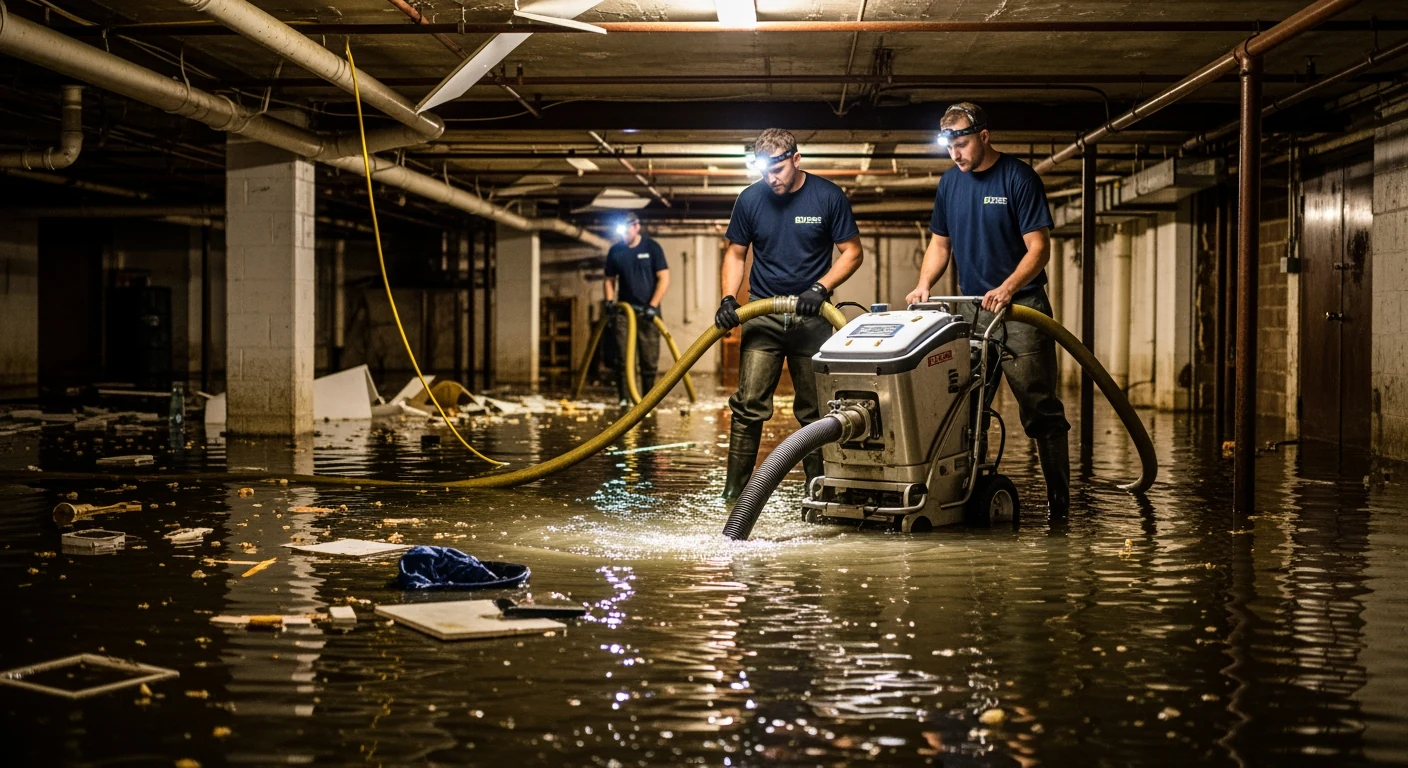
Identify the Source of the Water Damage
Water damage on Long Island typically originates from plumbing failures, appliance leaks, roof or flashing gaps, foundation and groundwater seepage, sewer backups, storm or coastal flooding, HVAC condensate lines, or overflow events. The source determines contamination level, safety precautions, and which insurance category (if any) may apply, so identifying it correctly is the first real diagnostic step.
A burst supply line behind a washing machine is a different animal than three inches of water in a basement after a nor’easter. The first is usually “clean water” from a potable source. The second may carry groundwater, sewage backflow, or road runoff, and needs to be treated as contaminated until proven otherwise. That distinction changes everything downstream, including whether you wear gloves and a mask, whether you can salvage carpet, and whether you’re calling your homeowners carrier or looking at a separate flood policy.
| Source | Typical Water Category | Likely Coverage Path |
|---|---|---|
| Burst supply line / appliance leak | Clean water | Homeowners policy (sudden, accidental) |
| Roof or flashing leak | Clean to gray | Homeowners policy, may involve maintenance exclusions |
| Sewer or septic backup | Black water | Often requires separate sewer backup rider |
| Groundwater / foundation seepage | Gray to black | Frequently excluded; check policy language |
| Storm surge / coastal flooding | Black water | Requires separate flood insurance (NFIP or private) |
| HVAC condensate overflow | Clean water | Homeowners policy, subject to maintenance clauses |
Treat this table as an orientation tool, not a coverage guarantee. Your specific policy language, endorsements, and adjuster’s determination govern the outcome, and we’ll get into why that gap matters in the insurance section below.
Safety First: Before You Touch Anything
Before starting any cleanup, shut off electricity to affected areas if water is near outlets or panels, turn off the water supply at the source if a pipe or appliance failed, and avoid walking through standing water that may be electrically charged or structurally unstable. Treat all floodwater as potentially contaminated.
Long Island’s building stock includes a lot of finished basements with outlets low on the wall, which puts water and electricity into direct contact more often than in homes with unfinished lower levels. If you can reach your electrical panel without stepping into water, shut off power to the affected circuits. If you can’t reach it safely, don’t attempt it, and don’t enter the space. Call an electrician or your utility provider instead.
The New York State Department of Health’s Disaster Recovery Information guidance recommends removing standing water and saturated porous materials, ventilating aggressively, running dehumidifiers, and using basic protective equipment (gloves, N95 respirator) for limited cleanup tasks. Water that has contacted sewage, groundwater, or floodwater from outside the home should be assumed to carry bacteria and other contaminants until you know otherwise. That assumption should govern what you touch, what you wear, and what you decide to salvage versus discard, a topic covered in more detail in the mold section further down.
Document the Loss Before You Start Cleanup
Photograph and video all affected areas and damaged items before moving or discarding anything, keep a written log of the timeline and any actions taken, save receipts for emergency repairs, and notify your insurer promptly. Documentation supports any future claim and should happen before permanent repairs begin, not after.
It’s tempting to start ripping up wet carpet the moment you see it, especially with the 24 to 48 hour drying clock already running. Take ten minutes first. A phone camera capturing water lines on drywall, the condition of flooring, and the source of the intrusion creates a record that’s much harder to reconstruct later. Adjusters work from evidence, not memory.
Documentation checklist: Photograph and video every affected room and item before cleanup. Keep damaged materials until your insurer or adjuster has reviewed them, if safely possible. Log the date, time, and suspected cause. Save all receipts for emergency mitigation work. Contact your insurance company as soon as you’re safe to do so.
Avoid making permanent repairs before your insurer has had a chance to inspect, if that’s feasible given safety and mold-timing constraints. There’s a real tension here: waiting too long to dry things out invites mold, but repairing too fast can complicate a claim. Emergency mitigation, extraction, drying, and temporary tarping are generally acceptable to start immediately; permanent reconstruction is where you want documentation locked in first.
Understanding Your Insurance: Homeowners vs. Flood Coverage
Standard homeowners insurance policies generally exclude flood damage, according to the Federal Emergency Management Agency. Flooding typically requires a separate flood insurance policy, often through the National Flood Insurance Program or a private carrier, with its own limits, deductibles, and exclusions. Sewer backup usually needs its own endorsement as well.
This is the single most misunderstood piece of the whole picture, and it’s worth being direct about it: a homeowner with a fully paid-up homeowners policy can still be financially exposed to flood damage with zero coverage, simply because flood is treated as a separate peril under nearly every standard policy in the country. FEMA’s National Flood Insurance Program materials are explicit that flood coverage is not automatic and must be purchased separately.
FEMA flood maps are a useful planning tool for understanding relative risk, but FEMA itself frames them as guidance, not a guarantee. A property outside a mapped high-risk zone can still flood from heavy rainfall, overwhelmed storm drains, groundwater intrusion, or a localized coastal surge that doesn’t match historical mapping. The Federal Reserve Bank of New York’s report, “Flood Risk and the Tristate Housing Market,” found that more than 1 million properties across New York, New Jersey, and Connecticut, over 1 in 10 in the region, face serious flood risk, and the report specifically defines Long Island as Nassau and Suffolk counties. That’s not a reason for alarm; it’s a reason to actually read your policy before storm season rather than during it.
None of this is a substitute for reviewing your actual policy documents or speaking with your agent or adjuster. Coverage determinations depend on your specific policy language, the cause of loss, and your carrier’s claims process. Treat this section as orientation, not a coverage promise.
The 24-48 Hour Drying Window (and Why It Matters)
The U.S. Environmental Protection Agency’s Homeowner’s and Renter’s Guide to Mold Cleanup After Disasters sets 24 to 48 hours as the target window to fully dry wet materials and prevent mold growth. Extraction, dehumidification, and forced air movement are needed; household fans alone generally aren’t sufficient for saturated materials.
The 24-48 Hour Rule: The EPA identifies 24 to 48 hours as the practical window to dry wet building materials before mold growth becomes likely. This is the single most important number in this entire guide, worth writing on a sticky note near your water shutoff valve.
Box fans move air across a surface. They don’t pull moisture out of saturated drywall, insulation, or subflooring, and they don’t reduce ambient humidity in a room that’s already saturated with water vapor. Professional drying uses truck-mounted or portable extraction to remove standing and absorbed water, commercial dehumidifiers to pull humidity out of the air, and air movers positioned to create controlled airflow across wet surfaces, not just around the room.
Wet wiring, receptacles, or fixtures should not be handled by anyone without electrical training. If water has reached electrical components, that’s a job for a licensed electrician, not a DIY drying project, regardless of how the clock is ticking on the 48-hour window.
If you’re inside the drying window right now and unsure whether household equipment is enough, Upper Restoration provides 24/7 emergency response with EPA-aligned drying protocols and IICRC-trained technicians across Long Island and the wider tri-state area.
Mold: A Moisture Problem, Not Just a Cleaning Problem
Mold remediation requires both removing existing mold growth and correcting the underlying moisture source; addressing only the visible mold without fixing the cause typically allows regrowth. The New York State Attorney General’s “Mold in Your Home” guidance notes that painting or sealing over mold is not a substitute for physical removal and moisture correction.
Proper remediation, per the Attorney General’s office, generally involves physical removal of affected material, HEPA vacuuming, and detergent cleaning, with sealing or priming appropriate only after the moisture source has actually been fixed. The EPA’s guidance adds a practical wrinkle: once mold is present, running fans indiscriminately can spread spores through the air rather than contain them, and mixing bleach with ammonia or other household cleaners produces hazardous fumes and should be avoided entirely.
Porous materials that have been wet for an extended period, carpet, ceiling tile, wallboard, insulation, wood paneling, wallpaper, generally need to be discarded rather than dried and reused, according to both the EPA and the New York State Department of Health’s “Flood Cleanup and Home Repair” guidance. Hard, nonporous surfaces can usually be cleaned with soap and water once the source is addressed.
Professional assessment is warranted for large affected areas, HVAC system involvement, any sewage exposure, or households with occupants who have asthma, allergies, or other sensitivities, per the New York State Department of Health’s Disaster Recovery guidance. This isn’t a scare tactic; it’s a scope-and-risk threshold, and it’s worth taking seriously rather than guessing.
Long Island, Specific Risk Factors
Long Island homeowners face concentrated risk from coastal storm surge, overwhelmed municipal drainage, basement and crawlspace groundwater intrusion, sewer backups during heavy rain, older housing stock that may contain lead or asbestos, freeze-thaw pipe failures in winter, and slower drying conditions during humid summer months.
Nassau and Suffolk counties sit on a barrier of sandy soil with a naturally high water table in many areas, which means groundwater can seep into basements even without a storm event, particularly after sustained rainfall. Coastal communities from the North Shore to the South Shore face additional storm surge exposure, and the Federal Reserve Bank of New York’s tristate flood risk report singled out this exact geography as carrying elevated risk relative to the rest of the region.
A large share of Long Island’s housing stock predates 1978, meaning lead-based paint and asbestos-containing materials (old floor tile, pipe insulation, some plaster) are a real possibility. The New York State Department of Health’s guidance on “Addressing Mold, Bacteria, Lead Dust, and Asbestos” flags that flood cleanup itself, tearing out wet drywall, disturbing old flooring, can release lead dust or asbestos fibers if not handled carefully. This is general information, not a diagnosis of your specific home; if your house predates 1978 and you’re dealing with significant water intrusion, that’s a reasonable trigger to bring in a professional who can assess before demolition-style cleanup begins.
Summer humidity works against the 24 to 48 hour drying target discussed earlier, since ambient moisture in the air slows evaporation even with dehumidifiers running. Winter brings the opposite problem: frozen and burst pipes, especially in unheated crawlspaces, garages, and exterior-wall plumbing runs common in older Long Island construction.
Year-Round Prevention Checklist
Annual prevention steps for Long Island homeowners include testing sump pumps, clearing gutters and downspouts, inspecting roofing and flashing, replacing aging supply hoses, installing leak detection devices, insulating exposed pipes, reviewing sewer-backup and flood insurance coverage, maintaining a home inventory, and checking current FEMA flood maps for your address.
- Test your sump pump before storm season and again mid-season, including the battery backup if you have one.
- Clear gutters and downspouts twice a year; on Long Island, that generally means before spring rain and after fall leaf drop.
- Inspect roofing and flashing annually, especially around chimneys and skylights, where seals fail first.
- Replace washing machine and dishwasher supply hoses every five to seven years, before they become the “burst pipe” story in someone else’s living room.
- Install water leak detection sensors near water heaters, washing machines, and under sinks; many are inexpensive and pair with a smartphone alert.
- Insulate exposed pipes in unheated spaces before the first hard freeze.
- Review your policy annually for flood and sewer-backup coverage, and consider the Federal Alliance for Safe Homes’ mitigation recommendations, such as elevating vulnerable equipment above expected flood levels and improving site drainage or backwater valves.
- Keep an updated home inventory (photos, receipts, serial numbers) somewhere accessible outside the home, such as cloud storage.
- Check FEMA’s flood maps for your property periodically; remember they’re a planning reference, not a guarantee against flooding.
When to call a professional restoration team: Bring in professional help for standing water over a few inches, any sewage or gray/black water exposure, mold covering more than a small patch, water damage involving HVAC systems, homes built before 1978 where lead or asbestos may be disturbed, or households with occupants who have asthma, allergies, or other health sensitivities. Smaller clean-water spills with prompt drying are often manageable without professional intervention.
If any of those thresholds apply to your situation, or you’re simply not sure which side of the line you’re on, Upper Restoration’s 24/7 emergency response team offers a free same-day consultation across Long Island, backed by IICRC-trained technicians, EPA-aligned protocols, and NYS-licensed remediation work.
Frequently Asked Questions
Does homeowners insurance cover flood damage on Long Island?
Standard homeowners insurance policies generally exclude flood damage caused by rising water, storm surge, or groundwater, according to FEMA. Flooding typically requires a separate flood insurance policy through the National Flood Insurance Program or a private carrier. Sudden, accidental water damage from a burst pipe or appliance failure is more commonly covered under a standard homeowners policy, but coverage always depends on individual policy language.
How long do I have before water damage turns into a mold problem?
The EPA identifies 24 to 48 hours as the general target window to fully dry wet building materials and reduce the likelihood of mold growth. This window can shrink in humid conditions or when materials are heavily saturated, and professional-grade extraction and dehumidification equipment is typically more effective than household fans alone at meeting this timeline.
Can I clean up water damage myself, or do I need a professional?
Small, clean-water spills with prompt drying can often be managed by homeowners using basic protective equipment. Standing water, sewage or floodwater exposure, mold beyond a small area, HVAC system involvement, or households with sensitive occupants generally warrant professional assessment, per New York State Department of Health guidance.
Should I check FEMA flood maps before buying flood insurance?
FEMA flood maps are a useful planning resource for understanding relative flood risk in your area, but they are not a guarantee. Heavy rainfall, overwhelmed drainage, groundwater, and localized coastal events can cause flooding even outside mapped high-risk zones, so homeowners should use maps as one input alongside their insurance agent’s guidance.
Are older Long Island homes at higher risk during water damage cleanup?
Homes built before 1978 may contain lead-based paint or asbestos-containing materials, and the New York State Department of Health notes that flood cleanup activities like tearing out wet drywall or flooring can disturb these materials. This is general information; homeowners with older properties facing significant water intrusion should consider professional assessment before extensive demolition-style cleanup.
What should I do immediately when I discover water damage?
Shut off electricity to affected areas if safely reachable, turn off the water source if applicable, avoid walking through standing water, photograph and video the damage, and contact your insurer. Treat all floodwater as potentially contaminated until you know otherwise, and avoid starting permanent repairs before documenting the loss.
Is painting over mold an acceptable fix?
No. The New York State Attorney General’s guidance on mold states that sealing or priming over mold is not a substitute for physical removal and correcting the underlying moisture source. Proper remediation involves removing affected material, HEPA vacuuming, and detergent cleaning, with sealing appropriate only after the moisture problem has been fixed.
Sources
- U.S. Environmental Protection Agency, “A Brief Guide to Mold, Moisture and Your Home” (2014)
- U.S. Environmental Protection Agency, “Homeowner’s and Renter’s Guide to Mold Cleanup After Disasters”
- U.S. Environmental Protection Agency, “Flood Cleanup to Protect Indoor Air and Your Health” (2019)
- New York State Department of Health, “Flood Cleanup and Home Repair”
- New York State Department of Health, “Addressing Mold, Bacteria, Lead Dust, and Asbestos”
- New York State Department of Health, “Disaster Recovery Information” (FAQ, Hurricane/Weather Emergency Guidance)
- New York State Attorney General, “Mold in Your Home”
- Federal Emergency Management Agency, “Flood Insurance”
- Federal Emergency Management Agency, “National Flood Insurance Program”
- Federal Emergency Management Agency, “Flood Maps”
- Federal Alliance for Safe Homes (FLASH), “Flood Protection and Preparedness”
- Federal Reserve Bank of New York, “Flood Risk and the Tristate Housing Market”
This content is for general informational purposes only and is not legal, medical, or insurance advice. Remediation scope, timelines, and costs vary by site conditions. Contact Upper Restoration for a professional assessment. Licensing and certifications apply per jurisdiction.