“`html
By: NYS Licensed Mold Remediation Contractor | Environmental Compliance Officer
Discovering mold in your home is a stressful, often overwhelming experience. Whether it is a damp basement in Merrick, a humid attic in Smithtown, or a persistent leak in a Manhattan brownstone, the sight of black or green growth triggers immediate concerns about health, property value, and the daunting cost of cleanup. In the past, the mold industry in New York was often referred to as the “Wild West”—a landscape filled with uncertified “experts” who could inflate prices or perform subpar work with little oversight.
To protect homeowners from predatory practices and ensure public safety, the New York State Department of Labor enacted NYS Mold Law Article 32. If you are a homeowner in Long Island, Nassau, Suffolk, or the five boroughs of NYC, understanding this law is not just a matter of legal compliance; it is your greatest defense against fraud and ineffective remediation. This guide breaks down the complexities of Article 32 and explains why the mandatory separation of assessment and remediation is designed entirely for your protection.
What is Article 32?
Effective January 1, 2016, New York State Labor Law Article 32 established strict licensing requirements and minimum work standards for professional mold providers. The law was a direct response to the surge in mold-related scams following major weather events like Superstorm Sandy, where many residents were exploited by contractors who lacked the necessary training to handle hazardous spores safely.
Article 32 dictates three primary requirements for the industry:
- Licensing: Every individual and company performing mold-related tasks must be licensed by the NYS Department of Labor. This requires rigorous training, proof of insurance, and regular renewals.
- Work Standards: The law establishes specific protocols for how mold must be identified, contained, and removed to prevent cross-contamination of the home.
- Separation of Roles: Perhaps the most critical component for a homeowner to understand is the “independence clause.” Under Article 32, it is a conflict of interest—and a violation of state law—for the same company to perform both the initial mold assessment and the subsequent remediation on the same project.
The Conflict of Interest Problem
Before the implementation of the NYS Mold Law, a single contractor could walk into your home, tell you that you had a “toxic mold emergency,” charge you thousands for testing, and then charge you tens of thousands more to clean it up. There were no checks and balances. This created a scenario often described as “the fox guarding the henhouse.”
When a company performs both roles, there is a financial incentive to exaggerate the scope of the problem during the assessment phase to increase the cost of the remediation. Conversely, if the same company performs the “clearance” testing after they finish the cleanup, they have every incentive to pass their own work—even if hidden mold remains or if the air quality is still compromised.
By mandating that the Mold Assessor and the Mold Remediation Contractor be two entirely independent business entities, NYS ensures that:
- The Assessor provides an unbiased, third-party diagnosis of the problem.
- The Remediation Contractor (like Upper Restoration) is held accountable to a specific, written plan.
- A final “clearance” test is conducted by someone who has no financial stake in whether the remediation crew passes or fails.
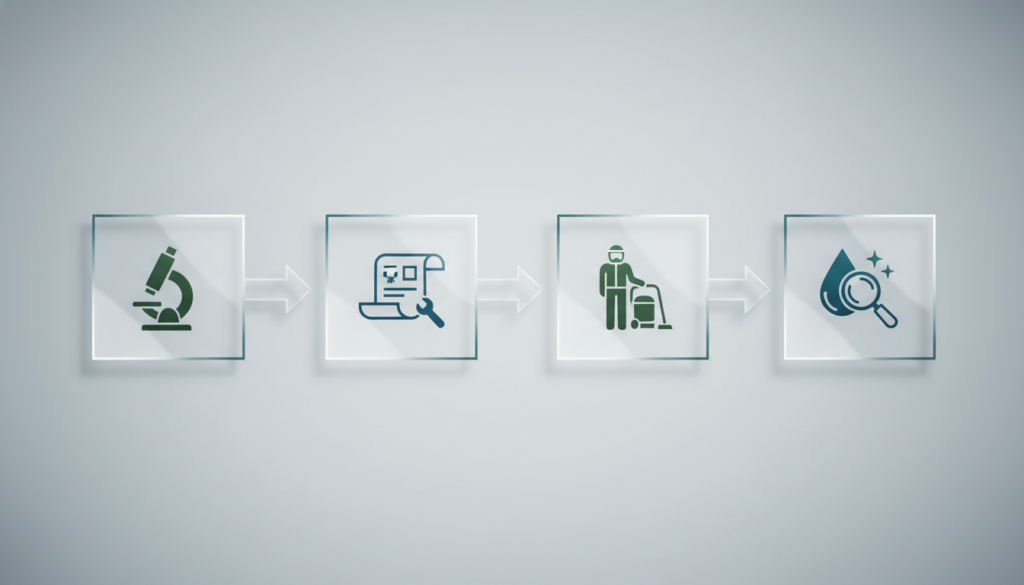
Step 1: The Assessment
Your journey to a mold-free home begins with a licensed Mold Assessor. This professional’s job is to act as a “doctor” for your home. They do not do the cleaning; they diagnose the extent of the growth and prescribe the “cure.”
During a professional assessment, the licensed individual will perform a visual inspection and, if necessary, take moisture readings and air or surface samples. Under Article 32, the Assessor is legally required to provide you with a Mold Remediation Plan. This document is the roadmap for the entire project. It must include:
- The specific rooms or areas where the mold is located.
- The quantities of materials to be removed (e.g., “100 square feet of drywall”).
- The methods to be used for cleaning and sanitization.
- The requirements for “containment”—the plastic barriers and air scrubbers used to keep spores from spreading to the rest of your house.
Without this written plan, a remediation contractor cannot legally begin work. As a homeowner, this plan is your contract of protection; it ensures you aren’t paying for unnecessary work and that nothing essential is skipped.
Step 2: The Remediation (Our Role)
Once you have your Remediation Plan in hand, you hire a licensed Mold Remediation Contractor. This is where Upper Restoration steps in. Our role is to execute the “surgery” prescribed by the Assessor with surgical precision.
As a specialized remediation firm, we strictly adhere to the protocols outlined in Article 32 and your specific Remediation Plan. Our process typically involves:
- Critical Barriers: Sealing off the work area with 6-mil polyethylene sheeting to protect your family and the clean areas of your home.
- Negative Air Pressure: Utilizing HEPA-filtered air machines to ensure that air flows into the work zone and is filtered before being exhausted outside, preventing spores from migrating.
- Controlled Demolition: Removing contaminated porous materials (drywall, insulation, carpeting) according to the Assessor’s plan.
- HEPA Vacuuming and Antimicrobial Cleaning: A multi-stage cleaning process that physically removes spores from non-porous surfaces like studs and subflooring.
By choosing a dedicated remediation firm that does not perform testing, you can rest assured that our only goal is to return your home to a “Normal Fungal Ecology” (Condition 1) as efficiently and safely as possible. We follow the plan to the letter because we know an independent Assessor will be checking our work at the end.
Step 3: Clearance
The final stage of the NYS Mold Law process is the Post-Remediation Clearance. After the remediation team has finished cleaning but before the containment barriers are taken down and the walls are rebuilt, the original Mold Assessor (or another independent licensed Assessor) must return to the site.
The Assessor will perform a “Clearance Examination,” which includes a visual inspection and often air sampling to confirm that the mold has been removed and the air quality is safe. If the project passes, the Assessor issues a written passed clearance report. This document is vital for your records, especially if you ever plan to sell your home in Nassau or Suffolk County, as it proves that a mold issue was handled professionally and legally.
If the project fails clearance, the remediation contractor is responsible for re-cleaning the area until it meets the standards of the plan—at no additional cost to the homeowner (provided the scope of the plan was followed). This is the “check-and-balance” that prevents contractors from cutting corners.
Choosing Licensed Contractors
When you are dealing with a mold crisis, time is of the essence, but you must not bypass the legal requirements. Hiring an unlicensed “handyman” to clean mold might save a few dollars upfront, but it often leads to cross-contamination, recurring growth, and legal headaches when you try to sell the property later. Most importantly, unlicensed work often violates your homeowner’s insurance policy requirements.
To ensure you are hiring the right professionals, follow these steps:
- Verify the License: Ask to see the NYS Department of Labor Mold License. It should be a hard card with the individual’s photo and an expiration date.
- Check for Independence: Ask the company directly: “Do you also do the testing/clearance for this job?” If they say yes, they are violating Article 32.
- Demand the Plan: Never let a remediation crew start work without a written plan from an independent Assessor.
| Role | Responsibilities | NYS License Required? |
|---|---|---|
| Mold Assessor | Visual inspection, sampling, writing the Remediation Plan, post-work clearance. | Yes (Assessor) |
| Mold Remediator | Containment, physical removal, cleaning, sanitizing, reconstruction. | Yes (Remediation) |
| Homeowner | Selecting two independent, licensed firms. | No |
Frequently Asked Questions
Q: Can Upper Restoration test my mold?
A: No. To remain in 100% compliance with NYS Mold Law Article 32 and to protect you from any conflict of interest, we strictly perform the remediation (cleanup). However, we have a network of trusted, independent, licensed Mold Assessors in Long Island and NYC that we can refer you to for your initial inspection.
Q: What happens if I hire one company to do both?
A: The contractor is committing a violation of the NYS Labor Law and could face significant fines. More importantly, the clearance report provided by a non-independent party may not be recognized by insurance companies or mortgage lenders, potentially devaluing your home.
Q: Is Article 32 required for small amounts of mold?
A: The law generally applies to projects involving more than 10 square feet of mold. However, for the health and safety of your family, following these professional standards is recommended regardless of the size of the growth.
Navigating mold issues in the New York metropolitan area doesn’t have to be a nightmare. By following the roadmap laid out by Article 32, you ensure that your home is treated with the scientific and legal rigor it deserves. At Upper Restoration, we pride ourselves on being a high-integrity partner in this process, providing compliant, effective, and transparent remediation services to our neighbors in Nassau, Suffolk, and NYC.
Have a remediation plan from an assessor? Contact Upper Restoration today for a compliant, professional cleanup quote and take the first step toward a healthier home.
“`