Why the 72-Hour Drying Window Matters (and What It Actually Means)
The 72-hour drying window is a practical industry benchmark for demonstrating measurable drying progress, not an official EPA rule or a mold-prevention guarantee. It reflects the time typically needed to verify, through moisture readings rather than visual inspection, that a structure has reached acceptable dryness standards after a water event.
Anyone who has called a restoration company after a burst pipe or a flooded basement has heard the phrase “72 hours” thrown around like it’s a countdown clock on a bomb. It isn’t. There’s no federal statute, EPA rule, or insurance code that says mold appears at hour 73 and not a minute before. What actually exists is a body of technical drying practice built around the idea that you need roughly three days of monitored, verified drying to confirm a structure is dry, not just that it’s had equipment running on it for three days.
That distinction matters more than most people realize. A room can have a dehumidifier humming in the corner for 72 straight hours and still have soaked subfloor sheathing underneath the visible flooring. Elapsed time tells you how long equipment has been operating. It tells you nothing about the actual moisture content of the drywall, framing, or subfloor unless someone is measuring it. Upper Restoration treats 72 hours as a checkpoint for data, not a finish line for the clock.
The EPA’s 24-48 Hour Guideline: A Target, Not a Guarantee
The EPA recommends drying wet materials within 24 to 48 hours to reduce the likelihood of mold growth, but explicitly states this is a guideline, not a guarantee. Mold can still occur even when materials dry within that window, and drying beyond 48 hours doesn’t automatically mean mold will develop.
According to the U.S. Environmental Protection Agency’s “A Brief Guide to Mold, Moisture and Your Home,” it’s important to dry water-damaged areas and items within 24 to 48 hours, and in most cases, mold will not grow if that happens. Notice the qualifiers: “important to,” not “required to,” and “in most cases,” not “always.” The same EPA source is direct about the limits of this window: mold may still occur even when materials are dried within 48 hours, and mold does not necessarily occur whenever materials remain wet longer than that.
For commercial buildings and schools, EPA’s “Mold Remediation in Schools and Commercial Buildings” (Chapter 3 and Chapter 4) draws a sharper line. Materials that stay wet longer than 48 hours, or that already show visible mold, should be treated as a different kind of problem than a straightforward drying assignment. Chapter 4 goes further, noting that even materials dried within the 48-hour window may have already experienced mold growth, so each material needs individual evaluation rather than a blanket assumption based on the calendar.
Myth vs. Fact: Myth: “72 hours guarantees no mold.” Fact: EPA’s actual guideline is a 24 to 48 hour drying target, and EPA is explicit that this is not a guarantee. What matters is verified, measured dryness, documented material by material, not a number of hours on a work order.
This is the corrective point worth remembering: 72 hours is a project target restoration professionals use to structure a drying plan and demonstrate progress. It’s not a substitute for actually measuring moisture content in the materials that matter, which is the only thing that tells you whether a structure is dry.
How LGR Dehumidifiers Work: The Science Behind Faster, Deeper Drying
Low Grain Refrigerant (LGR) dehumidifiers pull moist air across a pre-cooling stage and a cold evaporator coil, condense the moisture out, then reheat and discharge drier air back into the room. This enhanced heat exchange lets LGR units keep extracting moisture even as ambient humidity drops, unlike standard refrigerant dehumidifiers.
Here’s the six-step cycle in plain terms. Warm, moist air from the damaged room gets pulled into the unit. It passes through a pre-cooling heat exchanger that starts stripping heat before the air ever hits the main coil. That pre-cooled air then hits a cold evaporator coil, cold enough that water vapor condenses out of it, the same principle as a cold glass sweating on a humid day. The collected water drains into a bucket or gets pumped out through a hose. The now-drier air gets reheated slightly and pushed back into the room. That reheating step matters because it increases the air’s capacity to pull additional moisture out of wet materials, which speeds up evaporation from carpet, drywall, and framing.
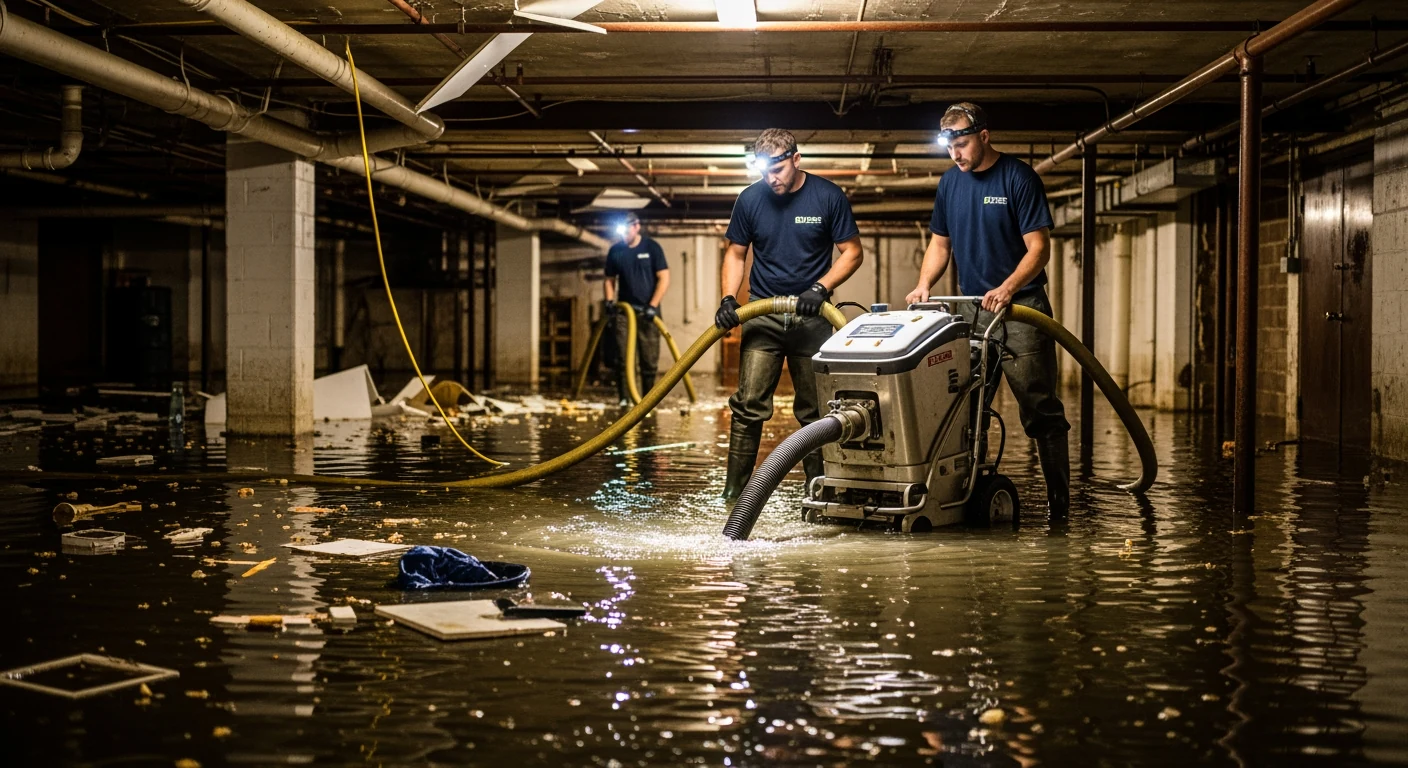
The reason restoration crews use LGR equipment instead of the box store dehumidifier in your basement comes down to what happens late in a drying job, when the room air is already fairly dry. According to Restoration Training Institute’s Water Damage Restoration/Applied Structural Drying (WRT/ASD) course material, standard refrigerant dehumidifiers have real performance limits tied to temperature and humidity. As the room dries out or gets cold, a standard unit’s coil can ice over or simply lose its ability to condense much water, and effectiveness drops fast. LGR units are engineered specifically to keep performing in those low-humidity, cooler conditions because of the pre-cooling stage and enhanced heat exchange design. Commercial equipment documentation from Grainger on portable LGR/R-410A dehumidifiers confirms the same mechanism: pre-cooling and enhanced heat exchange let these units continue pulling moisture from air even in already-dry conditions, which is exactly the environment you’re working in during hour 50 or 60 of a drying job.
That’s the technical reason “just running a dehumidifier” isn’t the same as running the right dehumidifier. A rental-grade unit might perform fine on hour one, when the air is saturated. By hour 40, when the easy moisture is gone and what’s left is trapped in wall cavities and subfloor, a standard unit’s output can fall off a cliff. LGR equipment is built to keep working through that harder, later phase of drying, which is often where the real difference between “looks dry” and “is dry” gets decided.
| Feature | Standard Refrigerant Dehumidifier | LGR Dehumidifier |
|---|---|---|
| Performance as room dries out | Drops off significantly once ambient humidity is already low | Designed to keep extracting moisture even at lower humidity levels |
| Cold-condition operation | Coil can ice over, reducing output | Pre-cooling stage helps maintain performance in cooler air |
| Best suited for | Early-stage, high-humidity drying | Full drying cycle, especially the harder late-stage moisture |
| Typical use case | General consumer dehumidification | Structural drying after water damage events |
Why Fans and Air Movement Alone Never Dry a Structure
Fans move air across wet surfaces to encourage evaporation, but they don’t remove water from the air or the structure. If room humidity stays high, evaporation slows or stalls entirely, which is why EPA’s own water-damage guidance pairs fans with extraction and dehumidification rather than treating airflow as a stand-alone fix.
Think about hanging a wet towel in a closed bathroom versus hanging it outside on a dry, breezy day. The towel outside dries because the surrounding air has room to absorb more moisture. The towel in the closed bathroom stays damp because the air around it is already saturated. Fans without dehumidification create the bathroom problem: they keep moving the same humid air across wet drywall and carpet, and once that air reaches its moisture capacity, evaporation has nowhere to go.
EPA’s “Table 1: Water Damage, Cleanup and Mold Prevention” reflects this directly, recommending water extraction, dehumidification, and fans together for wet carpet and backing, with a target of drying within 24 to 48 hours, and a specific note that the subfloor beneath also has to be checked and dried independently. EPA’s Mold Course Chapter 4 reiterates the same combination. None of the EPA guidance treats fans as sufficient on their own, because they aren’t. Extraction removes bulk water first. Dehumidification removes moisture from the air so evaporation can keep happening. Air movement speeds evaporation once the air actually has capacity to absorb more moisture. Skip any one leg of that stool and the process stalls, no matter how many box fans are running.
What a 72-Hour Drying Timeline Should Actually Look Like (Hour-by-Hour)
A properly managed drying timeline moves through distinct phases: bulk water removal and initial readings in the first 24 hours, active dehumidification and monitoring through 48 hours, targeted drying of hidden or slow-drying materials through 72 hours, and a verification phase afterward if readings haven’t stabilized.
First 24 Hours: Standing water extracted, baseline moisture readings taken on affected materials and an unaffected reference area, dehumidifiers and air movers placed based on the moisture map, not guesswork.
24 to 48 Hours: Continued dehumidification, daily moisture readings compared to baseline, adjustments to equipment placement if certain materials aren’t trending drier, checks inside wall cavities and under flooring where water may be trapped.
48 to 72 Hours: Focus narrows to slower-drying materials (subfloor, framing, insulation, cabinetry), readings from multiple depths and locations, comparison against the unaffected reference area to confirm the space is trending toward normal.
After 72 Hours: If moisture content in structural materials hasn’t reached acceptable, stable levels, drying continues with documented justification rather than stopping on a schedule. Materials that stayed wet longer get individually evaluated per EPA’s material-by-material guidance.
The point of laying it out this way isn’t to promise every job wraps in exactly 72 hours. It’s to show what should be happening during those hours: extraction, placement decisions driven by data, and daily comparative readings, not just equipment running unattended while a clock ticks.
What Should Be Measured, and Why Relative Humidity Isn’t Enough
A credible drying record tracks ambient temperature, relative humidity, and wood moisture content at multiple depths and locations, compared against an unaffected reference area. Relative humidity readings in the air alone can’t confirm that a wall, subfloor, or framing member has actually dried, because moisture can remain trapped inside materials while the room air reads acceptable.
This is a distinction adjusters and property managers should push on, because it’s where sloppy drying jobs hide. A moisture meter reading on the air in a room tells you about the air. It does not tell you what’s happening inside a double layer of drywall, under a vinyl-backed carpet pad, or inside a wood stud that looks fine on the surface but is still saturated at its core. EPA’s Chapter 4 guidance on mold remediation makes this same material-by-material point: you can’t assume dryness across an assembly just because one surface reading looks good.
A thorough drying log should include, at minimum, ambient temperature and relative humidity for the affected space and an unaffected comparison area, wood moisture content readings at multiple points and depths, moisture conditions found inside wall cavities, under flooring, behind cabinets, and beneath carpet or pad, equipment placement with operating hours and total water removed, and day-over-day changes in every reading rather than a single final snapshot. That last item matters for anyone reviewing a claim file: a single “dry” reading on the final day proves less than a documented trend showing consistent, believable improvement across the whole job.
Factors That Can Extend Drying Time Beyond 72 Hours
Drying can legitimately take longer than 72 hours due to water category, material type, assembly design, ambient temperature and humidity, airflow placement, the volume and duration of water exposure, and occupancy constraints. A longer timeline doesn’t automatically mean mold has formed; it means the structure needed more verified time before readings confirmed acceptable dryness.
Clean water from a supply line dries differently than contaminated water from a sewage backup, both in how it’s handled and how deeply it penetrates porous materials. Layered floor assemblies (tile over plywood over joists, for example) and enclosed wall cavities trap moisture in ways an open, single-layer surface never does, simply because there’s more distance and more material for moisture to travel through before it reaches the air. Cold ambient temperatures slow evaporation and can reduce standard dehumidifier performance, which is part of why the Restoration Training Institute’s WRT/ASD material flags temperature and humidity as direct limiters on refrigerant equipment output. High water volume or a slow leak that ran for days before discovery simply means more total moisture has to come out, regardless of equipment quality.
None of these factors are cause for alarm on their own, and none of them mean a job has failed. They mean the drying plan needs to keep running, with continued measurement, until the readings, not the calendar, say the structure is dry.
What Homeowners, Landlords, and Adjusters Should Ask For
Anyone managing or reviewing a water damage claim should request a written drying log showing daily moisture readings, equipment placement and run time, materials checked at each depth, and a final verification reading compared against baseline and unaffected areas. This documentation is what distinguishes a verified dry structure from one that simply had equipment running.
For adjusters building a claim file, that documentation is the difference between a defensible record and a guess. For homeowners and property managers, it’s the difference between confidence that a space is actually safe to rebuild into and hoping three days was enough.
What to request in a drying log: Daily temperature and relative humidity readings, wood moisture content by location and depth, readings from an unaffected reference area, notes on wall cavity, subfloor, and under-cabinet conditions, equipment inventory with placement and total hours run, total water extracted, and a final comparison showing the trend from day one to completion.
Dealing with active water damage, or reviewing a completed drying job for an insurance claim? Upper Restoration documents moisture readings and drying progress with EPA-informed, industry-standard protocols, not just elapsed time.
Frequently Asked Questions
Is there an official 72-hour rule for mold after water damage?
No. There is no official EPA rule setting mold onset at exactly 72 hours. EPA’s guidance recommends drying materials within 24 to 48 hours as a mold-prevention target, and explicitly states this is a guideline, not a guarantee. The 72-hour window used by restoration professionals is a practical benchmark for verifying drying progress, not a mold deadline.
What happens if drying takes longer than 72 hours?
A longer drying time doesn’t automatically mean mold has developed. EPA guidance notes mold does not necessarily occur whenever materials remain wet beyond the recommended window. Factors like water category, material type, assembly design, and temperature can all extend the time needed to reach verified dryness, and the process should continue with monitoring until readings confirm the structure is dry.
Why can’t a store-bought dehumidifier and some fans dry out water damage?
Standard refrigerant dehumidifiers lose effectiveness as ambient humidity and temperature drop, which happens naturally as a room dries. Fans alone only move air; they don’t remove moisture, so evaporation stalls once room air reaches capacity. Restoration-grade LGR dehumidifiers use pre-cooling and enhanced heat exchange to keep extracting moisture even in already-dry conditions.
How do you know if a structure is actually dry, not just visually dry?
Visual dryness is unreliable because moisture can remain trapped inside drywall, subfloor, insulation, or framing while surfaces look and feel dry. Verified dryness requires moisture content readings taken at multiple depths and locations, compared against an unaffected reference area, tracked daily until readings stabilize at levels consistent with the surrounding structure.
What documentation should an insurance adjuster expect from a drying job?
A complete drying log should include daily temperature and relative humidity readings, wood moisture content by location and depth, comparison readings from unaffected areas, conditions found in wall cavities and under flooring, equipment placement and run hours, total water extracted, and a day-over-day trend showing progress from initial to final readings.
Does EPA guidance differ for commercial buildings and schools?
Yes. EPA’s “Mold Remediation in Schools and Commercial Buildings” recommends drying non-moldy materials within 48 hours. Materials wet longer than 48 hours, or already showing visible mold, are treated as a different remediation problem rather than a standard drying assignment, and EPA notes that even materials dried within 48 hours should be evaluated individually for possible mold growth.
Can drying alone guarantee mold will not grow?
No. EPA is explicit that drying materials within its recommended window does not guarantee mold will not occur, and remediation outcomes vary by site conditions, material type, and how quickly water intrusion was addressed. Verified, documented drying reduces risk but is not a substitute for professional assessment of a specific property.
Sources
- U.S. Environmental Protection Agency, “A Brief Guide to Mold, Moisture and Your Home”
- U.S. Environmental Protection Agency, “Mold Remediation in Schools and Commercial Buildings, Chapter 3: Cleanup Methods”
- U.S. Environmental Protection Agency, “Mold Remediation in Schools and Commercial Buildings, Chapter 4”
- U.S. Environmental Protection Agency, “Mold Course Chapter 4”
- U.S. Environmental Protection Agency, “Table 1: Water Damage, Cleanup and Mold Prevention”
- U.S. Environmental Protection Agency, “Homeowners’ and Renters’ Guide to Mold Cleanup After Disasters”
- Restoration Training Institute / Property Restoration Academy, “Water Damage Restoration/Applied Structural Drying (WRT/ASD) Course Study Material,” 2021
- Grainger, portable dehumidifier (LGR/R-410A) product and technology information
This content is for general informational purposes only and is not legal, medical, or insurance advice. Remediation scope, timelines, and costs vary by site conditions. Contact Upper Restoration for a professional assessment. Licensing and certifications apply per jurisdiction.