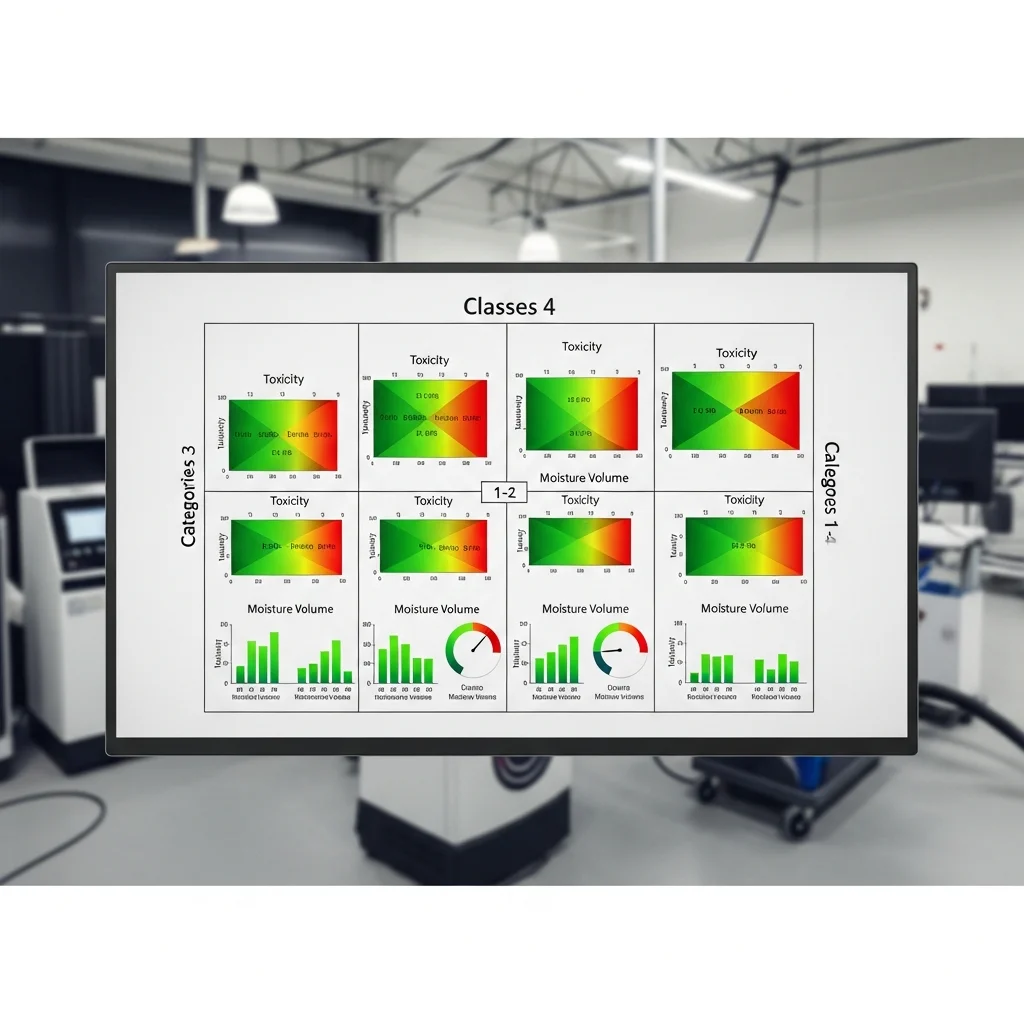
When a water damage contractor or insurance adjuster refers to “Class 2” or “Category 3” water damage, they’re using a specific technical classification system — the IICRC S500 Standard for Professional Water Damage Restoration. These classifications aren’t industry jargon; they determine the remediation protocol, the equipment requirements, the materials that must be removed versus dried in place, and the documentation standards your insurance carrier will use to evaluate your claim. Understanding both systems gives you the ability to verify that a contractor’s scope matches your actual damage — and to spot proposals that are either over-scoped (charging for unnecessary demolition) or under-scoped (missing hidden moisture that will create mold problems).
The Three Categories: Contamination Level
Categories describe the contamination level of the water itself — not the damage it caused. This determines what materials can be dried in place versus must be removed, and what protective equipment and decontamination protocols workers must use.
Category 1 — Clean water. Water from a sanitary source: broken supply pipes, overflow from a clean sink or tub (no contamination), appliance supply line failures, meltwater from ice makers. No significant contamination at the time of loss. Category 1 porous materials can be dried in place if extraction and drying begin within approximately 24–48 hours. After 48 hours, Category 1 water can be reclassified to Category 2 due to microbial growth from organic materials in the water or on the surfaces it contacted.
Category 2 — Gray water. Water containing significant contamination that can cause illness or discomfort if ingested or contacted. Sources: dishwasher or washing machine discharge, toilet bowl overflow (no feces), sump pump failure water, and Category 1 water that has been standing more than 48 hours. Gray water requires careful evaluation of each affected material — porous materials that absorbed Category 2 water are typically removed rather than dried in place, particularly in residential settings with vulnerable occupants.
Category 3 — Black water. Grossly contaminated water containing pathogenic, toxigenic, or other harmful agents. Sources: sewage backup, toilet overflow with feces, rising floodwater, storm surge, and any Category 2 water left untreated for 48+ hours. All porous materials in contact with Category 3 water must be removed — no exceptions. This is non-negotiable under IICRC S500, OSHA regulations, and insurance industry claims standards. Drywall, carpet, pad, insulation, and any paper-faced material in contact with black water must be bagged and disposed of. Workers must use full biohazard PPE: waterproof gloves, goggles, N95 minimum respirator, and protective coveralls.
The Four Classes: Drying Difficulty
Classes describe how difficult the drying process will be — specifically, the rate of evaporation the materials involved can sustain, which determines equipment quantity and drying timeline. These are independent of category: a Category 1 event can be any Class; a Category 3 event can be any Class.
Class 1 — Slow evaporation rate. Water affected only part of a room or area, absorbed into materials with low permeance or porosity (concrete, plaster), or the volume of water and materials affected is small. Carpet and pad may be wet in a limited area. Least equipment required, fastest drying — typically 1–3 days.
Class 2 — Fast evaporation rate. Water affected an entire room, wicked up walls 12–24 inches into drywall and insulation, and may have saturated the carpet and pad throughout the space. This is the most common classification for NYC and Long Island residential water events. Equipment: typically 1 LGR dehumidifier and 4+ air movers per room. Drying timeline: 3–5 days.
Class 3 — Fastest evaporation rate. Water came from above — a ceiling leak, overhead pipe failure, or water migrating down through floor assemblies from an upper story. Walls, ceilings, insulation, and structural framing are saturated. Often requires opening walls and ceiling cavities to allow drying equipment airflow access to the saturated assembly. Equipment: maximum density placement. Drying timeline: 5–10 days, sometimes longer for dense materials.
Class 4 — Special drying situations. Materials with very low permeance that require extended drying beyond standard equipment setups. Examples: hardwood flooring (requires specialty floor drying systems), wet plaster (pre-war NYC buildings), concrete slabs, crawlspace soil, and adobe or rammed earth construction. Class 4 may require desiccant dehumidification systems, heat drying systems, or specialized floor mat systems in addition to standard LGR equipment. Drying timelines vary widely — potentially 10–21 days for dense assemblies.
How Category and Class Combine in Practice
A typical NYC scenario: dishwasher supply line fails on a second-floor kitchen, water flows through the floor into the apartment below and is discovered 6 hours later. Classification: Category 2 (dishwasher gray water), Class 2 or 3 (water migrated through floor assembly into ceiling below, affecting walls). The Category 2 classification means the ceiling drywall in the lower apartment that contacted the water must be removed — it can’t be dried in place. The Class 3 classification means the floor/ceiling assembly above and below will require opening and maximum equipment density.
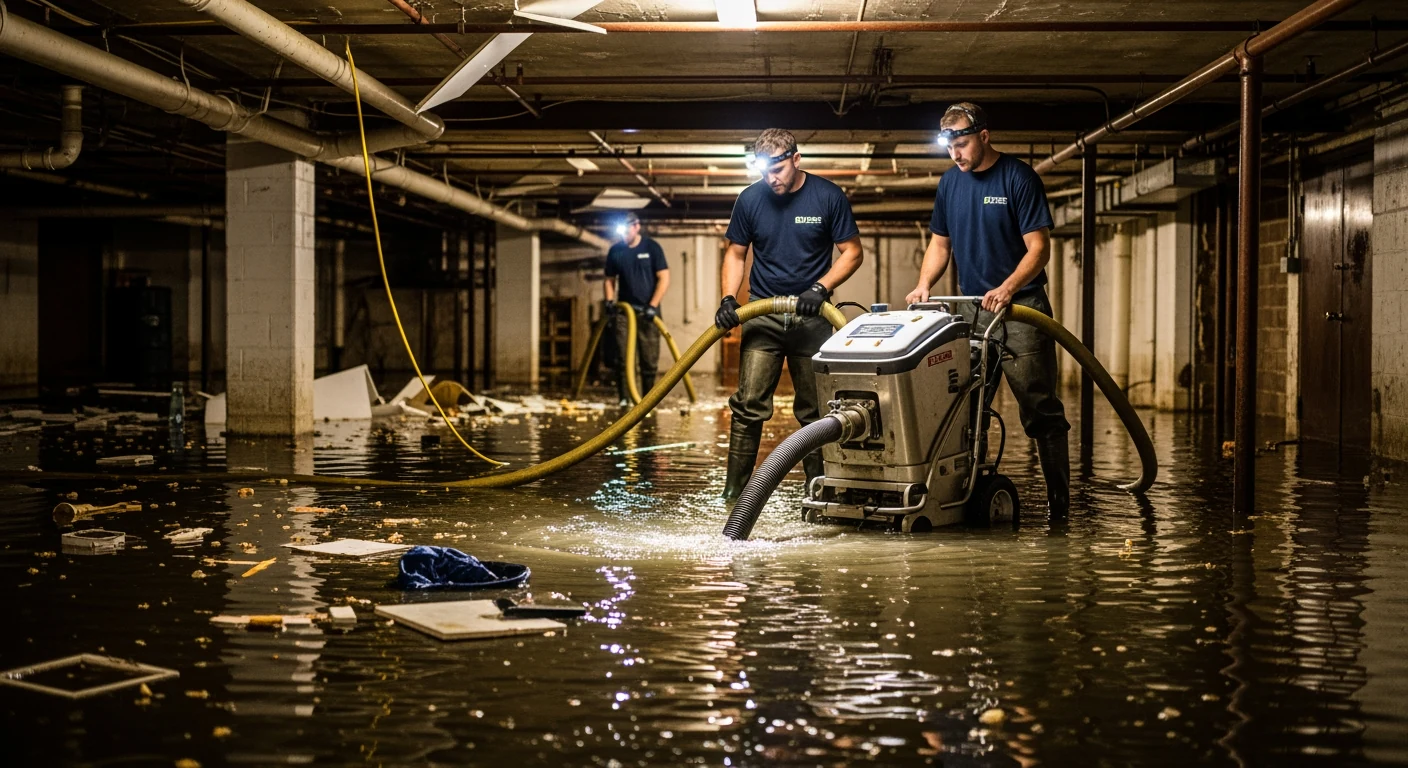
A Long Island scenario: basement sump pump fails during a storm and the basement takes on 8 inches of groundwater and stormwater. Classification: Category 3 (external groundwater, potential sewage contamination from combined surface runoff), Class 2 or 3 depending on what’s in the basement. All porous materials — any finished drywall, carpet, pad, wood paneling, stored cardboard boxes — must be removed. The concrete floor and block foundation walls can be decontaminated rather than removed after the water is extracted.
What These Classifications Mean for Your Insurance Claim
Insurance carriers use IICRC classification as the framework for evaluating claim scopes. An adjuster reviewing a mitigation invoice will expect the scope to be consistent with the documented classification. A Class 3 event should show full ceiling and wall assembly drying equipment. A Category 3 event should show complete porous materials removal. Inconsistencies between the documented classification and the proposed scope are the most common trigger for adjuster disputes — both when a contractor under-scopes (misses hidden moisture) and when a contractor over-scopes (charges for demolition that wasn’t required for the documented classification).
Frequently Asked Questions
Can Category 1 water become Category 3? Yes. Category 1 water that has been standing for more than 48 hours at room temperature can be reclassified to Category 2 due to microbial growth. Water that contacts sewage-contaminated materials at any point — including building materials in a historically flooded basement — can be reclassified to Category 3. Category always escalates, never de-escalates.
How does a contractor determine the class? Through physical moisture mapping: penetrating moisture meters on wood and drywall, non-penetrating RF meters behind surfaces, and thermal imaging to map hidden moisture. The class is determined by the highest level of moisture involvement found — not just what’s visibly wet. A Class 2 event with water in the wall cavity but no visible wall damage is still Class 2.
What should my drying logs show? Daily moisture readings at the same measurement points, mapped to the moisture mapping diagram from the initial assessment. Equipment quantity and placement per day. Temperature and relative humidity readings inside the drying chamber. The drying curve should show a steady reduction in moisture readings from day 1 through the final day, ending at or below the dry standard for each material type. A final entry confirming all points are at dry standard and equipment is being removed.
See also: Water Damage Risks & Restoration on Long Island