
Mold Remediation in Coram, NY
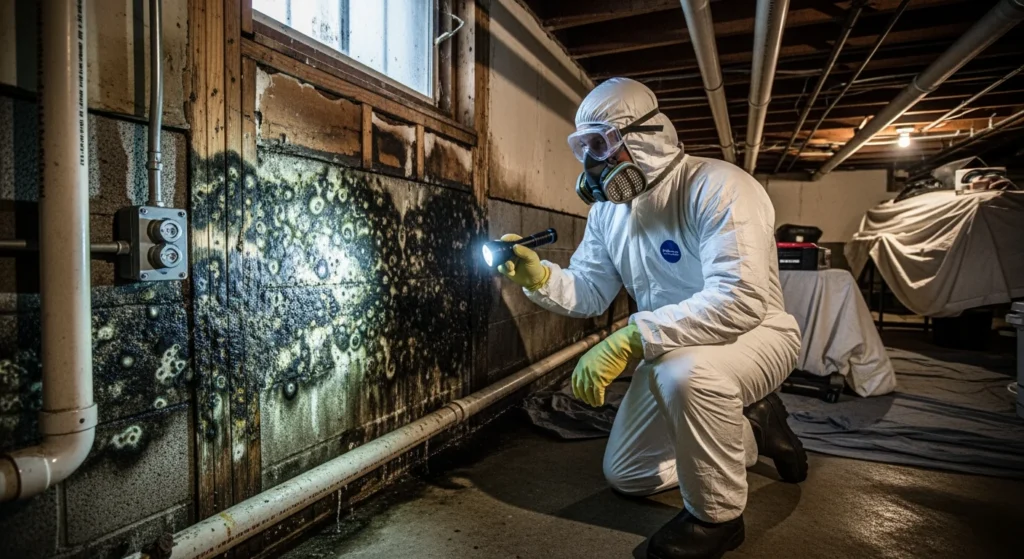
Coram’s shallow water table drives a persistent basement mold pattern — hydrostatic seepage through foundation walls and floor slabs creates chronic moisture that initiates mold on concrete surfaces, wood framing, and finished basement materials each spring, producing a recurring mold cycle that requires both remediation and drainage correction to break.
Mold Remediation in Commack, NY
Commack’s 1960s-1980s split-level stock carries endemic below-grade family room condensation mold — fiberglass batts against uninsulated block producing seasonal mold that recurs without assembly correction — alongside Cape Cod attic mold in the hamlet’s older housing.
Mold Remediation in Central Islip, NY
Central Islip’s 1960s-1980s residential stock carries standard interior Suffolk mold risk — below-grade family room condensation mold in split-levels, attic mold in inadequately ventilated Cape Cods, and summer ambient mold in basements without mechanical dehumidification.
Mold Remediation in Brentwood, NY
Brentwood’s dense rental housing stock carries above-average mold risk from the multi-family shared assembly pattern — mold in one unit’s shared wall indicates mold throughout the shared assembly — and from summer ambient humidity in the large proportion of basement and below-grade spaces without mechanical dehumidification.
Mold Remediation in Bay Shore, NY
Bay Shore’s south shore flooding history — including Sandy damage and recurring Great South Bay tidal events — has produced the same post-storm hidden mold legacy in bay-front communities as Nassau’s south shore, alongside the standard interior Suffolk mold pattern in Bay Shore’s post-war residential neighborhoods.
Mold Remediation in Glen Cove, NY
Glen Cove’s mold profile spans its historic Gold Coast estates — where original plaster and fieldstone foundations create moisture retention conditions unlike modern construction — and its denser post-war residential neighborhoods carrying Nassau County’s standard Cape Cod attic and basement mold profile.
Mold Remediation in Long Beach, NY
Long Beach’s barrier island position and its complete Sandy inundation make it the highest mold remediation risk community in Nassau County — every home that was flooded in 2012 without full Category 3 protocol is a potential hidden mold site, and the city’s ongoing tidal flooding events create a recurring moisture cycle that sustains mold in assemblies never fully dried.
Mold Remediation in Massapequa, NY
Massapequa’s south shore communities carry the same post-Sandy hidden mold legacy as Freeport and Island Park — Category 3 bay water flooding that was surface-cleaned rather than fully remediated in 2012 has produced decade-long mold accumulation in south shore wall assemblies being discovered during current renovation projects.
Mold Remediation in Valley Stream, NY
Valley Stream’s oldest housing stock — some built before 1940 — carries mold risk from historic building assemblies without modern moisture management, while its post-war Cape Cod and Colonial stock carries the standard Nassau County attic and basement mold profile.
Mold Remediation in Freeport, NY
Freeport’s canal community carries the highest mold discovery rate from post-Sandy incomplete remediation of any Nassau County village — the combination of Category 3 bay water flooding, rushed post-storm surface cleaning rather than full demolition protocol, and summer humidity cycling has produced hidden wall cavity mold in thousands of Freeport canal homes over the decade since 2012.
