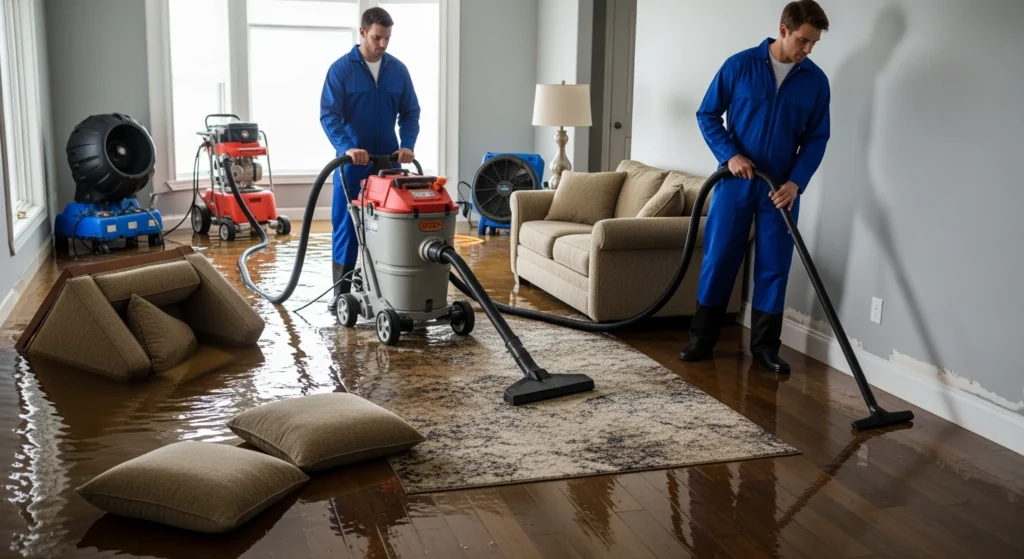
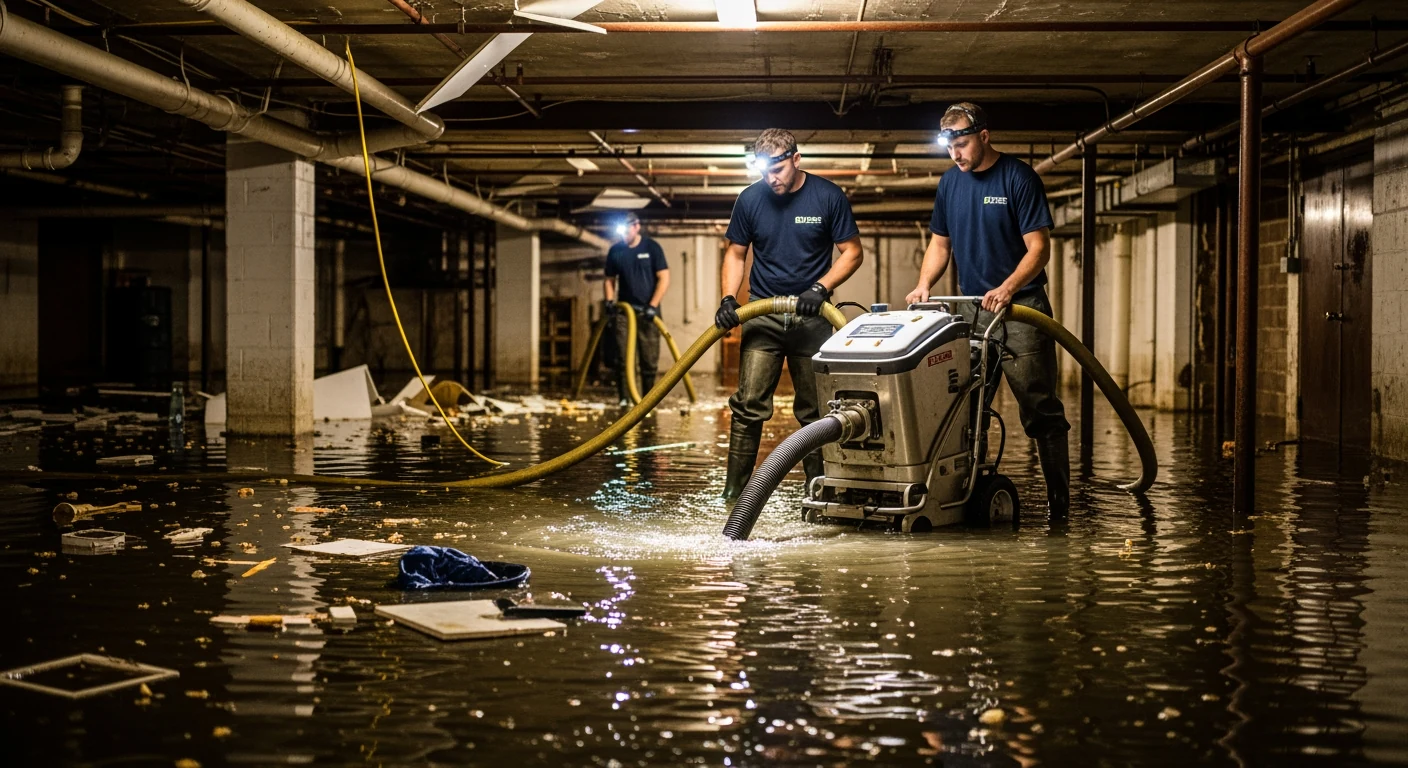
Living on the coast of Long Island or within the boroughs of New York City offers unparalleled beauty and lifestyle, but it comes with a high-stakes trade-off: the constant threat of the Atlantic. As a Coastal Disaster Response Team Leader, I have walked through hundreds of homes from the South Shore of Nassau to the tip of Montauk following major surge events. One thing I’ve learned is that homeowners often underestimate the fundamental difference between a “wet” house and a “salted” house.
When a pipe bursts in a basement in Queens, it’s a tragedy, but it is manageable. When the Great South Bay or the East River pushes two feet of storm surge into that same basement, it isn’t just a flood—it’s a chemical invasion. The cleanup protocols for saltwater flood damage cleanup are fundamentally different from standard restoration. If you treat a saltwater surge like a freshwater pipe burst, you aren’t just wasting money; you are leaving a ticking time bomb in your walls.
The Salt Factor
The primary keyword in coastal restoration isn’t “water”—it’s “salt.” In a freshwater flood, such as those caused by heavy rains or plumbing failures, the water carries silt and biological contaminants (bacteria), but once the water is extracted and the materials are dried, the primary threat is mold. In a storm surge, the water is a brine solution saturated with sodium chloride and other minerals.
Salt is a mineral that does not evaporate. When the water dries, the salt remains behind in the form of microscopic crystals. These crystals are deeply embedded in your 2×4 studs, your subflooring, and your drywall. This leads to a phenomenon known as being “hygroscopic.” Salt literally pulls moisture out of the air. Even if we use industrial dehumidifiers to get your home down to a safe moisture content, the moment those machines are turned off, the salt left in the wood will suck humidity from the Long Island air, making the wood damp again. This creates a perpetual cycle of moisture that fuels wood rot and mold growth long after the storm has passed.
Why Saltwater is Different
Understanding the technical differences between these two types of flooding is the first step toward a successful recovery. Freshwater is an inconvenience; saltwater is a corrosive agent. The following table highlights the critical distinctions our team evaluates when arriving at a disaster site:
| Factor | Freshwater Flood | Saltwater/Storm Surge |
|---|---|---|
| Source | Rain, Pipes, Rivers | Ocean, Bay |
| Corrosivity | Low | High (Rapid Oxidation) |
| Electrical | May be cleanable | Total Replacement |
| Residue | Silt/Mud | Salt Crystals (Hygroscopic) |
In the technical world of restoration, we categorize water based on its cleanliness. While freshwater from a pipe is “Category 1,” storm surge is always “Category 3” (Black Water). Not only because of the salt, but because the surge picks up everything in its path: automotive fluids from the street, sewage from overwhelmed municipal systems, and fuel oil from breached basement tanks. However, it is the salt that dictates our structural cleanup strategy.
The Corrosion Clock
In a coastal environment, time is your greatest enemy. We refer to this as the “Corrosion Clock.” The moment saltwater contacts metal, an electrochemical reaction begins. This is particularly devastating for the structural integrity of a home. Think about the thousands of nails, screws, and hurricane clips holding your floor joists and wall studs together.
In a freshwater flood, these fasteners might stay wet for a few days without significant degradation. In a saltwater flood, the oxidation process is accelerated by a factor of ten. Within 48 to 72 hours, we begin to see “pitting” on metal surfaces. If the salt isn’t neutralized and removed, the fasteners will continue to corrode inside the wood, eventually losing their “grip.” We have seen homes in Howard Beach and Long Beach where, years after a storm, the structural integrity was compromised because the internal nails had essentially turned to dust, despite the home looking “clean” on the outside.
Structural Fasteners and Plates
Modern homes use galvanized steel plates and hangers. Saltwater eats through galvanization quickly. Our technical protocol involves inspecting every metal connector touched by the surge. If there is evidence of salt crusting, those fasteners often need to be treated with specialized corrosion inhibitors or, in extreme cases, the structural members must be reinforced with new, marine-grade hardware.
Electrical System Risks
This is perhaps the most dangerous aspect of storm surge recovery. FEMA and the National Electrical Manufacturers Association (NEMA) are very clear on this: any electrical component submerged in saltwater is generally considered non-salvageable.
Why? Because saltwater is an incredible conductor of electricity, and the salt residue left behind is both conductive and corrosive. Even if an outlet or a breaker box seems to work after it dries out, the salt crystals inside the mechanism will continue to eat away at the copper wiring and the plastic insulation. This creates “arcing”—where electricity jumps across a gap. Arcing is a primary cause of post-flood house fires.
- Wiring: Capillary action can pull saltwater up through the insulation of a wire, inches or even feet above the actual water line. This is known as “wicking.”
- Outlets and Switches: These must be discarded. The internal springs and contact points will fail.
- Appliances: If the control board of your furnace, water heater, or laundry unit was touched by the surge, the salt will eventually short-circuit the electronics.
When we manage saltwater flood damage cleanup in Nassau or Suffolk County, we coordinate closely with licensed electricians to ensure the system is not just “dry,” but safe. In most cases, this means a “gut to the studs” approach for any area touched by the surge to replace the wiring entirely.
Flushing and Cleaning Protocols
This is where our experience as a coastal response team truly matters. In a freshwater flood, we extract the water and start the fans. In a saltwater flood, if you start the fans immediately, you are simply “locking in” the salt.
Our specialized protocol involves a process called Freshwater Flushing. It sounds counter-intuitive to a distressed homeowner to see us bringing more water into a flooded house, but it is the only way to save the structure. We use low-pressure freshwater rinses combined with specialized salt-neutralizing detergents. These chemical agents break the ionic bond between the salt and the wood fibers, allowing the salt to be suspended in the water and then extracted.
The Step-by-Step Recovery Process:
- Muck-out and Stripping: We remove all “porous” materials that cannot be flushed, such as drywall, insulation, and carpeting. These act like sponges for salt and can rarely be saved.
- Decontamination: We apply biocides to handle the “Category 3” contaminants (sewage and bacteria) carried in by the surge.
- Salt Neutralization: We apply a neutralizing agent to all exposed framing and subfloors.
- Pressure Flushing: We use freshwater to rinse the salt out of the cracks and crevices of the sill plates and wall junctions.
- Advanced Extraction: High-powered vacuums remove the rinse water immediately.
- Technical Drying: Only after the salt is removed do we deploy LGR (Low Grain Refrigerant) dehumidifiers and air movers to pull the remaining moisture out of the timber.
Rebuilding for Resilience
Once the saltwater flood damage cleanup is complete and the moisture readings are back to baseline, the focus shifts to rebuilding. For our clients in NYC and Long Island, we don’t just want to put the house back the way it was; we want to build it back better.
This includes using “flood-hardy” materials. For example, replacing standard fiberglass insulation with closed-cell spray foam, which does not absorb water and provides structural reinforcement. We also recommend the installation of “flood vents” in crawlspaces and garages, which allow surge water to flow in and out, equalizing pressure and preventing foundation collapse.
Furthermore, we advise moving mechanical systems—furnaces, electrical panels, and water heaters—out of the basement and onto higher floors or elevated platforms. In the coastal zones of Suffolk and Nassau, this isn’t just a good idea; it’s often a requirement for flood insurance compliance.
The Importance of Professional Documentation
Recovering from a storm surge is also a financial battle. Insurance adjusters often treat surge damage differently than rain damage. Our team provides the technical documentation—including moisture maps, salinity tests, and thermal imaging—needed to prove to the insurance company that a simple “dry out” was insufficient. We document why the “flush and neutralise” protocol was necessary to prevent long-term structural failure, helping homeowners get the coverage they deserve under their NFIP (National Flood Insurance Program) policies.
Frequently Asked Questions
Q: Can I save my outlets after a storm surge?
A: No. Saltwater corrosion creates a high fire risk. Even if they appear to work, the internal components will oxidize and fail. All electrical components touched by saltwater must be replaced by a licensed professional.
Q: Why can’t I just use a shop-vac and some fans?
A: A shop-vac won’t remove the salt embedded in the wood pores. Without professional flushing and neutralizing, the salt will keep the wood damp forever (hygroscopic action), leading to mold and rot behind your new walls.
For more information on our specific disaster services, visit our Residential Restoration | Storm/Disaster Restoration page.
The Atlantic Ocean is a powerful force. When it enters your home, it leaves a chemical footprint that requires a technical, experienced response. Don’t let a “clean” looking basement hide a corrosive future. Trust the team that understands the unique challenges of the Long Island and New York City coastline.
Affected by coastal flooding? Don’t wait for rust. Call us today for a professional assessment.
Contact Upper Restoration
Upper Restoration provides professional water and flood damage restoration services across Nassau County, Suffolk County, and all five NYC boroughs — available 24/7.