By: IICRC-Certified Odor Control Technician (OCT) | Upper Restoration
As an IICRC-certified Odor Control Technician, I have walked into hundreds of Long Island and NYC homes where the owner was certain they had fixed the fire damage. The walls were freshly painted, the carpets shampooed, and the soot nowhere in sight. Yet the moment the HVAC kicked on or the afternoon sun hit the windows, the acrid stench of a structure fire returned. Every time. Without fail.
The most common and costly mistake homeowners make after a fire is treating smoke damage as a cosmetic problem. It isn’t. Smoke is a chemical and physical intrusion into the substrate of your home. Painting over it doesn’t fix it — it traps it. Understanding why requires a brief look at the physics of smoke, and understanding the physics is what separates permanent smoke odor removal from a smell that keeps coming back. For a complete breakdown of pricing, see our guide to smoke damage repair cost.
The Physics of Smoke Particles: Why Paint Fails
Smoke from a structure fire consists of solid particles, liquid aerosols, and gases ranging from 0.1 to 4 microns in size. A human hair is approximately 70 microns wide. These particles are small enough to penetrate virtually every porous material in your home — wood framing, drywall, insulation, concrete, and upholstery.
Fire also involves extreme heat, and heat causes materials to expand. As a fire burns, the pores in your walls and floors open up. The pressurized smoke is driven deep into these materials. When the fire is extinguished and the structure cools, those pores contract — locking the smoke particles and charred resins inside. The odor is not on the wall. It is in the wall.
This creates a phenomenon called off-gassing. When temperature or humidity rises — on a hot Long Island summer day, or when your boiler kicks on — those materials expand again and release the trapped particles back into the air. This is why the smell returns in warm weather even in homes that were “fully cleaned” months earlier.
Applying paint over smoke-saturated surfaces doesn’t stop off-gassing. It creates what restoration professionals call a smoke sandwich: the paint briefly seals the odor, but because smoke residue is often oily (especially in kitchen fires), the paint fails to bond correctly over time — peeling, bubbling, and eventually releasing the odor right back through the film.
Why Cleaning Is Only Step One
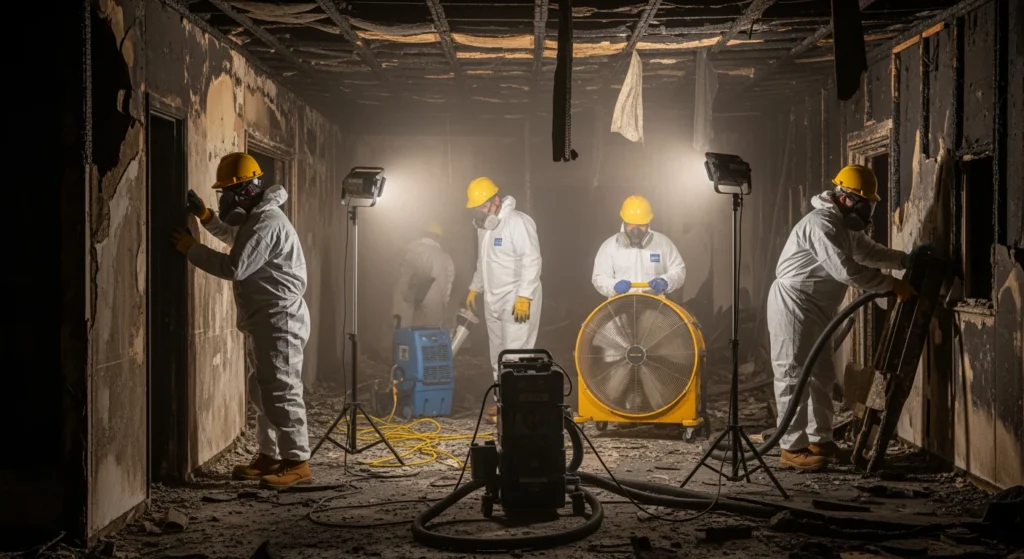
Professional fire restoration follows the IICRC S700 Standard for Professional Fire and Smoke Damage Restoration. The first step is always source removal — physically cleaning soot and char from every surface using dry chemical sponges, HEPA vacuuming, and wet cleaning methods appropriate to each material type.
Soot is often acidic. Left on surfaces it causes pitting in glass, permanent staining on stone and plastics, and corrosion of metals. It must be removed before any deodorization begins. But even after a surface looks and smells clean, the molecular “ghost” of the fire remains in the substrate. Surface cleaning is the prerequisite for deodorization — not the substitute for it.
Effective smoke odor removal requires a multi-phase approach that addresses the air, the surfaces, and the internal pores of the building materials simultaneously. Upper Restoration serves homeowners and property managers throughout Nassau County, Suffolk County, and all five NYC boroughs — and no two fire profiles are identical. The deodorization method we choose depends on the fire type, the materials involved, and whether the space can be vacated.
Ozone vs. Hydroxyl: The Two Industrial Deodorization Methods
When professional restorers talk about “breaking down” smoke odors, we are describing oxidation — using industrial equipment to change the chemical structure of odor molecules so they no longer register as smell to the human nose.
Ozone Generators (O3)
Ozone is an unstable gas consisting of three oxygen atoms. Because it is highly reactive, it seeks out organic odor molecules and oxidizes them on contact. It is highly effective for heavy “protein fires” (burning meat, kitchen fires) or deep wood char where odor has penetrated structural framing. Ozone treatment is fast — typically 24 to 48 hours — and delivers thorough results.
The limitation: ozone is a respiratory irritant at industrial concentrations. During treatment, the home must be completely vacated — no people, no pets, no indoor plants. It can also degrade certain rubber and elastic materials over extended exposure. After treatment, the home is ventilated and the O3 quickly reverts to standard O2, leaving no toxic residue.
Hydroxyl Generators (OH)
Hydroxyl radicals are what atmospheric scientists call the “detergent of the atmosphere.” In nature, they are created by UV rays reacting with moisture in the air. Industrial hydroxyl generators replicate this process at high intensity. Unlike ozone, hydroxyls are safe for occupied spaces — which makes them the preferred choice for homeowners who cannot fully vacate, or for environments containing sensitive materials like fine art, high-end electronics, or documents.
Hydroxyls work more slowly than ozone (typically 3 to 5 days for equivalent results), but they penetrate and neutralize odor molecules in the air and on surfaces continuously throughout the treatment period.
| Method | Occupancy Safe? | Mechanism | Speed | Best For |
|---|---|---|---|---|
| Ozone Generator | No — must vacate | Oxidizes odor molecules | 24–48 hrs | Heavy char, protein fires, deep penetration |
| Hydroxyl Generator | Yes | UV-generated radicals neutralize molecules | 3–5 days | Occupied spaces, sensitive materials |
| Thermal Fogging | No — briefly | Heat-driven deodorizer penetrates substrate | Immediate impact | Structural penetration, wood framing, drywall |
| Encapsulation Primer | Yes (after fogging/oxidation) | Vapor-tight barrier seals remaining particles | Permanent | Final step only — never used alone |
Thermal Fogging: The Missing Link in Smoke Odor Removal
If ozone and hydroxyls are the chemical solution to smoke odor, thermal fogging is the physical solution — and it is often what separates a permanent result from a result that fails when the seasons change.
Here is the logic: smoke entered the walls because it was hot and pressurized, driving particles into the pores of wood, drywall, and insulation. Thermal fogging reverses this by mimicking those same conditions. A specialized machine heats a petroleum- or solvent-based deodorizer and converts it into a dense fog with a particle size of 0.5 to 2 microns — nearly identical to smoke. Because the fog is hot, it follows the exact same pathways the original smoke traveled, penetrating deep into the substrate. Once inside, the deodorizer pairs with the smoke molecules at the molecular level and neutralizes them.
This is why homeowners who had their home “cleaned and painted” still have a smoke smell in summer. The thermal fogging step was skipped. Upper Restoration includes thermal fogging as a standard component of our fire damage deodorization protocol for any structure fire where smoke penetrated framing or drywall.
Encapsulation: The Final Step (Not the First)
After the air has been treated, the surfaces cleaned, and the structure fogged or oxidized — and only after those steps — it is appropriate to discuss sealing the surfaces. In the restoration industry this is called encapsulation.
Standard latex house paint cannot seal smoke. The product required is a specialized smoke-sealing primer — typically shellac-based (such as BIN) or a high-solids oil-based product (such as Kilz Restoration). These are formulated to create a vapor-tight barrier that prevents any remaining microscopic particles from off-gassing through the finished surface. Used correctly, as the final step in a complete deodorization sequence, encapsulation is permanent. Used as the first and only step, it is a temporary band-aid that will fail.
Frequently Asked Questions About Smoke Odor Removal
Why does the smoke smell come back on hot days?
This is off-gassing. Heat causes the pores in wood, drywall, insulation, and upholstery to expand, releasing smoke particles that were trapped deep in the material during the fire. This will continue to happen until the smoke particles in the substrate are neutralized — not just the ones on the surface. Professional deodorization using thermal fogging and/or ozone must happen before surfaces are sealed to permanently stop this cycle.
Can charcoal or HEPA air filters remove smoke smell from a house?
Activated carbon filters and HEPA units can reduce airborne VOCs and particles in the immediate air, but they do nothing to address odor molecules locked in your walls, framing, insulation, or flooring. They are a temporary improvement for a structural problem. They are useful as a supplemental measure during and after professional deodorization, but not as a standalone solution.
Is ozone treatment safe for my home and belongings?
Yes, when performed correctly by an IICRC-certified technician. Industrial ozone treatment requires the home to be fully vacated — people, pets, and plants — during the treatment window. After the generator is shut off, the home is ventilated and ozone rapidly reverts to standard oxygen (O2), leaving no residue. Sensitive rubber items and certain electronics should be removed before treatment. A trained technician will walk through the space before treatment to identify anything that needs to be protected.
How long does professional smoke odor removal take?
A typical single-family home in Nassau or Suffolk County with moderate smoke damage takes three to five days for the full deodorization sequence: initial cleaning, ozone or hydroxyl treatment, thermal fogging, and final surface encapsulation. Severe structural fires with deep penetration into framing may take longer. Upper Restoration provides a timeline and scope during the initial assessment — call 516-715-3385 for a same-day evaluation.
Do I need to leave my home during smoke odor treatment?
It depends on the method. Ozone treatment and thermal fogging both require temporary vacating — typically 24 to 48 hours for ozone and a few hours for thermal fogging. Hydroxyl generator treatment can be conducted in occupied spaces. In most full-deodorization protocols, a combination of methods is used, so partial temporary vacating is usually required. Your restoration technician will give you a specific occupancy schedule before any work begins.
Struggling with smoke smell that keeps coming back? Upper Restoration combines IICRC-certified technique with industrial-grade ozone, hydroxyl, and thermal fogging equipment to eliminate smoke odors permanently — not just temporarily. We serve homeowners and property managers throughout Long Island and New York City.
Contact Upper Restoration for a free smoke odor assessment →
Related: Fire & Smoke Damage Restoration Services | The 7 Steps of Fire Damage Restoration | Long Island Fire & Smoke Damage Cleanup