For homeowners in Long Island, from the densely packed neighborhoods of Nassau County to the sprawling estates of Suffolk and the high-rise residences of NYC, a fire is a life-altering event. Once the flames are extinguished and the fire department leaves, a secondary, more insidious battle begins: the fight against smoke odor. As an IICRC Certified Fire & Smoke Restoration Technician (FSRT), I have walked through hundreds of charred properties. The most common question I encounter isn’t about the structural integrity—it’s about the smell. “How do we get the stench of burnt plastic and wood out of our lives?”
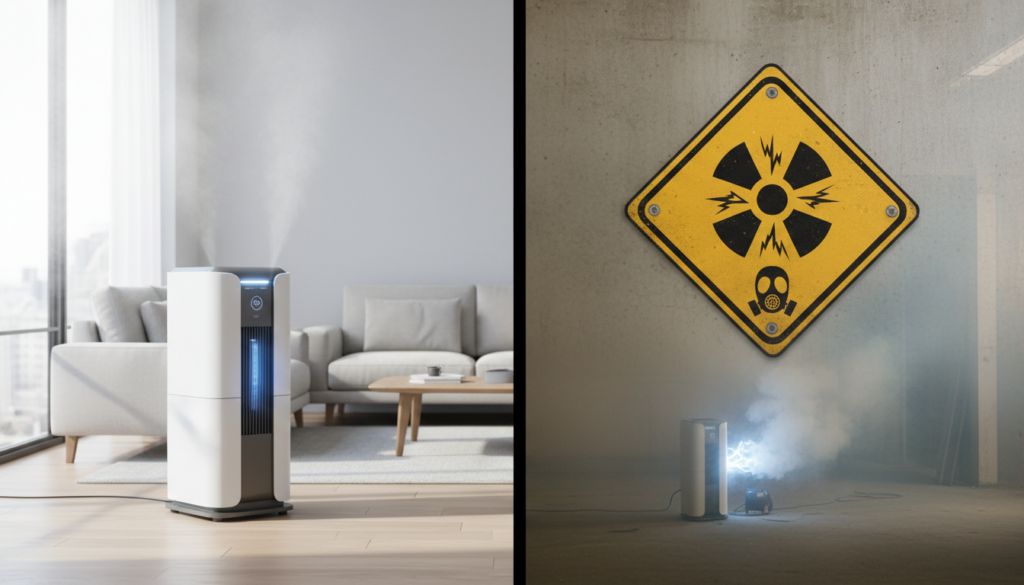
The answer lies in advanced smoke odor removal equipment. However, not all technology is created equal. In the professional restoration industry, two primary titans dominate the field: Ozone Generators and Hydroxyl Generators. Choosing between them isn’t just a matter of preference; it is a matter of science, safety, and the specific chemistry of your home’s environment. This guide provides a definitive, safety-first comparison to help you understand how we restore your indoor air quality.
The Science of Smoke Odor
To understand why a simple “air freshener” or a bowl of vinegar fails, we must look at smoke on a molecular level. Smoke is a complex byproduct of incomplete combustion. It contains particulates (soot), vapors (oils and tars), and gases (Volatile Organic Compounds or VOCs). When materials like synthetic carpets, pressurized wood, or kitchen plastics burn, they release “complex odors.”
These odor molecules are not merely sitting in the air; they are porous-surface invaders. They penetrate drywall, settle into fiberglass insulation, and bond with the fabrics of your upholstery. Smoke odor is essentially a chemical bond that has formed between the byproduct of the fire and the surfaces of your home. To neutralize it, we must break that bond. This is where professional-grade smoke odor removal equipment comes into play, utilizing oxidation to “dismantle” the odor molecules at their source.
How Ozone Generators Work
Ozone ($O_3$) is a highly reactive gas composed of three oxygen atoms. The oxygen we breathe is $O_2$. An ozone generator uses a high-voltage discharge (corona discharge) to split $O_2$ molecules, which then reassemble into $O_3$. Because this third atom is weakly bonded, it is “unstable” and looking for something to attach to.
When ozone is pumped into a smoke-damaged room, that third oxygen atom detaches and attaches itself to odor molecules. This process, known as oxidation, chemically changes the structure of the odor-causing substance. Once oxidized, the molecule no longer possesses the chemical signature of “smoke.” It is effectively neutralized, often leaving behind a “clean” smell similar to the air after a heavy thunderstorm.
In the restoration industry, we refer to this as “shock treatment.” It is incredibly effective for heavy protein fires (like burnt meat) or deep-seated structural smoke damage. However, because ozone is a powerful oxidizer, it is non-discriminatory. It will oxidize anything it touches—including the soft tissues in human lungs.
How Hydroxyl Generators Work
Hydroxyl radicals ($OH$) are often called the “detergent of the atmosphere.” In nature, they are created when the sun’s ultraviolet rays react with water vapor in the air. In professional restoration, hydroxyl generators replicate this process using high-intensity UV lamps and a specialized catalyst.
The machine draws in ambient humidity and passes it through a chamber where UV light breaks the water molecules ($H_2O$) into hydroxyl radicals. These radicals are even more reactive than ozone, but they have a much shorter lifespan—usually less than a second. They initiate a “cascade” reaction, where they strip hydrogen atoms from odor molecules, creating a chain reaction that breaks down VOCs and smoke particles throughout the treated area.
The primary advantage of hydroxyl technology is its safety profile. Unlike ozone, which is a gas that accumulates in a space, hydroxyls are highly localized and dissipate almost instantly. This allows the equipment to be used in environments that would otherwise be too sensitive for ozone treatment.
Safety Comparison
Safety is our absolute priority. When discussing smoke odor removal equipment, the distinction between these two technologies is stark. According to EPA guidelines, ozone is a potent lung irritant. Even at low levels, it can cause chest pain, coughing, and shortness of breath. For this reason, ozone treatment requires a 100% vacant property.
Before an ozone generator is turned on, a certified technician must ensure that:
- All human occupants have left the premises.
- All pets (including fish) are removed.
- Live plants are removed, as ozone will kill them.
- Sensitive materials like natural rubber, certain foams, and delicate silks are protected or removed, as ozone can cause them to become brittle or “dry rot.”
Hydroxyl generators, conversely, offer a “business-as-usual” approach. Because the concentration of radicals is kept at a safe level and they do not linger in the air like ozone gas, they can be operated while homeowners, pets, and even technicians are present. This makes them the definitive choice for NYC apartments or Long Island homes where the residents are staying in an unaffected wing of the house during the restoration process.
When We Use Each Method
As professionals, we don’t choose a tool based on convenience; we choose it based on the specific requirements of the job. There is a “right tool for the right time” philosophy in IICRC-standard restoration.
Ozone is used when:
- The damage is severe and structural.
- The house is entirely unoccupied.
- We need a fast “knockdown” of odors before other contractors enter the space.
- The odor source is “protein-based” (kitchen fires).
Hydroxyl is used when:
- The property is occupied.
- We are deodorizing “soft contents” like clothing, delicate rugs, or electronics that might be damaged by ozone.
- A slower, continuous treatment is preferred over a “shock” treatment.
- The weather is humid (hydroxyls require moisture in the air to function effectively).
The Cleaning Pre-Requisite
It is a common misconception that you can simply “gas” a house clean. Whether we use ozone or hydroxyls, these technologies are deodorizers, not cleaners. In the world of IICRC S540 standards, the first rule of odor control is Source Removal.
If soot and char remain on the walls, floors, or inside the HVAC system, no amount of ozone will permanently fix the problem. The odor will simply return once the machines are turned off. Before deploying our advanced smoke odor removal equipment, our team performs a meticulous physical cleaning. This involves:
- HEPA vacuuming to remove loose soot particles.
- Chemical sponging to lift oily residues from non-porous surfaces.
- Washing structural elements with specialized degreasers.
- Sealing “un-cleanable” charred surfaces with odor-blocking primers.
Only after the physical source of the odor is removed do we utilize atmospheric neutralization to address the “ghost” odors trapped in the air and deep within porous materials. For more information on this integrated approach, visit our Fire & Smoke Damage Restoration service page.
Comparison Data Table
| Feature | Ozone Generator | Hydroxyl Generator |
|---|---|---|
| Occupancy Safety | Unsafe (Must be vacant) | Safe (Can be occupied) |
| Speed of Action | Fast (Shock treatment) | Slower (Continuous process) |
| Material Risks | Can degrade rubber/plastics | Safe for most materials |
| Best Application | Severe, unoccupied odor removal | Occupied content cleaning |
Frequently Asked Questions
Q: Is it safe to stay home during ozone treatment?
A: No. Ozone is harmful to the lungs; people, pets, and plants must be removed from the treatment area for the duration of the cycle and a venting period afterward.
Q: Will these machines remove the smell of a “puff-back” from my furnace?
A: Yes, both technologies are effective for furnace puff-backs, provided the soot is first professionally cleaned from the home’s surfaces and ductwork.
Q: How long does the process take?
A: Ozone treatments usually last 12 to 48 hours depending on the severity. Hydroxyl treatments may run for 3 to 7 days since they operate at a slower, safer concentration.
Professional Assessment and Brand USP
Navigating the aftermath of a fire is overwhelming. At Upper Restoration, we bring more than just equipment to your doorstep; we bring advanced odor control technology deployed by IICRC-certified technicians who understand the nuances of Nassau and Suffolk County homes. We don’t just “mask” the smell—we scientifically eliminate it, ensuring your home is safe, breathable, and truly restored.
If you are struggling with the lingering scent of smoke, do not wait. The longer soot and odors sit, the more difficult they become to remove.
Ready to breathe easy again?
Schedule a professional smoke odor assessment today.