After a fire on Long Island, the flames may be limited to one room — but smoke damage rarely is. Smoke moves through every opening, travels through HVAC systems, and deposits soot on surfaces throughout a structure within minutes of a fire starting. The smell persists long after the visible soot is cleaned because smoke molecules embed deeply in porous building materials, fabrics, and contents.
Upper Restoration handles smoke damage repair across Long Island and New York City. This guide explains what the repair process actually involves and what separates professional smoke remediation from surface cleaning.
Smoke damage repair is more technically complex than most homeowners expect. Smoke doesn’t just discolor surfaces — it penetrates porous materials at a molecular level, migrates through wall cavities into areas untouched by fire, and continues to corrode and etch surfaces for weeks after the fire is out. Understanding the repair process before you start prevents the two most common costly mistakes: starting cleanup too early and using the wrong cleaning methods for the type of smoke residue present. For a complete breakdown of pricing, see our guide to smoke damage repair cost.
Why Smoke Damage Is Harder to Repair Than It Looks
Soot is not just dirt — it is an acidic, oily residue that actively corrodes the surfaces it coats. Left untreated, soot etches glass, tarnishes metals, and permanently stains porous materials. The longer it sits, the more damage it causes. And smoke odor is not on surfaces — it is inside them.
Three things make professional smoke damage repair necessary:
- Soot type varies: Dry smoke, wet smoke, and protein smoke require different chemical cleaning agents. Using the wrong cleaner can spread and set the soot permanently.
- Odor is structural: Smoke molecules penetrate drywall, wood framing, insulation, and subfloor materials. Surface cleaning does not reach them.
- Hidden spread: HVAC systems distribute smoke throughout the structure — ducts, air handlers, and filters must all be addressed to prevent odor recirculation.
The 4 Types of Smoke Damage (and Why the Type Determines the Repair)
Smoke residue behaves differently depending on what burned and at what temperature. Using the wrong cleaning approach for the residue type — the most common DIY error — spreads contamination, embeds soot deeper into surfaces, and invalidates insurance documentation. Identifying the type before starting is the essential first step.
| Smoke Type | Cause | Residue Characteristics | Cleaning Approach |
|---|---|---|---|
| Dry smoke | Fast-burning, high-temp fire (paper, wood) | Dry, powdery, non-smearing | Dry chemical sponge first, then wet cleaning |
| Wet smoke | Slow-burning, low-temp fire (rubber, plastic) | Sticky, smearing, strong odor | Specialized wet cleaning agents; do not dry-sponge |
| Protein smoke | Kitchen fires (food, grease) | Nearly invisible, extreme odor, varnish-like film | Enzyme-based cleaners; extremely difficult to remove |
| Fuel/oil smoke | Furnace puffbacks, fuel fires | Black, oily, penetrating soot | Chemical degreaser, HEPA extraction; often requires surface removal |
What Not to Do Before Smoke Damage Repair Begins
The actions you take in the first 24–48 hours after smoke damage can significantly increase total repair costs — or reduce them. The following are the most common homeowner mistakes that complicate professional restoration:
- Using a regular vacuum on soot. Standard vacuums lack the filtration to capture fine soot particles — they exhaust the particles back into the air and push them deeper into surfaces. HEPA-rated equipment only.
- Washing walls before dry-sponging. Applying water or liquid cleaners to dry smoke residue first causes it to smear and permanently stain porous surfaces. Dry chemical sponges must be used before any wet cleaning.
- Painting over smoke odor. Paint seals in odor temporarily, but smoke particles in the substrate continue to off-gas as temperature and humidity fluctuate. The odor returns within weeks. Deodorization of the substrate must precede any repainting.
- Discarding contents before insurance documentation. All damaged items should be photographed and inventoried before removal. Discarding items before adjuster sign-off is the leading cause of claim underpayment.
- Delaying HVAC system cleaning. Smoke particles travel through ductwork within minutes of a fire. If HVAC cleaning is omitted, smoke odor recirculates throughout the entire building after restoration is otherwise complete.
The Smoke Damage Repair Process: Step by Step
Step 1: Safety Assessment and Air Quality Testing
Before any repair work begins, the property must be assessed for structural safety, electrical hazards, and air quality. Carbon monoxide, hydrogen cyanide (produced by burning plastics and synthetics), and fine particulate matter (PM2.5) are the primary airborne hazards following a fire. Professional-grade air quality testing establishes a baseline and identifies whether respiratory protection is required during cleanup. This step is not optional — it protects both workers and occupants and provides documentation for the insurance claim.
Step 2: Contain the Affected Area
Smoke migration is one of the most underestimated aspects of fire damage. Smoke travels through gaps around electrical outlets, plumbing penetrations, HVAC ducts, and wall cavities into areas of the structure that had no direct fire exposure. Professional containment uses polyethylene barriers and negative air pressure (HEPA air scrubbers exhausting to the exterior) to prevent soot from spreading to unaffected areas during the cleaning process. Skipping containment during cleanup is a primary cause of cross-contamination that turns a localized smoke problem into a whole-house problem.
Step 3: Remove Damaged Contents and Non-Restorable Materials
Porous soft goods — mattresses, heavily affected upholstered furniture, carpet padding, and insulation — typically cannot be fully cleaned of smoke odor and are more cost-effective to replace. Non-porous and semi-porous items (hard furniture, electronics, clothing, documents) are candidates for restoration via pack-out cleaning services. All items should be inventoried before removal for insurance documentation. Your restoration contractor can provide an item-by-item restorability assessment that satisfies most insurance adjuster requirements.
Step 4: Dry Soot Removal from All Hard Surfaces
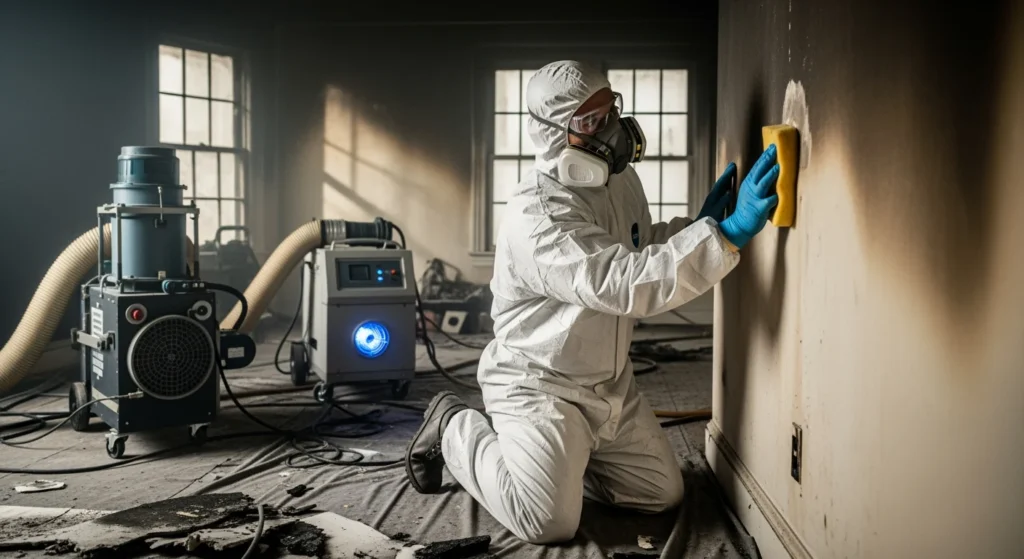
Dry chemical sponges are used to lift dry smoke residue from walls, ceilings, and hard surfaces without smearing. This step must come before any liquid cleaning. For heavily coated surfaces, HEPA vacuuming precedes sponging. The dry-sponge step is non-negotiable for dry smoke residue — it is not a preparatory step that can be accelerated or combined with wet cleaning.
Step 5: Wet Cleaning and Degreasing
After dry soot removal, affected surfaces are cleaned with detergent solutions appropriate to the residue type. Wet smoke and fuel/oil soot residues require chemical degreasers. Protein smoke residue requires enzyme-based cleaners specifically formulated to break down organic matter. Standard household cleaners are not effective and can set stains permanently.
Step 6: HVAC Duct Cleaning
All supply and return ducts must be professionally cleaned after any structural fire. HVAC systems act as smoke distribution networks — soot and odor-causing compounds deposit on duct interior surfaces and on the evaporator coil and blower fan. Professional duct cleaning uses negative pressure extraction combined with mechanical agitation to remove deposits. The air handler unit (coil, blower, and drain pan) should be cleaned separately from the ductwork. Failure to clean the HVAC system is the single most common reason smoke odor returns after an otherwise complete restoration.
Step 7: Odor Neutralization of the Structural Shell
After surfaces are cleaned, the structural shell — wood framing, subfloor, drywall substrate — retains smoke odor that requires active neutralization rather than surface cleaning. Three methods are used depending on penetration depth:
- Thermal fogging: Solvent-based deodorizer heated into a fine aerosol that penetrates the same porous pathways smoke traveled. Most effective for deep structural penetration. Property must be vacated.
- Ozone treatment: High-concentration ozone oxidizes odor-causing molecules. Very effective but requires complete evacuation (including pets and plants) and cannot be used in occupied buildings.
- Hydroxyl generation: Slower-acting than ozone but safe for occupied spaces. Used when partial occupancy is required during restoration.
Step 8: Sealing, Priming, and Repainting
After deodorization is confirmed complete, smoke-damaged walls and ceilings are sealed with an appropriate primer before repainting. Shellac-based primers (such as Zinsser BIN) are the standard for heavy smoke damage — they block odor bleed-through that latex primers do not. Standard latex primer applied directly over smoke-damaged drywall without shellac-based sealing is the most common reason painted surfaces develop recurring odor and visible staining.
Smoke Damage Repair Costs: What to Expect
Smoke damage repair costs vary widely based on the type of residue, affected square footage, and extent of content involvement. As a general framework for NYC and Long Island projects:
| Scope | Typical Cost Range | Driving Factors |
|---|---|---|
| Single-room minor smoke (no fire) | $1,500–$4,000 | Surface cleaning, deodorization, repainting |
| Single-room with fire damage | $4,000–$12,000 | Adds structural cleaning, content pack-out |
| Multi-room or whole-house | $15,000–$50,000+ | HVAC, content restoration, structural repairs |
| Protein smoke (kitchen fire) | Add 30–50% to any category | Extreme difficulty; often requires surface replacement |
Standard homeowner insurance policies (HO-3) cover smoke damage repair when resulting from a covered peril. Document all damage before cleanup and call your insurer within 24 hours of the incident. Upper Restoration works directly with all major insurance carriers and can assist with the claims process, including adjuster documentation and xactimate estimates.
Smoke Damage Repair in NYC and Long Island
NYC residential smoke damage — particularly in pre-war buildings, co-ops, and multi-family brownstones — presents specific challenges. Older plaster walls and original wood millwork absorb smoke more deeply than modern drywall, and the shared HVAC and ductwork in multi-unit buildings means smoke from one unit can migrate to adjacent units within minutes. In co-op buildings, the proprietary lease typically requires notification of the board and managing agent within 24–48 hours of any casualty event.
Long Island homes — particularly Cape Cods and split-levels with finished basements — frequently show smoke migration into basement levels after a first-floor fire event, due to the stack effect that draws smoke downward into the structure at night when temperatures drop. This is a commonly missed area in DIY cleanup attempts.
Upper Restoration provides professional smoke damage repair services across Nassau County, Suffolk County, and all five NYC boroughs. We are licensed under NYS contractor requirements and work directly with insurance adjusters. See our related guides on the fire damage restoration process and 10 steps to recovering after fire damage.
Upper Restoration provides professional fire and smoke damage cleanup services across Nassau County, Suffolk County, and all five NYC boroughs — available 24/7.
Frequently Asked Questions About Smoke Damage Repair
How long does smoke damage repair take?
Minor single-room smoke damage can be completed in 3–5 days. Moderate damage involving multiple rooms typically takes 1–3 weeks. Whole-house smoke damage with structural involvement can run 4–8 weeks. The HVAC cleaning and odor treatment phases often determine the overall timeline more than surface cleaning does.
Can I repair smoke damage myself?
Minor smoke damage in a limited area can be addressed with the correct techniques — dry sponge first, then appropriate wet cleaning, HEPA vacuuming, and shellac-based primer before repainting. However, without proper containment and professional deodorization equipment, cross-contamination to unaffected areas is likely. Any smoke damage involving HVAC systems, structural materials, or more than one room should be professionally remediated.
How long does smoke smell last after a fire?
Without professional deodorization, smoke odor can persist indefinitely — the molecules are embedded in porous building materials and will continue off-gassing. Surface cleaning alone will not eliminate embedded smoke odor. Professional thermal fogging or hydroxyl treatment neutralizes the odor molecules inside the materials.
What is the hardest type of smoke damage to repair?
Protein smoke damage from kitchen fires is the most difficult and most frequently underestimated. It leaves a nearly invisible residue with an extremely persistent odor, and it bonds chemically to surfaces in a way that standard cleaning agents cannot break down. Enzyme-based cleaners are required, and affected surfaces often need to be replaced rather than cleaned.
Will my insurance cover smoke damage if there was no fire in my unit?
This depends on your policy and the source of the smoke. Smoke damage from a neighboring unit’s fire is typically covered under your own policy’s fire/smoke provision regardless of origin. Smoke damage from long-term use of a fireplace or candles (a maintenance issue rather than a sudden event) is typically excluded. Document the incident and call your insurer promptly.
How do I know when smoke damage repair is complete?
Professional post-remediation air quality testing using a particle counter or air sampling can confirm that airborne soot and VOC levels have returned to baseline. For odor, the ozone or hydroxyl treatment should be followed by a 24-hour airing-out period and then a professional nose test by someone who was not involved in the remediation work. Persistent odor after full treatment typically indicates an area of missed structural penetration.
Smoke and Fire Damage Restoration: When Repair Becomes Full Restoration
Smoke damage repair and fire damage restoration are related but distinct scopes of work, and understanding where one ends and the other begins affects both your insurance claim and the contractor you need.
Smoke damage repair addresses properties where fire was contained or extinguished quickly — the structure is intact, but smoke, soot, and odor have penetrated surfaces, contents, and HVAC systems. The repair process is cleaning, deodorizing, sealing, and repainting without significant structural work.
Fire and smoke damage restoration applies when fire has damaged structural elements — charred framing, compromised roof decking, burned subfloor, or any situation where structural integrity must be assessed and rebuilt before cosmetic repair begins. This scope requires licensed general contracting in addition to remediation work.
On Long Island and in New York City, the line between the two also has regulatory implications. Smoke damage repair on a contained scope may not require building permits. Fire damage restoration that involves structural repairs requires permits from the relevant municipality and, in NYC, Department of Buildings filings. Working without required permits creates title issues and can void insurance payments.
The practical test: if any load-bearing wall, floor joist, roof rafter, or structural beam was exposed to direct flame or requires replacement, the scope is fire damage restoration, not smoke damage repair. A qualified contractor will identify this in the initial walkthrough — and if they don’t ask about structural elements before quoting, that’s a red flag.
Smoke and Fire Damage: What Insurance Covers and
Fire and Smoke Damage Repair: Understanding the Scope
The terms “smoke damage repair,” “smoke damage repairs,” and “fire and smoke damage repair” are often used interchangeably, but the scope differs meaningfully — and the distinction affects your insurance claim, contractor selection, and permitting requirements.
Smoke damage repair applies when fire was contained or extinguished before structural elements were compromised. The structure is intact. Work involves cleaning soot, deodorizing surfaces, cleaning HVAC systems, sealing, and repainting. No building permits typically required for this scope in most Long Island municipalities.
Fire and smoke damage repair applies when the fire damaged structural components — charred framing, burned subfloor, compromised roof decking. This scope requires licensed general contracting in addition to remediation, and building permits are required in NYC and most Nassau/Suffolk municipalities. Asbestos testing is also required before any demolition in pre-1978 Long Island homes.
The practical test: if any load-bearing element was exposed to direct flame or requires replacement, you are in fire and smoke damage restoration territory. A qualified contractor identifies this in the initial walkthrough — the initial assessment should always include a structural evaluation, not just a cleaning estimate.
What Gets Disputed
Homeowners and renters insurance typically covers both smoke and fire damage under the dwelling and personal property sections of a standard policy. But the claims process has predictable friction points worth knowing before you file:
- Contents documentation: Smoke damage to personal property — clothing, electronics, furniture — is often underdocumented. Photograph and itemize everything before any cleaning begins. Cleaned items that still carry odor may need to be replaced, not just cleaned, and that distinction requires documentation.
- Odor claims: Smoke odor that persists after professional remediation is a legitimate additional loss. Adjusters sometimes push back on ozone treatment and thermal fogging costs — get these itemized separately in the contractor’s scope of work.
- Code upgrade coverage: If the fire revealed code violations that must be corrected before repair work can be permitted, the upgrade cost is often covered under “ordinance or law” coverage. Many homeowners don’t know this coverage exists until it’s too late to invoke it.
- ALE (Additional Living Expenses): If the property is uninhabitable during repairs, ALE coverage pays for temporary housing, meals, and related costs. Document every expense from day one.