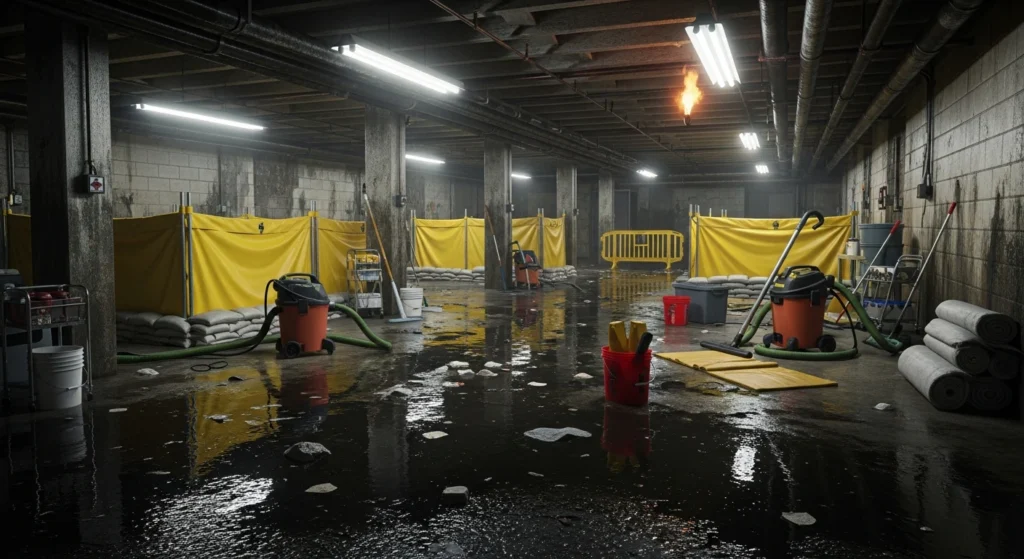
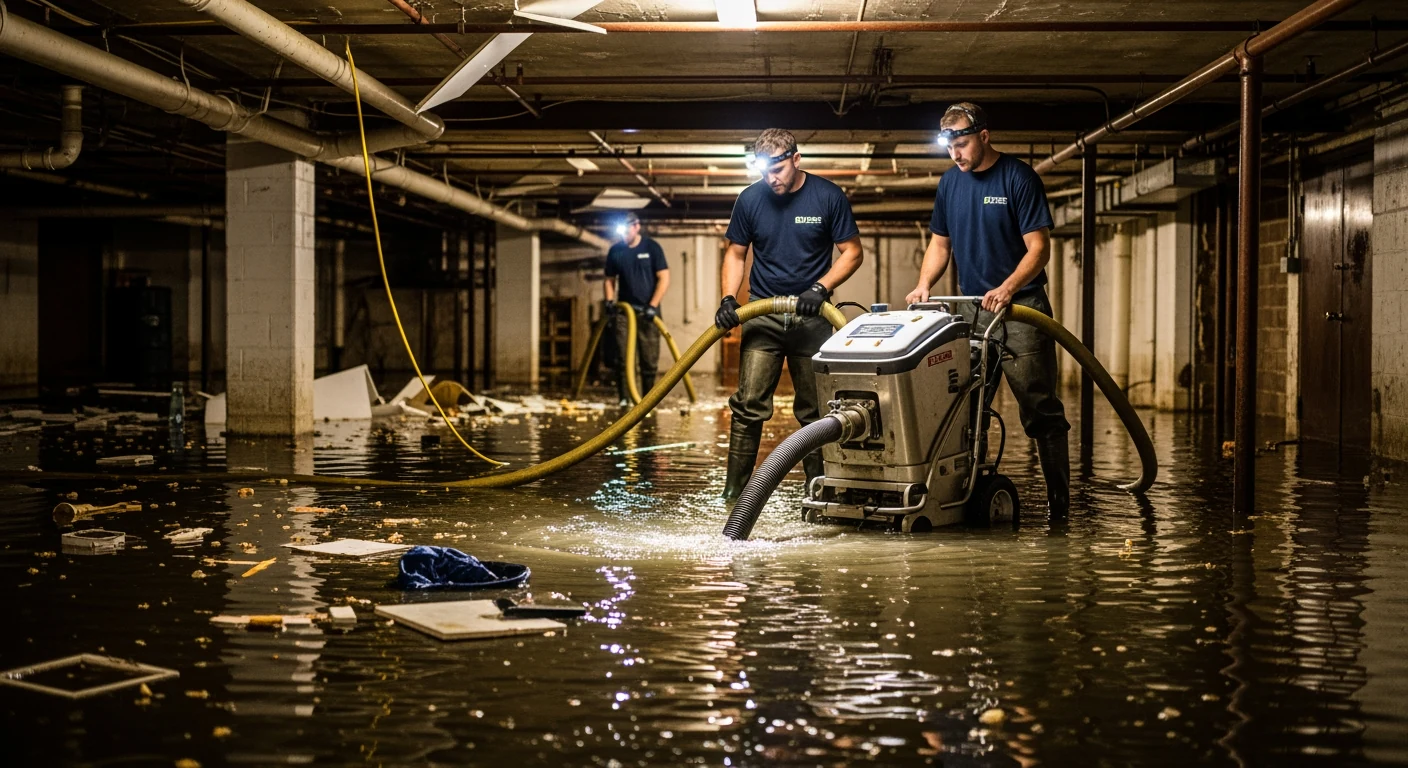
Sewage damage restoration on Long Island occupies a unique position in the restoration landscape: it is one of the most hazardous restoration services, one of the most poorly covered by standard homeowners insurance, and one of the most underdiscussed topics relative to its actual incidence across Nassau and Suffolk Counties. The island’s infrastructure tells the story. Long Island’s sewer systems — particularly in Nassau County and western Suffolk communities that developed rapidly in the 1950s and 1960s — are now 60 to 70 years old. The lateral lines connecting homes to municipal sewers in these communities have been corroding and root-infiltrating since installation. The result is a predictable and recurring pattern of sewage backup events that are structurally driven, not incidental.
This guide covers sewage cleanup and restoration across Long Island’s 13 townships — the infrastructure conditions that drive backup events, the Category 3 contamination protocol required for all sewage losses, the health hazards specific to Long Island’s sewage event profile, cost benchmarks, the insurance landscape, and the seasonal and environmental triggers that elevate sewage risk across the island.
Long Island’s Sewage Infrastructure: Why Backups Happen Here
Long Island’s sewage infrastructure divides into two systems with different failure modes: municipal sewer systems in Nassau County and western Suffolk communities, and private septic systems in central and eastern Suffolk. Each system has failure patterns specific to its design and age.
Municipal Sewer System Age and Failure
Nassau County’s municipal sewer network was largely constructed between the 1920s and the 1960s, with the major expansion coinciding with post-war suburban development. The primary pipes and lateral connections installed during the 1950s expansion are now 65 to 75 years old — well beyond the 40 to 50 year design life for vitrified clay pipe, which was the dominant sewer pipe material of the era. Root infiltration through pipe joints is the most common failure mechanism: tree roots from the dense suburban tree canopy in Nassau’s older neighborhoods grow into lateral pipe joints seeking moisture, and over decades, these root masses can partially or completely obstruct flow. During heavy rainfall events, when storm water inflows exceed sewer capacity in older combined systems, the excess hydraulic pressure forces sewage backward through the path of least resistance — which is frequently the basement drain, toilet, or laundry drain of the lowest-lying structure on the affected lateral.
In Nassau County communities including Freeport, Valley Stream, Elmont, and the older incorporated villages of Hempstead town, basement sewage backups during and after heavy rain events are a documented, recurring phenomenon. Residents who have experienced sewage backup once have a substantially elevated probability of experiencing it again during subsequent storm events until the municipal infrastructure is repaired or replaced — a capital project that is decades behind in many Nassau communities.
Private Septic Systems in Suffolk County
Approximately 60 percent of Suffolk County’s population is served by private septic systems rather than municipal sewer connections. Suffolk County’s sole-source aquifer — the island’s only source of fresh groundwater — has been under pressure from decades of nitrogen loading from these systems, which drove the Suffolk County Septic Improvement Program (SCSHIP) launched in 2018 to subsidize replacement of conventional systems with advanced nitrogen-removing alternatives.
For sewage cleanup purposes, failed septic systems produce Category 3 contamination events at the surface and in basements adjacent to the drain field. High water table conditions — the water table in much of Nassau and western Suffolk can be as shallow as 2 to 8 feet below grade — cause septic system failure when the table rises during heavy rain events and the leach field loses infiltration capacity. The result is sewage surfacing in the yard and sometimes backing up into basement fixtures.
Category 3 Classification: Why Sewage Cleanup Is Fundamentally Different
The IICRC S500 Standard classifies all sewage-contaminated water as Category 3 — the most severe water damage classification. Category 3 water contains sewage, pathogenic microorganisms, and contaminants that present immediate health risks and require a fundamentally different restoration protocol from Category 1 (clean water) or Category 2 (gray water) events.
The critical protocol requirements in Category 3 restoration:
- All wet porous materials must be removed: Unlike Category 1 water damage where wet drywall can sometimes be dried in place, Category 3 contamination requires demolition and removal of all wet porous materials — drywall, insulation, carpet, padding, wood flooring — to 12 inches above the visible waterline. These materials cannot be decontaminated; they must be removed as contaminated waste.
- Full containment and negative air pressure: 6-mil poly containment at all doorways and penetrations, with HEPA air scrubbers exhausted to the exterior maintaining negative pressure throughout the Category 3 scope.
- EPA-registered antimicrobial treatment: All remaining structural surfaces within the affected area must be treated with an EPA-registered disinfectant rated for Category 3 applications. Standard household bleach solutions are not appropriate for structural decontamination in sewage events.
- Clearance testing before reconstruction: ATP swab testing or air sampling confirms decontamination of all structural surfaces before any reconstruction begins.
South Shore Bay Water: The Category 3 Risk Most Homeowners Miss
On Long Island’s south shore, the Category 3 classification applies beyond sewer backups. Storm surge that brings Great South Bay, Reynolds Channel, or Jamaica Bay water into south shore Nassau and Suffolk communities is classified as Category 3 because bay water in these areas carries sewage discharge from the island’s drainage systems. Every flooded basement in Freeport, Oceanside, Baldwin, Amityville, or Lindenhurst during a storm surge event is a Category 3 loss — regardless of whether the visible water appears clean or murky. Contamination is determined by water source, not appearance.
This means south shore Nassau and western Suffolk homeowners who experienced what appeared to be clean flooding during Sandy and other storm events may have Category 3 contamination in structural assemblies that was never properly addressed. Homes with finished basements that were flooded and dried without full Category 3 protocol may retain structural contamination that represents a health risk and a material disclosure obligation at property sale.
Cost Benchmarks for Sewage Cleanup on Long Island
- Basement sewage backup (toilet or floor drain overflow, 200-400 sq ft): $4,500-$11,000 for full Category 3 protocol including extraction, containment, material demolition, structural decontamination, drying, and antimicrobial treatment. Reconstruction of demolished materials is a separate subsequent scope.
- Full basement sewage event (main line failure, floor-to-ceiling backup): $12,000-$28,000 for extensive Category 3 scope with full basement finish demolition, structural decontamination, extended drying, and clearance testing.
- Storm surge Category 3 flooding (south shore communities): $18,000-$45,000+ — the full storm surge water damage scope with Category 3 protocol layered on top, representing the most labor-intensive and time-consuming restoration sequence on Long Island.
- Septic system surface failure (Suffolk County): $3,500-$9,000 for surface decontamination and affected soil removal. Septic system repair or replacement is a separate scope from the structural decontamination work.
Insurance Coverage for Sewage Backup on Long Island
Standard homeowners policies (HO-3 and HO-5) exclude sewage backup as a covered peril. It is treated as a service line or drainage backup event, not a sudden and accidental water discharge. Most Long Island carriers offer sewage backup endorsements as optional add-ons providing $10,000 to $25,000 in additional coverage for $50 to $200 annually. Given that Long Island sewage cleanup routinely exceeds $15,000, this endorsement is among the most cost-effective coverages available — and among the most under-purchased.
Sewage backup caused by storm-related sewer surcharging — the most common cause in Nassau County’s older sewer communities — may be further complicated by the flood insurance exclusion. If a carrier argues the backup was caused by flooding rather than internal drain failure, the standard policy may deny coverage entirely, leaving the homeowner to rely on a backup endorsement if purchased or a flood policy if the flooding trigger is defensible.
Seasonal Sewage Risk Calendar for Long Island
Spring (March-May): Peak sewage backup season. Spring snowmelt and rainfall saturate Long Island’s shallow soils and overwhelm aging combined sewer systems in Nassau County. High water table conditions in western Suffolk push septic systems toward failure. April and May produce the highest volume of sewage backup events in Upper Restoration’s Long Island project data.
Summer (June-September): Hurricane and tropical storm season. Any significant rainfall event that produces surface flooding in south shore communities carries Category 3 risk from bay water intrusion. Suffolk County septic failures increase when summer drought causes soils to crack and then absorb intense convective rainfall that the septic system cannot handle.
Fall (October-November): Nor’easter season begins. October and November storms in Nassau’s south shore communities produce the same storm surge and sewer surcharging pattern as spring events. This is also when homeowners discover that late-summer slow leaks in basement plumbing fixtures have been contaminating basement assemblies.
Winter (December-February): Frozen lateral lines in Nassau’s older neighborhoods are a distinct sewage backup trigger. Lateral pipes that run near or through uninsulated crawl spaces or shallow exterior runs can freeze during extended cold snaps, blocking the drain path and causing backup when fixtures are used.
Township Sewage Data Files
Upper Restoration maintains township-specific sewage cleanup data files for all 13 Long Island townships. Each file addresses the local sewer or septic infrastructure conditions, Category 3 contamination risk profile, regulatory context, and cost benchmarks specific to that township. Links coming as township files are published.
See also: Hazardous Material Remediation on Long Island