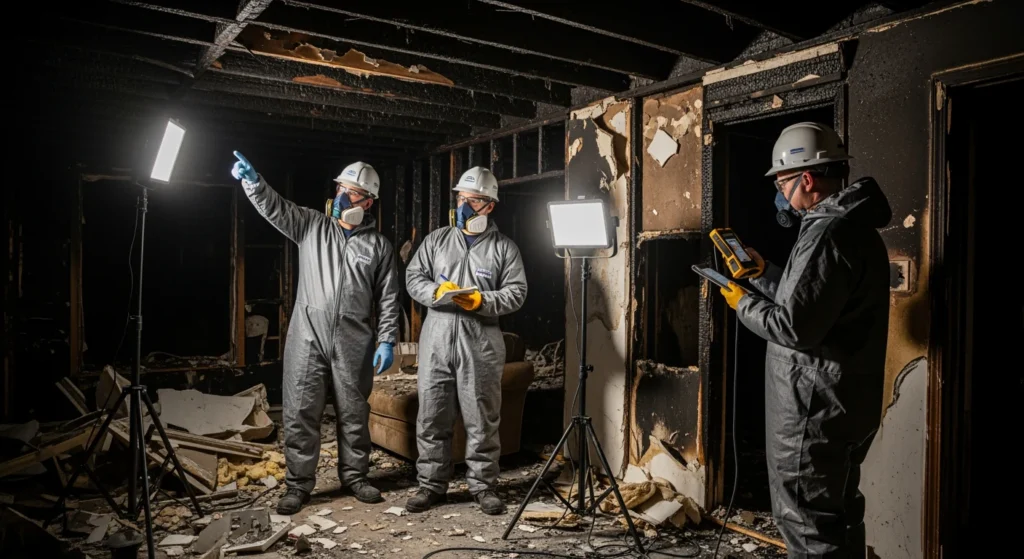
The fire restoration industry classifies smoke into types based on the fuel source and combustion conditions, because each type requires different cleaning chemistry to remove effectively. Applying dry soot cleaning chemistry to protein smoke produces near-zero visible improvement. Applying wet smoke cleaning approaches to dry soot produces smearing and spread. The classification is not academic — it directly determines whether the surfaces in a Long Island home after a fire can be cleaned to pre-loss condition or require replacement.
Dry Smoke: High Temperature, Fast-Burning Fires
Dry smoke results from fast, high-temperature fires with plenty of oxygen — the complete combustion conditions that produce fires like paper, dry wood, or light furnishings burning quickly. The soot is dry, powdery, and relatively easy to remove from non-porous surfaces with dry chemical sponge and chemical cleaning agents. It does not smear as readily as oil-based soot. Dry smoke has the highest surface coverage but typically the lowest penetration depth into porous materials, making it more amenable to surface cleaning without material replacement. The majority of Long Island residential structure fires — kitchen fires, fireplace-adjacent wood fires — produce some component of dry smoke.
Wet Smoke: Low Temperature, Smoldering Fires
Wet smoke results from smoldering, low-temperature, oxygen-limited combustion — the conditions produced by burning plastics, rubber, or synthetic materials at temperatures below their full combustion threshold. The soot is sticky, highly penetrating, and produces the most complex odors of any smoke type. Wet smoke penetrates porous materials more deeply than dry smoke and bonds to surfaces in a way that resists dry cleaning. It requires wet chemical cleaning methods and frequently encapsulation after cleaning to prevent continued odor emission from materials that absorbed smoke compounds. A kitchen fire where a plastic-handled pot smoldered on a stove produces wet smoke soot that cannot be cleaned with the dry sponge approach used for a paper fire.
Protein Smoke: Nearly Invisible, Maximum Odor
Protein smoke results from the combustion of organic materials with high protein content — food burning in an oven, a kitchen fire involving meat or other protein-rich foods. Protein smoke produces minimal visible soot deposition: surfaces appear essentially clean. The smoke is a nearly invisible, vaporized protein residue that deposits as a thin film on surfaces throughout the structure. The film is essentially odorless when cold but produces intense, lingering odor at cooking temperatures — homeowners consistently describe a persistent sour, rancid odor whenever the oven or stove is used after a protein smoke event, even after apparent cleaning. Standard smoke cleaning procedures produce no visible improvement on protein smoke events because there is nothing visible to remove. Protein smoke requires specialized enzymatic cleaning agents that break down the protein residue, applied to every surface in the affected area including inside appliances.
Puffback Smoke: Oil-Based, Requires Solvent Pre-Treatment
Oil soot from furnace puffback events is a distinct fourth category not covered in the standard three-type classification. It requires solvent pre-conditioning before any contact cleaning — see the puffback protocol article for the complete sequence. Nassau County’s Cape Cod communities experience puffback events at a rate that makes this effectively a local smoke type category that any Long Island fire restoration contractor must be prepared to handle.