The Geography of North Shore Long Island Storm Damage
The North Shore of Long Island, stretching from the Great Neck peninsula through the “Gold Coast” estates of Old Westbury and Oyster Bay to the wooded bluffs of Port Jefferson and beyond, presents a unique set of challenges for property owners. Unlike the South Shore, where the primary concern is often surge and flooding, north shore long island storm damage is characterized by high-velocity wind events and the failure of a mature, dense tree canopy. The rolling topography and proximity to the Long Island Sound create microclimates where wind speeds can escalate significantly during a nor’easter long island residents have come to expect as a seasonal reality.
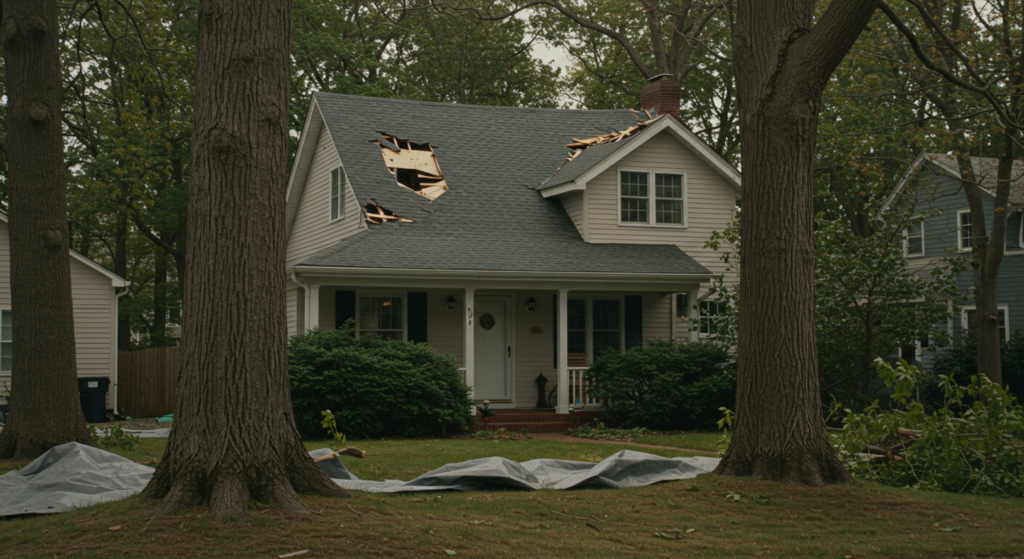
When a storm hits Nassau County, the combination of saturated soil and high-profile deciduous trees—many of which are over 80 years old—leads to significant structural impact. In neighborhoods like Sands Point and Locust Valley, the sheer volume of north shore tree damage often complicates emergency response. Large oaks and maples do not just fall; they often shear off sections of roofs, collapse gables, and bring down utility lines simultaneously. This intersection of tree, roof, and power emergencies requires a coordinated restoration approach that respects both the immediate safety of the structure and the long-term technical standards of the IICRC.
Emergency Tarping and Structural Board-Up Protocols
When a tree strikes a residence, the primary objective is to stabilize the structure and prevent secondary damage. This process begins with a professional assessment of the building’s envelope. In nassau county storm damage scenarios, the impact often compromises more than just the shingles. It can shift rafters, crack load-bearing walls, and shatter window systems. Long island roof damage following a major storm is rarely limited to a few missing tabs; it often involves structural penetration that allows rain to enter the building’s interior directly.
Upper Restoration prioritizes emergency stabilization through two main methods:
- Structural Board-Up: For homes with shattered windows or breached walls, we use 5/8-inch or 3/4-inch CDX plywood. This is not merely a visual deterrent but a structural necessity to keep the elements out and secure the property against unauthorized entry or wildlife intrusion while power is being restored.
- Emergency Roof Tarping: When the roof deck is compromised, we utilize heavy-duty, reinforced polyethylene tarps. Crucially, these are secured with furring strips rather than just sandbags or tape. A properly applied tarp must shed water away from the breach and be fastened to withstand the trailing winds that often follow a nor’easter long island storm system.
It is important to note that if your home was built before 1987, any structural disturbance to roofing materials or drywall may require a DEP ACP-5 asbestos inspection before significant demolition or restoration begins. Upper Restoration coordinates these compliance steps to ensure that suffolk storm cleanup and Nassau County repairs do not inadvertently release hazardous fibers into the living space.
Navigating the 72-Hour Insurance Documentation Window
The first 72 hours following north shore long island storm damage are critical for insurance recovery. Most homeowner policies (HO3 or HO5 forms) require the policyholder to take “reasonable steps” to mitigate further damage. This is where professional emergency services become vital. If a roof is left open to the rain for four days after the storm has passed, the insurance carrier may deny claims for the subsequent mold growth, citing a failure to mitigate.
Best Practices for Property Documentation
Before any debris is moved, documentation must be exhaustive. While Upper Restoration handles the technical documentation for the restoration file, homeowners should maintain their own records of the following:
1. Date and Time Log: Precisely when the damage occurred and when you first contacted your carrier and restoration professionals.
2. Photo and Video Evidence: Wide shots showing the tree’s position relative to the house, and close-ups of the point of impact.
3. Utility Coordination: Documenting the ticket numbers from PSEG Long Island if power lines were involved. In many north shore tree damage cases, restoration cannot begin until utility crews have de-energized the lines and cleared the immediate electrical hazard.
Tree Removal vs. Structural Restoration: Defining the Scope
A common point of confusion for homeowners dealing with suffolk storm cleanup is the distinction between tree service and structural restoration. Most insurance policies have a “debris removal” cap, often ranging from $500 to $2,000 per tree, which may not cover the full cost of a crane-assisted removal of a 70-foot oak from your kitchen. Furthermore, tree companies are experts at cutting and hauling wood, but they are not trained in building science or moisture management.
When Upper Restoration manages a project, we coordinate with specialized tree crews to remove the weight from the house safely, but we take over the moment the tree is clear. Once the tree is removed, the “Category of Water” must be addressed according to IICRC S500 standards. Water entering a home via a storm is typically classified as Category 3 (Black Water) because it has traveled over the ground, through tree bark, and across roofing materials, collecting microbes and contaminants. This means that porous materials like insulation and carpet padding that have been saturated must be removed, not simply dried.
Long Island Roof Damage and Moisture Intrusion Standards
In the aftermath of long island roof damage, the invisible threat is often more dangerous than the visible hole. Moisture that travels down wall cavities can lead to mold growth (governed by IICRC S520 standards) within 24 to 48 hours. In the climate of the North Shore, where humidity levels often spike after a storm, the drying environment must be controlled immediately.
Upper Restoration utilizes industrial-grade LGR (Low Grain Refrigerant) dehumidifiers and high-velocity air movers to create a “pressure envelope” that pulls moisture out of structural lumber and subflooring. We monitor these levels daily using moisture meters and thermal imaging cameras to ensure that the home is reaching “dry standard” before any new drywall or finish materials are installed. This rigorous adherence to building science is what separates a professional restoration from a simple “patch and paint” job that may result in structural rot or indoor air quality issues years later.
Frequently Asked Questions
Does insurance cover the full cost of tree removal on the North Shore?
Generally, insurance covers tree removal only if the tree has landed on a “covered structure” (the house, a detached garage, or a fence). If a tree falls in your yard without hitting anything, coverage is often limited or non-existent. When a tree hits the house, the cost to remove the portion of the tree off the house is usually covered, though specific sub-limits apply depending on your policy.
How long does it take to get a roof tarped after a major storm?
Upper Restoration maintains 24/7 emergency crews for north shore long island storm damage. In the immediate aftermath of a major nor’easter, response times can vary based on local road closures and utility hazards, but our goal is always stabilization within 4 to 12 hours of the initial call.
What should I do if a tree brings down power lines on my property?
Do not approach the tree or the house. Contact PSEG Long Island immediately to report the downed line. Even if the power in your house is out, the line could still be “live” or could become energized at any moment. Restoration professionals cannot work on the structure until the utility company has officially cleared the site of electrical hazards.
Is storm water considered “dirty”?
Yes. Under IICRC S500 standards, rain that enters a building after hitting trees, roofs, or the ground is considered Category 3 water. It contains environmental contaminants and requires specific sanitization protocols. Simply “drying out” a carpet that was soaked by storm water is often insufficient and potentially hazardous to your health.
Talk to Upper Restoration
If you are facing the aftermath of north shore long island storm damage, you need more than just a contractor; you need a restoration partner who understands the specific architectural and environmental demands of Nassau and Suffolk Counties. From initial board-up and tarping to complex structural repairs and insurance navigation, Upper Restoration provides the technical expertise and calm professional guidance required to return your property to pre-loss condition. We handle the documentation, the IICRC compliance, and the structural stabilization so you can focus on your family’s safety. Contact our team to begin the restoration process with a firm that values precision and property integrity over quick fixes.