The Key Differences Between Mold and Mildew
| Characteristic | Mildew | Mold |
|---|---|---|
| Growth pattern | Flat, surface-only | Penetrates porous materials |
| Color | White, grey, or light yellow | Black, green, blue, white, orange |
| Texture | Powdery or fluffy | Fuzzy, slimy, or powdery |
| Smell | Musty but mild | Strong, earthy, or pungent |
| Location | Tile grout, shower surfaces, fabric | Drywall, wood, insulation, paper |
| Health risk | Low (irritant) | Moderate to high (species-dependent) |
| DIY treatment | Usually yes | Only under 10 sq ft in NY |
| Structural damage | No | Yes (degrades materials over time) |
What Mildew Looks Like and Where You’ll Find It
Mildew is a surface fungus — specifically, most of what homeowners call “mildew” is either Oidium or downy mildew, which grows on the surface of materials without penetrating them. In NYC and Long Island homes, mildew appears most commonly as:
- White or grey powdery growth on bathroom tile grout and caulk
- Light discoloration on shower curtain liners and bath mats
- Surface growth on window sills with condensation accumulation
- Flat grey or white patches on basement walls with minor moisture
The defining characteristic: mildew stays on the surface. You can wipe it off with a damp cloth and a mild cleaning solution. It grows back if the moisture condition isn’t corrected, but it hasn’t penetrated the material it’s growing on.
What Mold Looks Like and Why It’s Different
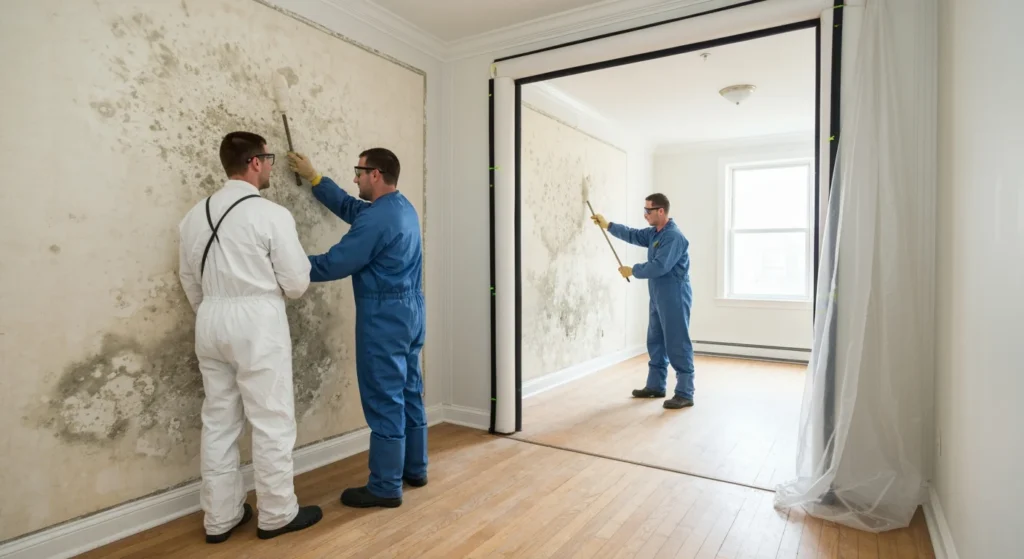
Mold — from genera including Cladosporium, Aspergillus, Penicillium, and Stachybotrys — grows into porous materials, not just on top of them. The visible growth on the surface is the tip of the problem; the mycelium network extends into the material itself. This is why painting over mold doesn’t work, and why scrubbing visible mold off drywall doesn’t solve the problem — the roots remain.
Color alone cannot identify mold species. “Black mold” is colloquial shorthand for Stachybotrys chartarum, but Cladosporium and Aspergillus niger also appear black. Green mold is typically Aspergillus or Penicillium. White mold is often mistaken for efflorescence (mineral deposits) on concrete and masonry — the test is whether it wipes off clean (efflorescence) or leaves staining (mold). The CDC’s guidance on mold health effects notes that no color-based identification is reliable — laboratory testing is required for species identification.
Health Effects: Mildew vs. Mold
Mildew Health Effects
Mildew exposure is generally a respiratory irritant at most — headache, coughing, sore throat in sensitive individuals. It does not produce mycotoxins. People with asthma or severe allergies may react more strongly, but mildew does not typically cause the serious health effects associated with mold exposure.
Mold Health Effects
Mold health effects range from mild allergic reactions to serious respiratory illness depending on species, exposure duration, and individual sensitivity. The National Institute of Environmental Health Sciences links mold exposure to asthma exacerbation, hypersensitivity pneumonitis, and — for species producing mycotoxins — more serious systemic effects.
Stachybotrys chartarum (true black mold) produces trichothecene mycotoxins that have been associated with serious health impacts at sustained high-exposure levels. However, the popular media narrative that “black mold” is uniquely lethal is not supported by the scientific consensus — the CDC notes that Stachybotrys is far less common in homes than other mold species and requires sustained water damage to develop. Any mold growth in quantity warrants professional assessment regardless of color.
When to Call a Professional vs. Handle It Yourself
New York State provides a clear legal threshold:
- Under 10 square feet: Homeowners may address mold themselves. Use N95 respirator, gloves, and eye protection. Fix the moisture source first — without source correction, mold returns.
- Over 10 square feet: NYS Labor Law Chapter 32 requires a licensed mold remediator for projects over this threshold. A licensed mold assessor must write a remediation plan before work begins.
- Any amount of mildew: DIY with household cleaners (diluted bleach on non-porous surfaces, commercial bathroom cleaners, or hydrogen peroxide). Fix the ventilation problem that caused it.
The practical test if you’re unsure whether you have mold or mildew: apply diluted bleach to a small area. If the discoloration lightens quickly, it’s likely mildew. If it persists or if the material feels soft or spongy beneath the surface growth, treat it as mold and get a professional assessment.
Preventing Both in NYC and Long Island Homes
Both mold and mildew are moisture problems. The prevention strategies are identical:
- Maintain indoor humidity below 60% — ideally 30–50% — using dehumidifiers in basements and high-humidity spaces
- Ensure bathroom exhaust fans vent to the exterior, not into attic space
- Fix plumbing leaks immediately — even slow drips under sinks create chronic moisture conditions
- Ventilate crawl spaces and basement areas adequately
- Address roof and window flashing failures before moisture enters the building envelope
- After any water event, dry affected materials within 24–48 hours using dehumidifiers and air movers
In NYC apartments where tenant control of building systems is limited, document moisture problems and notify building management in writing. Under NYC Housing Maintenance Code, landlords are required to maintain apartments free of conditions that cause mold growth — written notice creates the legal record for habitability complaints if conditions aren’t addressed.
Frequently Asked Questions: Mold vs. Mildew
How can I tell if I have mold or mildew?
Mildew is flat, powdery, white or grey, and grows only on the surface — it wipes off cleanly. Mold is fuzzy or slimy, can be black, green, blue, or white, and penetrates porous materials. Apply diluted bleach to a small area: quick lightening suggests mildew; persistent discoloration or a soft/spongy material beneath suggests mold. When in doubt, treat it as mold and get a professional assessment.
Is mildew dangerous?
Mildew is a mild respiratory irritant at most — headache, coughing, or sore throat in sensitive individuals. It does not produce mycotoxins and does not cause the serious health effects associated with mold exposure. However, mildew that is left untreated can create conditions for mold growth if the underlying moisture problem isn’t addressed.
Can I remove mold myself in New York?
For mold covering less than 10 square feet, New York homeowners may remediate themselves using N95 respirator, gloves, and eye protection — but the moisture source must be corrected first. For any mold project over 10 square feet, NYS Labor Law Chapter 32 requires a licensed mold remediator. A licensed mold assessor must also write a remediation plan before work begins.
What kills mold vs. mildew?
For mildew on non-porous surfaces: diluted bleach (1 cup per gallon water), commercial bathroom cleaners, or hydrogen peroxide work well. For mold: the same surface treatments may kill surface mold, but they don’t address penetration into porous materials. EPA-registered antimicrobial solutions applied by licensed professionals, combined with physical removal of contaminated material, are required for effective mold remediation above 10 square feet.
Does black mold require special treatment?
Stachybotrys chartarum (black mold) does require full containment and professional remediation, but its treatment protocol follows the same IICRC S520 and NYS Chapter 32 standards as other mold species — it’s not a separate special category legally or procedurally. Any mold covering more than 10 square feet requires a licensed professional in New York regardless of species or color.