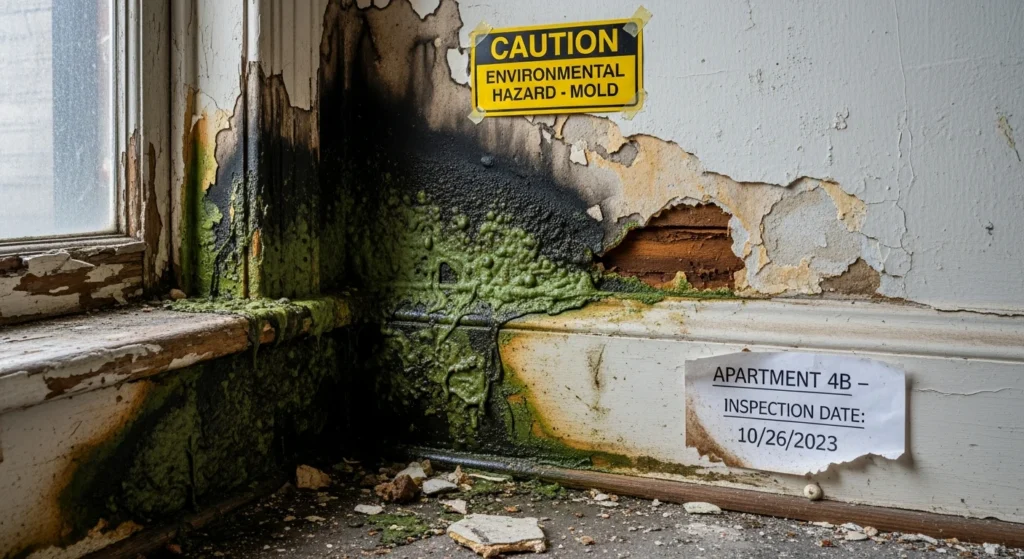
The Town of Huntington’s mold remediation demand originates primarily from its interior suburban housing stock rather than coastal flooding — the township’s Sound shore exposure, while real, affects a smaller portion of the housing base than the widespread split-level and Colonial construction in Huntington Station, Dix Hills, and Commack. The split-level’s below-grade family room is the defining mold habitat in Huntington: partially embedded in the ground, wrapped in original fiberglass batt insulation against uninsulated block, and ventilated by HVAC rather than by natural air movement. This assembly is endemic in Huntington Station and Dix Hills, and it produces mold reliably during Long Island’s summer humidity season. For the regulatory framework, see the Long Island Mold Remediation Master Guide.
The Huntington Split-Level Family Room: A Systematic Mold Producer
The split-level home’s below-grade level was designed as a family room or recreation space. Built in the 1960s and 1970s throughout Huntington Station, Dix Hills, and Commack, these rooms were finished with drywall nailed to wood framing installed directly against the concrete block exterior walls, with kraft-faced fiberglass batts between the framing and the block. The paper facing on the batt insulation — pressed against a surface that is consistently cooler than the interior air during summer — creates a condensation zone that initiates and sustains mold colonization throughout the summer humidity season.
The mold in these assemblies is not the result of a water event — there is often no visible moisture, no wet surface, no leak that a homeowner would notice. It is the slow accumulation of condensation behind a finished wall, feeding on the paper facing and the drywall paper face on the room side, growing for summers at a time before it becomes visible as discoloration at the base of the wall or produces the musty odor that finally prompts investigation. When Upper Restoration opens these walls in Huntington Station and Dix Hills, we find Penicillium and Cladosporium colonies covering the interior face of the block wall and the back face of the drywall in patterns that confirm years of undisturbed growth.
Cold Spring Harbor and Northport: Sound Shore Older Construction
Cold Spring Harbor and Northport’s older residential communities — particularly the pre-war and early post-war construction along the harbor waterfronts — face mold risk driven by the combination of Sound-shore humidity amplification and building assemblies without modern vapor management. These structures were built before vapor barriers became standard practice, and their original wall and floor assemblies absorb and hold moisture from the surrounding environment at levels that modern construction would prevent. Annual mold inspection and active humidity management are practical preventive measures for homeowners in Cold Spring Harbor and Northport’s older harbor-adjacent properties.
Cost Benchmarks
- Huntington Station or Dix Hills split-level below-grade family room mold: $7,000–$18,000 for mold remediation and assembly reconstruction — removing the original fiberglass-against-block assembly and rebuilding with appropriate drainage board and vapor management to prevent recurrence. Mold remediation alone without assembly correction produces recurrence within one to two seasons.
- Cold Spring Harbor or Northport older construction (crawl space or basement): $4,500–$12,000 for structural surface treatment with humidity management recommendations.
- Commack or Hauppauge attic or standard residential: $3,000–$8,000 for typical scope.