The Town of North Hempstead presents a bifurcated mold remediation landscape that follows the township’s own topographic and architectural divide. The Sound-shore peninsula communities — Great Neck, Kings Point, Sands Point, Port Washington, and Manhasset — contain a significant population of pre-war Tudor, Colonial, and estate construction with building characteristics that produce distinct mold risk profiles from the post-war stock. The interior communities of New Hyde Park, Mineola, Williston Park, and Herricks contain standard Nassau County post-war construction with the typical Cape Cod and Colonial mold risk patterns. Same township, different remediation considerations entirely. For the regulatory framework, see the Long Island Mold Remediation Master Guide.
Pre-War Estates: Moisture Retention in Historic Assemblies
The Gold Coast estates and pre-war residences of Great Neck, Kings Point, and Sands Point contain building assemblies that manage moisture fundamentally differently from modern construction. Original plaster-on-lath wall systems — dominant in pre-1945 construction — absorb and release moisture slowly rather than failing abruptly like modern drywall. A slow roof leak or a window seal failure in a 1930s Tudor may wet the plaster over weeks and months without producing the immediate visible ceiling staining that would prompt a modern homeowner to call for help. By the time mold is visible in these assemblies, it has frequently colonized the entire depth of the plaster and the wood lath behind it.
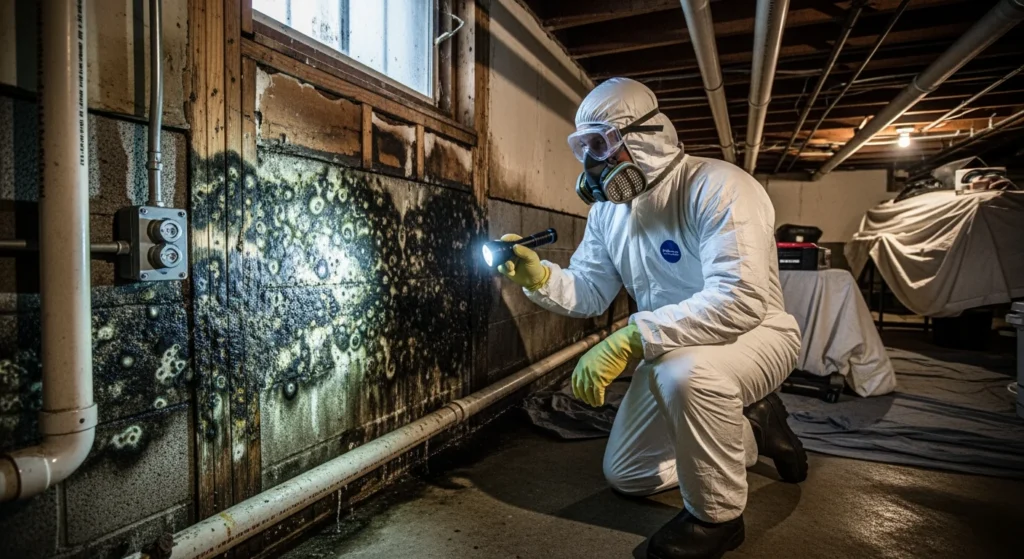
Crawl spaces and unfinished basement areas in North Hempstead’s older construction often retain original fieldstone foundation walls without any interior moisture barrier — these surfaces continuously transfer soil moisture into the below-grade space throughout the humid season. Original timber floor joists directly exposed to this humidity cycle develop Cladosporium and Penicillium surface growth that progresses slowly but persistently. The remediation of structural mold on original timber in a historic North Shore estate is a preservation-sensitive scope: wherever possible, treating and encapsulating mold on historic timber elements is preferable to demolition, preserving the building’s historic character while eliminating the health hazard.
Sound Shore Humidity Amplification
North Hempstead’s north shore communities are directly exposed to Long Island Sound — the body of water that maintains the island’s marine humidity pattern. Sound-facing properties in Sands Point, Kings Point, and the Port Washington peninsula experience consistently higher outdoor humidity than interior Nassau communities during the summer months, as the prevailing southwest summer wind picks up Sound moisture before reaching the north shore. This ambient humidity amplification means that the indoor humidity threshold for mold initiation is reached earlier in the season and sustained later than in the island’s interior communities.
Interior New Hyde Park and Mineola: Standard Nassau Pattern
The interior communities of New Hyde Park, Mineola, Williston Park, and Garden City Park carry the standard Nassau County post-war mold risk profile: Cape Cod attic mold from ice dams and inadequate ventilation, finished basement mold from summer humidity and aging sump infrastructure, and increasingly, wall cavity mold discovered during kitchen and bathroom renovation projects in homes built between 1950 and 1975. The mold species encountered in these interior communities — Cladosporium in attics, Penicillium/Aspergillus in HVAC-connected spaces, and occasional Stachybotrys in chronically wet sub-floor assemblies — are consistent with the broader Nassau County mold profile.
Cost Benchmarks
- Historic estate crawl space or basement mold (Great Neck, Kings Point): $4,500–$14,000 for structural surface treatment and moisture management in older construction, with historic preservation protocols for original timber framing.
- Attic mold (interior North Hempstead Cape Cod): $3,500–$8,500 for standard blasting, HEPA vacuuming, and antimicrobial treatment.
- Article 32 assessment and clearance: $800–$2,500 — mandatory for all projects 10 sq ft or more.