Mold Remediation in Montauk, NY: What Property Owners Need to Know in 2026
Montauk occupies the eastern tip of Long Island — a peninsula flanked by the Atlantic Ocean to the south and Block Island Sound to the north, 18 miles from the nearest inland community. No other community on Long Island has Montauk’s combination of factors: maximum Atlantic humidity exposure, the highest concentration of seasonal-use properties in Suffolk County, aging bungalow and cottage stock that was never designed for year-round occupancy, and a shallow groundwater profile throughout most of the peninsula. These factors combine to make mold one of the most persistent maintenance challenges facing Montauk property owners — and one of the most frequently underestimated.
Why Montauk Has a Chronic Mold Problem
Montauk’s ambient relative humidity rarely drops below 65 percent, even in dry winter periods — the ocean surrounds the peninsula on three sides. During summer months, relative humidity regularly exceeds 80 percent in coastal zones. Any space in a Montauk property that lacks mechanical dehumidification during occupancy, and most spaces during the six-to-eight-month seasonal closure, exists in conditions that continuously support mold growth wherever organic material and any moisture are present.
Crawlspaces are the primary mold site in Montauk. The peninsula’s sandy, permeable soil means groundwater is close to the surface throughout most developed areas. Many Montauk properties — particularly the original fishing community cottages and post-war bungalows in the hamlet and along the lake communities — have crawlspaces with inadequate or absent vapor barriers, allowing ground moisture to evaporate continuously into the space. Joist systems, subfloors, and insulation in these crawlspaces often carry years of mold growth that goes undetected until a sale inspection or a structural concern brings someone into the space. Full crawlspace encapsulation — 20-mil poly vapor barrier sealed to the foundation walls — is the permanent mitigation solution for most Montauk crawlspace mold situations.
Attic mold from inadequate ventilation is the second most common pattern in Montauk’s older housing stock. Original bungalows and cottages were typically built without ridge vents and with minimal soffit ventilation, creating stagnant attic air that cannot exhaust the moisture that migrates up from the living space during occupancy. Add the ambient coastal humidity and a property that sits closed for eight months, and attic mold is essentially inevitable without a ventilation upgrade.
NYS Article 32 Requirements in Montauk
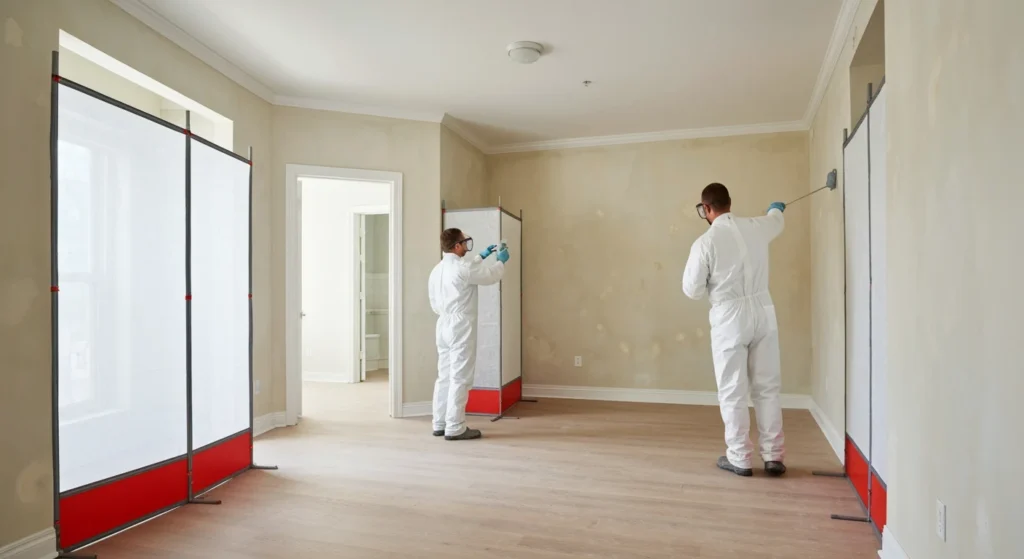
New York State Article 32 applies throughout East Hampton Township, including Montauk. Any mold project of 10 square feet or more requires a licensed NYS Mold Assessor to write the Mold Remediation Plan and a separate licensed Mold Remediator to execute it. Post-remediation clearance testing by the original assessor is mandatory before the project is legally complete. These requirements apply whether the property is a $400,000 fishing cottage or a $4 million oceanfront estate — the law makes no distinction.
For Montauk real estate transactions — which routinely include independent mold assessments in buyer due diligence — proper Article 32 documentation is what satisfies the buyer’s inspector. A mold remediation performed by an unlicensed contractor without proper documentation does not clear a Montauk property for sale and can delay or kill a transaction.
Mold Remediation Costs in Montauk (2026)
NYS Article 32 assessment and Mold Remediation Plan: $400–$900. Post-remediation clearance testing: $300–$600.
Crawlspace mold remediation (HEPA vacuuming, antimicrobial treatment of joists and subfloor, vapor barrier installation): $3,500–$12,000 depending on crawlspace size and mold extent. Attic mold remediation in a Montauk bungalow (HEPA vacuuming, cleaning, antimicrobial, ridge vent installation): $4,000–$14,000. Large seasonal-vacancy losses with multi-area involvement: $15,000–$45,000.
East End trade availability constrains scheduling in the off-season (October–May); projects requiring multiple subcontractors for both remediation and reconstruction can take four to eight weeks from assessment to clearance.