Mold on Long Island is not a random event. It is a predictable consequence of three intersecting conditions that are baked into the island’s physical and historical character: a building stock that is predominantly 50 to 80 years old, a climate where summer relative humidity consistently exceeds 70 percent, and a post-Sandy legacy of moisture events that were, in thousands of cases, imperfectly dried. When you understand these three conditions together, you understand why mold remediation is one of the most frequently needed restoration services across Nassau and Suffolk Counties — and why doing it wrong creates legal and financial exposure that follows a property through every future transaction.
This guide is the county-level authority document for mold remediation across Long Island’s 13 townships. It covers the environmental conditions that drive mold growth, the building stock characteristics that create risk, New York State’s Article 32 licensing requirements and how they apply to Long Island projects, cost benchmarks, the insurance landscape, and the seasonal pattern of mold discovery and remediation. Each of Upper Restoration’s township-specific mold data files links back to this guide for the regulatory and environmental framework.
Why Long Island’s Mold Problem Is Structural, Not Incidental
The national average for homes with mold issues is estimated at approximately 50 percent of all structures. On Long Island, several converging factors push that number higher — and make the mold that does occur more likely to be hidden, extensive, and entangled with other remediation requirements.
The Humidity Factor
Mold requires four things to grow: a surface, moisture, warmth, and time. Long Island’s marine climate provides three of those four in abundance for roughly five months of the year. From June through October, relative humidity on Long Island averages 70 to 75 percent during the day and climbs above 80 percent overnight. In a basement that was never designed for finished use — and then converted into a rec room, home office, or in-law suite as the original Cape Cod was expanded — that ambient humidity alone can sustain mold colonization on paper-faced drywall even without a visible water event. The critical threshold for mold growth on most building materials is 70 percent relative humidity sustained over 24 to 48 hours. Long Island’s summer climate meets and exceeds that threshold nearly every night from mid-June through mid-September.
The Post-Sandy Legacy
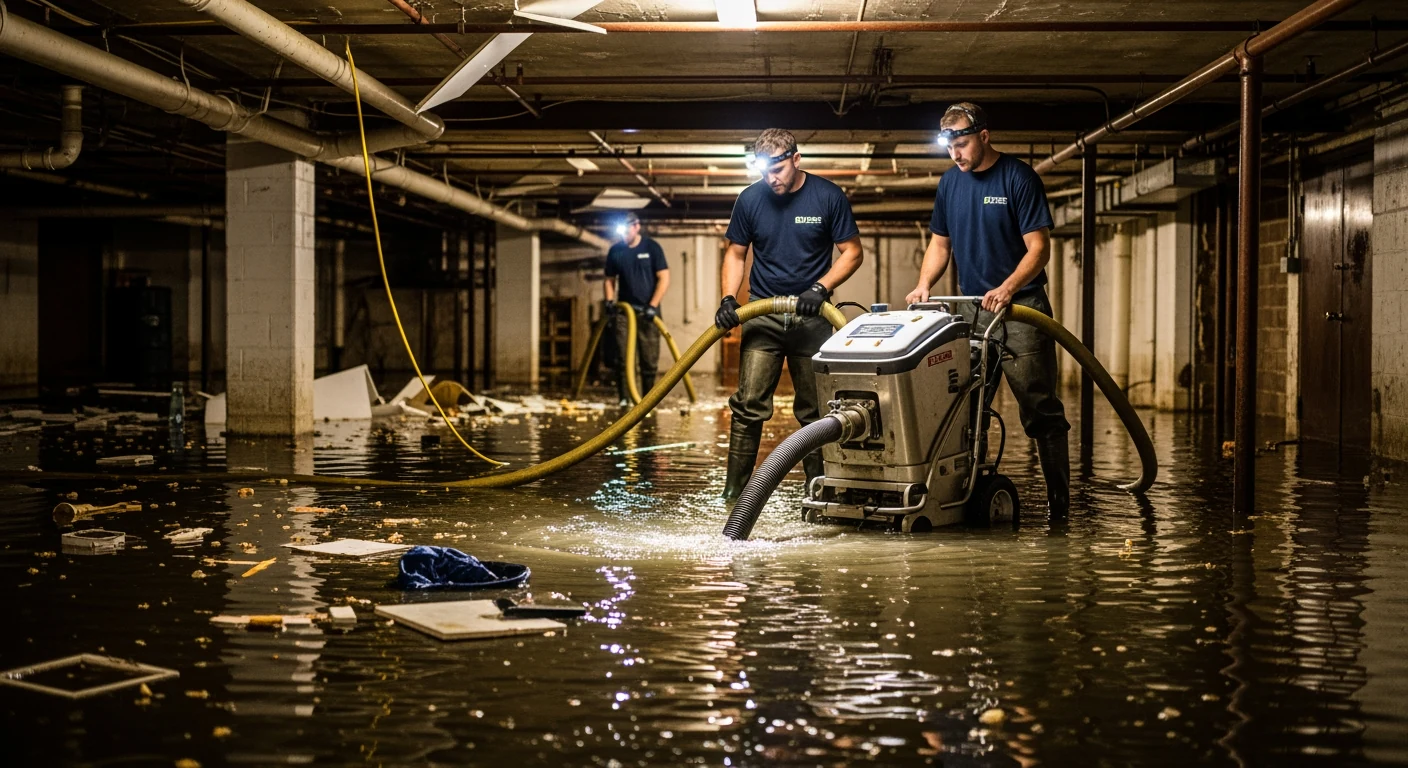
Hurricane Sandy flooded 95,534 buildings across Nassau and Suffolk Counties in October 2012. The immediate emergency response focused on water extraction and basic drying — but the IICRC’s own post-disaster assessment literature documents that in mass-casualty flood events, a significant percentage of structures receive incomplete structural drying. The combination of overwhelming demand for restoration services, extended power outages that prevented dehumidifier operation, and the complexity of evaluating Category 3 contaminated flood losses means that many Long Island homes that were flooded during Sandy have hidden mold colonies that were never properly identified or remediated.
More than a decade later, those homes are changing hands, being renovated, and having walls opened for the first time since the storm. Upper Restoration’s Long Island project data shows that mold discovered during renovation work on south shore Nassau and western Suffolk homes frequently traces to the 2012 flood event — visible in the form of staining and hyphal growth behind original-era drywall that was never removed, or in sub-slab and below-grade assemblies that never reached acceptable moisture levels following extraction.
The Building Stock Factor
Long Island’s post-war housing stock creates mold risk in specific, predictable locations that vary by housing type:
Cape Cod attics: The original Cape Cod’s steep-pitched roof with limited eave ventilation creates attic mold conditions when ice dams drive moisture under shingles in winter, or when bathroom exhaust fans are vented into the attic space rather than through the roof — a code violation in current construction but common in pre-1990 Capes. Attic mold on Long Island is frequently discovered during home sales inspections and constitutes one of the most common remediation triggers in Nassau County.
Split-level below-grade family rooms: The split-level’s partially below-grade family room level sits in the zone where exterior wall temperatures and interior humidity create consistent condensation risk. Original fiberglass batt insulation installed against the concrete or block foundation wall — without a drainage plane or vapor management — becomes a mold cultivation medium in the summer humidity window. These assemblies were standard construction in 1960s through 1980s split-levels across Babylon, Islip, and western Brookhaven.
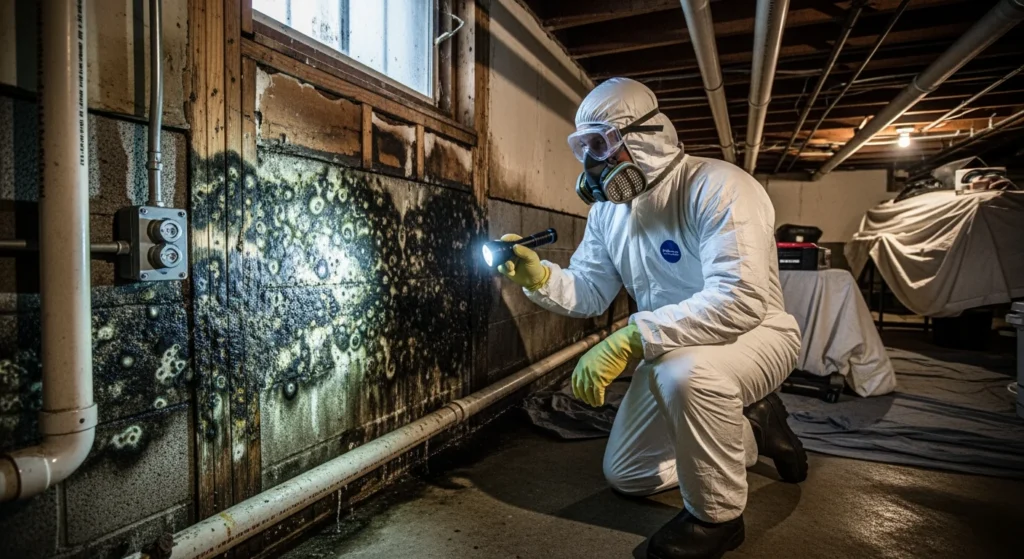
Finished basements in colonials: Long Island’s 1970s and 1980s colonial construction frequently includes finished basements with standard gypsum drywall installed directly against concrete block foundation walls, with kraft-faced fiberglass batts between the wall framing and the block. This assembly traps moisture in the fiberglass and provides a continuous paper food source for mold. Water table fluctuations during heavy rain events — even without standing water or visible flooding — can drive enough moisture into this assembly to initiate mold growth behind finished surfaces.
Crawl spaces in north shore homes: The north shore of Nassau and Suffolk has a higher proportion of homes built on crawl space foundations rather than full basements, particularly in hilly terrain where excavation would be expensive. Unconditioned crawl spaces with bare dirt floors are among the highest-risk mold environments in residential construction. Long Island’s water table depth in many north shore areas is sufficient to keep crawl space soil damp through most of the year.
New York State Article 32: The Legal Framework for Long Island Mold Remediation
New York State enacted Article 32 of the Labor Law to establish licensing requirements and minimum work standards for mold assessment and remediation. This law is the regulatory baseline for all mold work in Nassau and Suffolk Counties, and non-compliance carries civil penalties, claim denial risk, and property transaction complications that Long Island homeowners, landlords, and commercial property owners need to understand.
The Core Requirements of Article 32
Article 32 establishes three categories of licensed mold professional, each with distinct and non-interchangeable roles:
Licensed Mold Assessor: Conducts the initial evaluation of the suspected mold condition, collects bulk or air samples if indicated, and writes the Mold Remediation Work Plan that specifies the scope, methods, and containment requirements for the project. The assessor is legally prohibited from performing the remediation on the same project — this separation-of-powers requirement prevents contractors from inflating scope for financial gain and ensures independent oversight.
Licensed Mold Remediation Contractor: Executes the Mold Remediation Work Plan prepared by the assessor. Cannot deviate from the plan’s scope without assessor approval. Required to display signage at all accessible entrances to the remediation area during work. Required to provide the client with the work plan before beginning.
Licensed Mold Assessor (Post-Remediation): The original assessor or another licensed assessor must conduct a post-remediation assessment to confirm that mold has been removed in accordance with the plan, that the underlying moisture source has been addressed, and that the remediated area is clear. Without this clearance, the project is not legally complete under Article 32.
The 10-square-foot threshold: Article 32’s licensing requirements apply to mold remediation projects involving 10 square feet or more of mold-affected surface area. Projects below this threshold can legally be performed by unlicensed persons, including the property owner. However, in practice, mold affecting visible surfaces typically represents a small fraction of total mold extent — the 10 square feet visible on a finished drywall surface may be the tip of an infestation that extends through the wall assembly and into the structural framing behind it.
What Article 32 Means for Long Island Homeowners
In practice, Article 32 means three things for Long Island property owners:
First, any mold remediation contractor working in your home on a project of 10 square feet or more must carry a valid NYS DOL mold remediation license. Asking to see the license is not optional — it is due diligence. Unlicensed mold work may void your homeowners insurance coverage for the remediation claim and expose the contractor to civil penalties, but more importantly it exposes you to liability if the work is incomplete and mold returns or is discovered during a future property sale.
Second, the assessor and the remediator must be separate entities. Any company that offers to assess and remediate your mold in a single transaction — without separate licensed assessor and remediation entities — is operating outside Article 32 regardless of how they describe their workflow. Upper Restoration maintains its own NYS-licensed mold assessor staff who operate independently from our remediation crews for every project.
Third, you must receive a signed post-remediation clearance report from a licensed assessor before the project is complete. This document is your legal protection — without it, you have no independent confirmation that the mold was removed to Article 32 standards, and no documentation to provide to a future buyer or insurer.
Environmental Mold Risk Across Long Island’s Townships
Nassau County Mold Risk Profile
Nassau County’s mold risk is dominated by two factors: the concentration of post-war housing stock (the oldest suburban housing in the United States, built predominantly between 1945 and 1965) and the south shore’s flood history, which has driven moisture events into tens of thousands of homes that have been imperfectly remediated over decades of storm seasons.
The Town of Hempstead carries the highest mold discovery rate in Upper Restoration’s Long Island project data. Long Beach, Island Park, Freeport, and the south shore communities from Merrick to Wantagh have a documented history of repeated flooding — not just Sandy, but nor’easters, tropical remnants, and tidal surge events that occur multiple times in most years. Each event adds another layer of moisture risk to homes where previous events may not have been fully dried. The combination of older construction assemblies, high ambient humidity, and recurring moisture events creates the conditions for extensive hidden mold in wall cavities and below-grade assemblies across the Hempstead south shore.
North Hempstead and Oyster Bay carry elevated mold risk in their older housing stock — particularly the pre-war Tudors and Colonials on the Great Neck and Port Washington Peninsulas — but the frequency of flooding is lower than the south shore, so mold events are more often driven by plumbing failures, roof leaks, or chronic humidity than by storm surge.
Suffolk County Mold Risk Profile
Suffolk’s mold risk profile follows the same east-west gradient as its flood risk. Western Suffolk — Babylon, Islip, and Huntington — carries Nassau-equivalent risk from both housing stock age and flood history. The Islip south shore communities in particular (Bay Shore, East Islip, Islip Terrace) sustained significant Sandy damage and share the south shore mold discovery pattern seen in Nassau’s Hempstead south shore communities.
Central Suffolk presents a different mold risk pattern. Brookhaven’s large land area encompasses everything from densely developed 1960s south shore communities to rural agricultural land in the north — the mold risk is highly localized by sub-area. The Mastic-Shirley peninsula in southern Brookhaven sustained severe Sandy damage and has documented post-storm mold issues in a housing stock that is older and more densely packed than the eastern townships. Coram and Medford, in inland central Brookhaven, carry shallow water table risk that drives basement and crawl space mold unrelated to coastal flooding.
The East End townships — Southampton, East Hampton, Riverhead, Southold — carry lower mold incidence rates from flooding than western Long Island, but the high-value construction in the Hamptons creates a specific mold risk pattern: homes that are used seasonally, inadequately humidity-controlled during periods of vacancy, and then reopened in the summer to find mold growth that developed during periods of high humidity without active climate control.
Cost Benchmarks for Mold Remediation on Long Island
Long Island’s mold remediation cost structure is driven by the same labor market and building stock factors that affect water damage restoration. Validated benchmarks for common Long Island mold remediation scopes:
- Attic mold remediation (Cape Cod, 400–600 sq ft attic): $3,500–$9,000 including HEPA vacuuming of structural surfaces, dry-ice or media blasting of affected rafters and sheathing, application of EPA-registered antimicrobial sealant, improvement of attic ventilation to prevent recurrence, and post-remediation assessment and clearance. Attic mold in Long Island Capes is almost always Cladosporium or Penicillium/Aspergillus species feeding on the attic sheathing paper — extensive but typically contained to the attic assembly.
- Basement/crawl space mold remediation (partial, up to 200 sq ft affected): $2,500–$6,500 for remediation of mold on foundation walls, floor joists, and sub-slab surfaces, with containment and clearance. Does not include structural drying of an active moisture event — if the basement flooded, water mitigation is a separate prior scope.
- Wall cavity mold (post-flood, full demolition scope): $8,000–$25,000+ depending on extent. When mold is present in wall cavities following a flood event, the standard Article 32 protocol requires demolition of affected drywall, HEPA vacuuming and treatment of all structural surfaces within the affected cavity, replacement of insulation, and reconstruction. The cost range is wide because the extent of hidden mold behind finished surfaces is often larger than the initially visible affected area.
- Article 32 assessment and clearance fees (separate from remediation): $800–$2,500 for assessment and work plan; $600–$1,500 for post-remediation clearance inspection and report. These are mandatory costs under Article 32 for projects of 10 square feet or more and should be included in any legitimate mold remediation estimate.
The Insurance Landscape for Mold Claims on Long Island
Mold insurance coverage on Long Island is governed by one of the most complex and frequently litigated areas of property insurance law in New York. Standard homeowners policies (HO-3 and HO-5) typically cover mold remediation only when the mold is a direct, immediate result of a covered peril — typically a sudden water discharge event like a burst pipe or appliance failure. Mold that develops from a slow leak, chronic humidity, or flooding (which is excluded from standard policies) is typically excluded.
The practical consequence: most of Long Island’s mold problems — which trace to chronic moisture, high humidity, or storm flooding — are not covered under standard homeowners policies. This is why mold remediation on Long Island is predominantly a cash-pay or out-of-pocket service rather than an insurance-driven claim, unlike water damage restoration where insurance claims are more common.
The exception is mold that is directly attributable to a sudden, covered water event that the homeowner reported and had mitigated promptly. If a pipe bursts, a homeowner calls Upper Restoration within 24 hours, and we initiate proper drying immediately — but mold still develops because the water penetrated behind walls and the cavity couldn’t be dried without demolition — that resulting mold is typically covered under the same claim as the water damage. This is why prompt, documented response to water events is so important on Long Island: it preserves coverage continuity for secondary mold damage.
Seasonal Mold Pattern on Long Island
Winter discovery (December–March): Ice dam events drive moisture into Cape Cod attic assemblies and under roof shingles. Mold in these attic spaces is typically discovered when the homeowner goes into the attic during winter for storage access, or during spring home sale inspections. The mold colony has often been growing since the previous winter’s ice dam event.
Spring opening (March–May): Vacation homes on the East End and seasonal properties are opened after winter closures. In homes without adequate winter humidity control, spring opening frequently reveals mold growth in closets, on window sills, behind furniture, and in poorly ventilated bathrooms. The spring nor’easter window (March–April) also drives new moisture events that initiate the next cycle of mold risk.
Summer humidity peak (June–September): The highest ambient mold growth rate on Long Island. Existing moisture in wall cavities, uncontrolled basements, and crawl spaces reaches mold initiation thresholds during the extended high-humidity window. This is when homeowners discover musty odors in finished basements and crawl spaces, see mold on visible surfaces in poorly ventilated bathrooms and kitchens, and find colonization on stored goods in unconditioned spaces.
Fall renovation discovery (September–November): Fall is Long Island’s most active home renovation season — before the winter and after summer vacations. Renovation work that opens walls, removes flooring, or accesses attic spaces is the most common discovery pathway for hidden mold in Long Island’s older housing stock. Contractors and homeowners should plan for mold testing before any demolition work in pre-1980 construction, particularly in basement, crawl space, and attic areas that have a history of moisture exposure.
Long Island Township Mold Data Files
Upper Restoration maintains detailed, township-specific mold remediation data files for each of Long Island’s 13 townships. Each file applies the six mandatory data layers to mold risk specific to that township’s building stock, environmental conditions, regulatory context, and cost market. Use the links below to access the township guide for your area:
Nassau County
- Town of Hempstead — Highest mold incidence rate on Long Island. South shore post-Sandy legacy, dense pre-1960 Cape Cod stock. Coming soon.
- Town of North Hempstead — Great Neck and Port Washington older housing stock, Sound shore moisture patterns. Coming soon.
- Town of Oyster Bay — Hicksville, Massapequa, Farmingdale. South and north shore mold risk profiles. Coming soon.
Suffolk County
- Town of Babylon — Lindenhurst, West Babylon, Amityville, Deer Park. Great South Bay flooding legacy and 1960s split-level mold risk. Coming soon.
- Town of Brookhaven — Patchogue, Coram, Stony Brook, Mastic Beach. Diverse risk from coastal to shallow water table inland. Coming soon.
- Town of East Hampton — Seasonal vacancy mold, high-value construction. Coming soon.
- Town of Huntington — Huntington Station, Dix Hills, Commack. Sound shore and interior suburban mold patterns. Coming soon.
- Town of Islip — Bay Shore, Brentwood, Central Islip. Sandy legacy and Great South Bay exposure. Coming soon.
- Town of Riverhead — North Fork Peconic Estuary exposure, rural housing stock. Coming soon.
- Town of Shelter Island — Bi-directional Peconic Bay exposure, seasonal property mold risk. Coming soon.
- Town of Smithtown — Nissequogue River watershed, Kings Park, Hauppauge. Inland flooding and suburban mold patterns. Coming soon.
- Town of Southampton — South Fork barrier island exposure, Hampton Bays mold risk. Coming soon.
- Town of Southold — Greenport, Orient, Mattituck. North Fork Sound and Peconic exposure. Coming soon.
Frequently Asked Questions: Mold Remediation on Long Island
Does a Long Island homeowner need a licensed contractor to remove mold in their own home?
Under Article 32, a residential property owner may perform mold assessment and remediation on their own property without a license. However, this exception applies only to the owner personally — not to unlicensed contractors hired by the owner. Any contractor hired to perform mold remediation on 10 square feet or more must hold a valid NYS DOL mold remediation license. Additionally, owner-performed remediation produces no Article 32 clearance documentation, which creates disclosure and liability complications at property sale.
What types of mold are most common in Long Island homes?
The most common mold species in Long Island residential properties are Cladosporium (found in attics and exterior-facing assemblies, feeds on wood and paper), Penicillium/Aspergillus (found throughout interiors, associated with HVAC and moisture intrusion), and Stachybotrys chartarum — black mold — found in areas of sustained high moisture, such as permanently wet drywall paper and wet cellulose materials following flood events. Stachybotrys requires extended moisture (continuous wetness for weeks, not days) and is therefore more commonly found in homes with chronic leaks or inadequately dried flood losses than in acute single-event water damage.
How is mold discovered during a home sale handled in New York?
New York State requires property sellers to complete a Property Disclosure Statement that includes disclosure of known mold conditions. Mold discovered during a buyer’s inspection creates a negotiation point — buyers can request remediation as a condition of sale, request a price reduction, or withdraw. Under Article 32, the remediation must be performed by a licensed contractor and produce a post-remediation clearance report. Upper Restoration works directly with sellers’ attorneys and real estate agents to conduct Article 32-compliant mold remediation on an expedited timeline to preserve closing schedules.
Can mold grow in a Long Island basement without visible water damage?
Yes. In Long Island’s summer climate, ambient relative humidity above 70 percent is sufficient to initiate mold growth on paper-faced drywall, cardboard, stored fabric, and other porous materials in basements that have no active water intrusion. This is sometimes called ambient mold or hygroscopic mold — it requires no visible water event, only sustained high humidity. Basements without active mechanical dehumidification during Long Island’s June through September humidity window are at consistent risk for ambient mold colonization on finished wall and ceiling surfaces.
What is the difference between mold remediation and mold abatement?
Under Article 32, both terms describe the physical removal and treatment of mold. Remediation typically refers to the comprehensive process of removing mold, treating affected surfaces, and addressing the underlying moisture source. Abatement is used more specifically for the physical removal of mold-contaminated materials. In practice, a complete Long Island mold project involves both — abatement of affected materials followed by remediation of treated surfaces and moisture source correction.