Why Mold Remediation Costs More in New York Than National Averages
If you have searched mold remediation cost and found figures like “$500–$6,000,” those numbers reflect national averages that do not apply to the New York market. Several structural factors drive costs higher in NYC and Long Island:
- Labor rates: New York construction and remediation labor runs 25–40% above the national average, per RSMeans construction cost data.
- Access and logistics: Co-ops, condos, and attached row houses require coordination with building management, elevator scheduling, and hallway protection that adds cost and time.
- Regulatory requirements: New York City Local Law 55 and New York State mold assessment and remediation regulations (Chapter 32 of the Labor Law) impose specific licensing, documentation, and clearance testing requirements that add compliance costs.
- Building age: Pre-1980 construction frequently involves asbestos-containing materials that must be tested and potentially abated before mold remediation can proceed — adding a separate cost layer.
Mold Remediation Cost by Project Scope: NYC and Long Island
| Scope | Affected Area | NYC / LI Cost Range | Key Variable |
|---|---|---|---|
| Small / contained | Under 10 sq ft | $1,500–$3,500 | Single surface, bathroom or cabinet |
| Medium | 10–100 sq ft | $3,500–$8,000 | Drywall removal likely required |
| Large | 100–300 sq ft | $8,000–$18,000 | Structural materials affected |
| Extensive | 300+ sq ft | $18,000–$35,000+ | Multi-room, HVAC involvement |
| Full basement | Varies | $5,000–$20,000 | Waterproofing source required |
| Attic mold | Varies | $3,000–$12,000 | Access difficulty, roof decking |
| HVAC system | N/A | $3,000–$10,000 | Duct cleaning + coil treatment |
What Drives the Final Price: Seven Cost Factors
1. Affected Square Footage
Square footage is the primary cost driver. Remediation contractors price most projects based on the total area requiring treatment, including buffer zones around visible mold growth. The EPA’s Mold Remediation Guide defines areas over 10 square feet as requiring professional remediation — anything larger than a roughly 3×3 foot patch should not be DIY.
2. Mold Species
Black mold (Stachybotrys chartarum) and Chaetomium require more aggressive containment protocols than common species like Cladosporium or Penicillium. Species identification through air sampling or surface sampling — typically $300–$700 for a professional mold assessment — informs the remediation protocol and affects total cost.
3. Material Type
Mold on non-porous surfaces (tile, concrete, metal) can often be cleaned without material removal. Mold penetrating porous materials — drywall, wood framing, insulation, ceiling tiles — requires physical removal and disposal. In NYC buildings with plaster walls rather than drywall, remediation is more complex and typically more expensive.
4. Source of Moisture
Remediation without fixing the moisture source is pointless — mold will return within weeks. Source correction costs are separate from remediation costs and may include plumbing repairs, roof repairs, waterproofing, or HVAC fixes. Contractors who don’t ask about moisture source before quoting are not providing a complete solution.
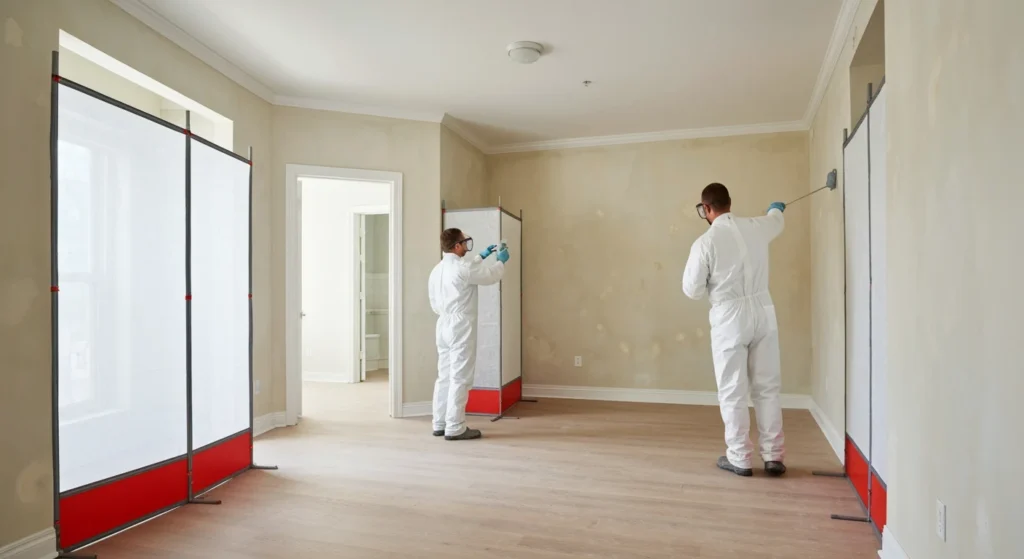
5. Containment Requirements
Under New York State Labor Law Chapter 32, mold remediation projects over 10 square feet require a licensed mold assessor to write a remediation plan before work begins and a separate licensed remediator to execute it. The assessor and remediator must be different companies. This two-party regulatory structure adds $500–$1,500 in assessment fees to most projects.
6. Post-Remediation Clearance Testing
New York State requires post-remediation clearance verification by the original licensed mold assessor — not the remediation contractor. Clearance testing costs $400–$900 and is a required line item, not optional. Projects that fail clearance require additional remediation before the space can be reoccupied.
7. Building Access and Logistics
Manhattan apartments, Brooklyn brownstones, and Long Island homes with limited access points all add complexity. Co-op and condo buildings require certificates of insurance, worker entry logs, and sometimes board notification before work begins. These logistics add 5–15% to project costs in managed buildings.
Mold Remediation Cost by Borough and Region
Labor and access conditions vary meaningfully across the New York metro area:
| Area | Cost Premium vs. National Avg | Primary Driver |
|---|---|---|
| Manhattan | 40–60% above national | Labor, access, logistics |
| Brooklyn / Queens | 30–45% above national | Labor, older building stock |
| Bronx / Staten Island | 25–35% above national | Labor, mixed housing types |
| Nassau County | 20–30% above national | Labor, suburban access |
| Suffolk County | 15–25% above national | Labor, travel time |
Does Homeowners Insurance Cover Mold Remediation in New York?
Coverage depends on the cause of mold. Standard New York homeowners policies follow this pattern:
- Covered: Mold resulting from a sudden, accidental covered water loss — burst pipe, appliance leak, storm-driven water intrusion. The mold remediation is covered as part of the water damage claim.
- Not covered: Mold resulting from long-term moisture problems, deferred maintenance, flooding (requires separate flood policy), or gradual leaks the homeowner knew about and did not address.
- Limited coverage: Many policies cap mold coverage at $5,000–$10,000 even for covered causes — check your policy declarations page for mold sublimits.
Under New York State Department of Financial Services regulations, insurers must respond to claims within specific timeframes. If your insurer is delaying a mold claim tied to a covered water loss, a licensed public adjuster can help document and negotiate the claim.
Mold Inspection Cost vs. Mold Remediation Cost
These are separate services with separate costs. A mold inspection (or mold assessment) comes first and informs the remediation scope:
- Visual mold assessment only: $300–$600
- Assessment with air sampling (2–3 samples): $500–$900
- Full assessment with surface and air sampling: $700–$1,500
- Post-remediation clearance testing: $400–$900
In New York State, the mold assessor who writes the remediation plan must be licensed under Chapter 32. The remediation contractor executing the work must hold a separate license. The same company cannot perform both services on the same project — this regulatory separation protects property owners from conflicts of interest.
Attic Mold Remediation Cost on Long Island
Attic mold is among the most common remediation projects on Long Island. Post-war Cape Cods, ranches, and colonials frequently develop attic mold from inadequate ventilation, bathroom exhaust fans venting into attic space instead of outside, or ice damming. Long Island attic mold remediation typically runs:
- Small affected area (under 100 sq ft): $2,500–$5,000
- Moderate (100–300 sq ft of roof decking affected): $5,000–$10,000
- Extensive (full attic, structural members): $10,000–$18,000
Attic mold remediation always requires fixing the ventilation source — adding soffit and ridge vents, rerouting exhaust fans, or installing powered attic ventilators. Remediation without ventilation correction will result in recurrence within 1–2 seasons.
How to Choose a Mold Remediation Contractor in NYC and Long Island
New York State licensing requirements give you clear verification checkpoints:
- Verify the mold assessor holds a valid NYS Mold Assessor license
- Verify the remediation contractor holds a valid NYS Mold Remediation Contractor license
- Confirm the assessor and remediator are different companies (required by law)
- Request proof of general liability insurance and workers’ compensation
- Ask for a written remediation plan before signing any contract — this is a legal requirement under Chapter 32
- Confirm post-remediation clearance testing is included in the scope
Upper Restoration holds all required New York State mold remediation licenses and carries full insurance coverage. Our certified mold assessors produce written remediation plans on every project, and we coordinate licensed third-party clearance testing as part of every completed remediation.
Frequently Asked Questions About Mold Remediation Cost
How much does mold remediation cost in NYC?
Mold remediation in New York City typically ranges from $1,500 for small contained areas to $35,000 or more for extensive projects involving multiple rooms or structural materials. NYC costs run 30–60% above national averages depending on borough, building type, and access conditions. The average mid-sized project (one to two rooms) runs $4,000–$10,000 in the five boroughs.
Does homeowners insurance cover mold remediation?
Standard homeowners insurance covers mold remediation when the mold results from a sudden, covered water loss like a burst pipe or appliance failure. Mold from long-term moisture problems, deferred maintenance, or flooding is typically not covered. Many policies also cap mold coverage at $5,000–$10,000 even for covered causes — check your policy declarations page for mold sublimits.
How long does mold remediation take?
Small to medium projects (under 100 square feet) typically take 1–3 days of active remediation plus drying time. Larger projects affecting multiple rooms or structural materials take 3–7 days or more. Post-remediation clearance testing adds 1–3 days for lab results. In NYC buildings, setup, logistics, and building access coordination can add 1–2 days before work begins.
What is the difference between mold removal and mold remediation?
Mold removal refers to physically removing visible mold from surfaces. Mold remediation is a broader process that includes containment, removal, treatment of affected materials, HEPA air filtration, moisture source correction, and post-remediation verification. Remediation addresses the conditions that allowed mold to grow — not just the visible mold itself. New York State regulates mold remediation specifically, not just removal.
Can I do mold remediation myself in New York?
New York State law requires licensed contractors for mold remediation projects over 10 square feet. Below that threshold, homeowners may address mold themselves, but the moisture source causing the mold must still be corrected or mold will return. For health reasons, even small DIY projects should use N95 respirators, gloves, and eye protection. If the affected area is over 10 square feet or involves HVAC systems or structural materials, hire a licensed professional.
How much does a mold inspection cost on Long Island?
A professional mold assessment on Long Island typically costs $300–$600 for a visual inspection only, or $500–$900 for an assessment with air sampling. Full assessments with both air and surface sampling run $700–$1,500. Post-remediation clearance testing — required by New York State after professional remediation — costs an additional $400–$900.
Why does mold keep coming back after remediation?
Mold returns after remediation when the moisture source has not been corrected. Common causes on Long Island and in NYC: bathroom exhaust fans venting into attic space instead of outside, foundation cracks allowing groundwater infiltration, failed roof or window flashing, and HVAC condensation draining improperly. Effective remediation always includes moisture source identification and correction — remediation without source correction is a temporary fix.