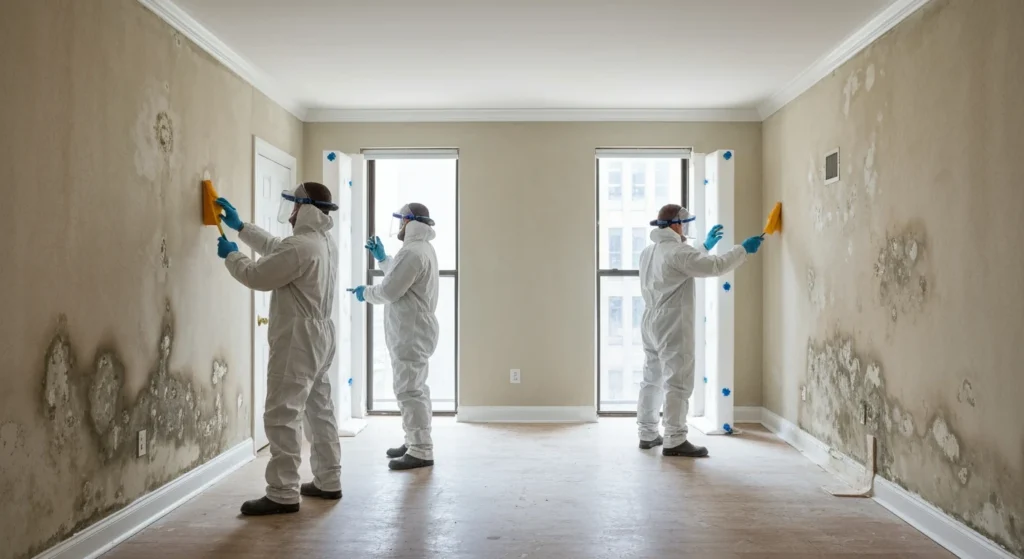
Mold behind walls is a common finding in New York and Long Island homes, particularly in older construction where vapor barriers were not standard and moisture management was not a design consideration. The challenge is that the mold causing the most significant indoor air quality problems may not be visible at all — it is growing in wall cavities, behind baseboards, or inside window bays where surface inspection cannot detect it.
Signs of Hidden Mold Without Visible Growth
The most reliable indicator of hidden mold is persistent musty odor in a specific room or area that does not correspond to any visible moisture or growth. Other indicators include occupants experiencing mold-related symptoms (nasal congestion, eye irritation, respiratory symptoms) only when in specific rooms, unexplained staining on baseboard or lower wall sections, wallpaper bubbling or separating from walls without an obvious water source, and visible mold on one side of a room that suggests a concealed source behind adjacent walls.
Air Quality Testing: The Non-Invasive First Step
Air quality testing with spore traps is the standard first step for detecting hidden mold. A certified industrial hygienist places collection cassettes in the affected space and in an outdoor reference location, then analyzes the samples in a laboratory to measure airborne spore concentrations and species composition. Elevated indoor spore counts — particularly of Stachybotrys, Chaetomium, or Aspergillus/Penicillium species — indicate active mold growth somewhere in the building envelope, even if no growth is visible. Air testing does not tell you exactly where the mold is, but it confirms whether it is present.
Thermal Imaging: Finding the Moisture Source
Since mold requires moisture, identifying hidden moisture is the key to locating hidden mold. Thermal imaging cameras detect temperature differentials in wall surfaces that indicate wet insulation, wet framing, or active condensation — all of which are conducive to mold growth. A trained thermographer can scan a room and identify the specific wall sections that show moisture signatures without opening any surfaces. Thermal imaging results guide the targeted physical investigation that follows.
When Physical Investigation Is Necessary
If air testing and thermal imaging both indicate hidden mold, physical investigation through small exploratory cuts in drywall is typically the next step. These cuts are made in the areas identified by thermal imaging, allowing a borescope to inspect the wall cavity. This approach is far less destructive than opening the entire wall and allows precise confirmation of mold location before remediation planning begins.
Frequently Asked Questions
Can I use a mold test kit from a hardware store to detect hidden mold?
Surface swab kits cannot detect mold that is not accessible on surfaces. Air sampling kits can detect elevated airborne spore levels, but consumer-grade kits are significantly less reliable than professional air sampling with laboratory analysis. For any serious concern about hidden mold, professional testing by a certified industrial hygienist is the appropriate standard.
See also: Mold Removal & Remediation in NYC & Long Island
Frequently Asked Questions
What does mold remediation involve?
Identifying moisture source, containing mold, HEPA filtering, removal, cleaning, and drying to prevent regrowth.
Is mold removal expensive?
Costs range from $500 (small areas) to $10,000+ (extensive mold). Early detection significantly reduces expenses.
How long does mold removal take?
Most remediation takes 1-5 days depending on extent. Professional containment is required to prevent spore spread.
Can I remove mold myself?
Small surface mold (under 10 sq ft) may be cleaned with bleach. Larger infestations require professional remediation.
What causes mold in homes?
Mold grows where there’s moisture: leaks, poor ventilation, high humidity, condensation, or water damage.
How do I prevent mold growth?
Keep humidity below 50%, fix leaks immediately, ensure proper ventilation, and address water damage within 24-48 hours.