Why the First 72 Hours Determine the Outcome
The first 72 hours after a water loss set the trajectory for everything that follows: material cost, whether mold becomes a factor, and how much of the structure needs to be opened up versus simply dried in place. This window matters because mold growth and structural drying operate on overlapping but competing clocks, and professional equipment exists to win that race.
The EPA’s guidance on mold and moisture control is specific: prompt drying within 24 to 48 hours is critical to prevent or limit mold growth on wet building materials.1 FEMA echoes this in its flood-recovery guidance, recommending structures be dried within roughly the same window to minimize mold colonization after a flood event.2 Neither agency treats this as a soft suggestion. Paper-faced drywall, the most common wall material in North American homes, offers mold spores an ideal cellulose food source once it stays wet past that point.
By hour 72, under normal indoor temperature and humidity conditions, the probability of active mold colonization on saturated drywall shifts from low to significant. That’s not a guarantee mold will appear. It’s a statement about risk curves. A consumer dehumidifier running in a closed room, pulling maybe a pint of moisture a day, simply can’t outpace that curve on a structure with wet framing, insulation, and drywall. That’s the gap professional drying equipment is engineered to close, and it’s the subject of the next section.
The Physics of Drying: Vapor Pressure, Grain Depression, and Evaporation
Structural drying works by creating a vapor pressure differential between wet materials and the surrounding air, forcing moisture to migrate out of drywall, framing, and flooring and into air that’s actively being dehumidified. Grain depression describes how much moisture-carrying capacity that air still has left to absorb.
Water doesn’t leave a wet 2×4 because a fan is blowing on it. It leaves because the air touching that stud has a lower vapor pressure than the moisture trapped inside the wood fibers, so evaporation is thermodynamically favored. Restoration technicians measure this in “grains per pound” of air, a psychrometric unit describing how much water vapor the air is already carrying relative to how much more it could hold before reaching saturation. Air with high grain depression (a big gap between its current moisture content and its maximum capacity) pulls moisture out of wet materials fast. Air that’s already saturated, like a closed, humid room, has nowhere to put that moisture and evaporation stalls.
This is why simply opening windows or running a box fan often backfires in humid weather: you’re introducing air that has little or no grain depression to spare. Air movers matter too, but for a different reason. Still air sitting against a wet surface forms a thin, saturated boundary layer that slows evaporation to a crawl. High-velocity air movers physically disrupt that layer, which is why professional setups always pair air movement with dehumidification rather than relying on either alone.
Quick reference: Vapor pressure differential is the driving force that pulls moisture out of wet materials. Grain depression is the air’s remaining capacity to absorb that moisture. Psychrometry is the measurement science, temperature, relative humidity, and grains per pound, that restoration crews use to track both in real time.
How LGR Dehumidifiers Actually Work: Two-Stage Cooling Explained
LGR stands for Low Grain Refrigerant. These units use a two-stage cooling process, pre-cooling incoming air before it hits the main refrigerant coil, which pushes air further below its dew point than a standard dehumidifier can manage and extracts more moisture per cycle as a result.
A standard refrigerant dehumidifier pulls warm, moist air across a single cold coil, condenses some water vapor, and reheats the air before releasing it. That works fine in a living room at 55% humidity. It performs poorly in a flooded basement where the air is already saturated and cold, because a single-stage coil can only pull the air down to roughly its own temperature before losing efficiency. LGR units solve this with a second cooling stage: incoming air passes over a pre-cooling coil first, dropping its temperature before it ever reaches the primary coil. That pre-cooling lets the main coil push the air well below the dew point, condensing out far more water per pass.
The practical result is that LGR units keep pulling substantial moisture even in already-dry conditions, and they maintain performance at ambient temperatures as low as 35°F, a range where standard consumer units essentially stop working. Restoration crews also keep the room itself in the 70 to 90°F range whenever possible, because that band maximizes both the evaporation rate off wet materials and the LGR unit’s own extraction efficiency, particularly during the critical first 36 to 48 hours of a job.
LGR vs. Consumer Dehumidifiers: The Real Numbers
A store-bought dehumidifier removes roughly a pint of water per day under real structural-drying conditions and maintains room humidity around 45 to 55%, a comfort-level target, not a drying target. A commercial LGR unit removes an estimated 10 to 15 gallons per day and drives relative humidity down to 20 to 30%, bringing material moisture content down to roughly 5% within days rather than weeks.
That gap isn’t marketing exaggeration, it’s a difference in what each machine is built to do. Consumer units are designed to keep a finished basement comfortable. Commercial LGR units are designed to strip moisture out of saturated framing lumber, subfloor, and drywall core as fast as physics allows. The numbers below reflect that design gap directly.
| Factor | Consumer Dehumidifier + Box Fan | Professional LGR System |
|---|---|---|
| Moisture removal | ~1 pint/day | 10-15 gallons/day |
| Target relative humidity | 45-55% (comfort level) | 20-30% (drying level) |
| Time to dry wet drywall | 14-21 days | 2-4 days |
| Mold risk (EPA/FEMA 24-48hr window) | High, exceeds threshold | Low, stays within window |
The 14 to 21 day estimate for consumer equipment isn’t a worst-case scare number. It’s what happens when a pint-a-day machine is asked to dry a structure holding dozens of gallons of absorbed water, while the EPA’s 24 to 48 hour mold-growth window has already closed days earlier.
The IICRC S500 Standard: What “Professional Drying” Actually Means
The IICRC S500 is the ANSI-recognized reference standard for professional water damage restoration. It defines water loss categories (1 through 3, based on contamination level), classes of intrusion (based on how much material absorbed water), and the documentation requirements crews must follow to verify a structure is actually dry, not just visually dry.
Category matters because a clean-water pipe burst dries differently, and faster, than a sewage backup or floodwater intrusion. Class matters because a wet carpet in one room dries on a different timeline than saturated framing behind multiple walls. The S500 doesn’t just categorize damage, it sets expectations: for a standard Category 1 loss under normal conditions, complete structural drying typically targets 3 to 5 days, a benchmark echoed across multiple restoration industry references.3
Crucially, S500 requires psychrometric documentation logged daily, not eyeballed. That means temperature, relative humidity, grains per pound, and material moisture content readings recorded at each affected area, tracked until they hit dry-standard targets. An operator who can’t produce that log wasn’t following the standard, they were running equipment and hoping. This documentation becomes the backbone of both the drying decision and, later, the insurance claim file, which the later section on documentation covers directly.
The Four-Phase Structural Drying Process
Professional structural drying moves through four distinct phases: water extraction, air movement, dehumidification, and temperature control. Each phase targets a different physical mechanism, and skipping or under-resourcing any one of them is what causes drying jobs to stall past the mold-safe window.
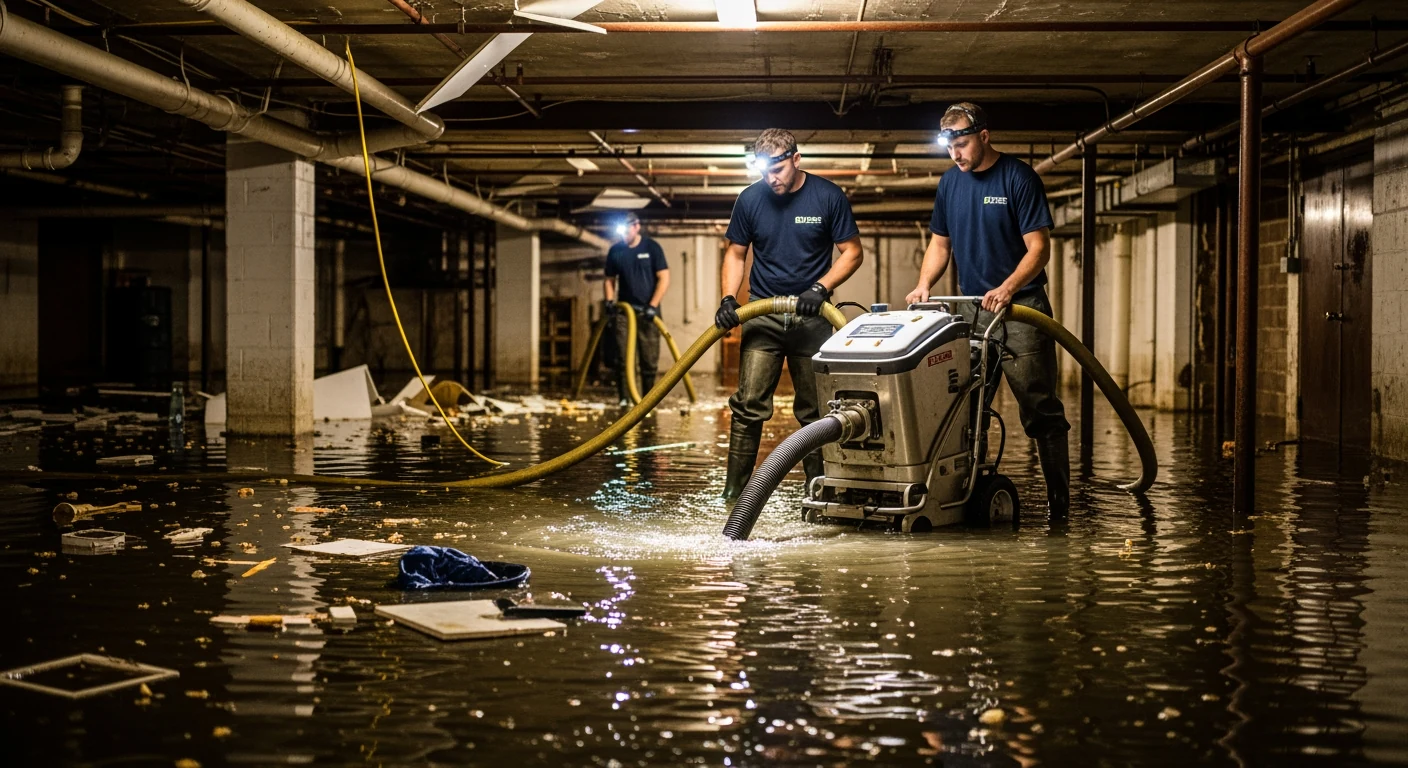
Extraction comes first because it’s dramatically more efficient than any drying equipment. Pulling standing or absorbed bulk water out with truck-mounted or portable extraction units removes moisture up to roughly 500 times faster than waiting for a dehumidifier to pull the equivalent volume out of the air.4 Skipping straight to fans and dehumidifiers on a structure that still has bulk water sitting in carpet pad or wall cavities wastes the most valuable hours of the whole process.
Air movement comes next, using high-velocity air movers positioned to break the saturated boundary layer described earlier, keeping evaporation moving off every wet surface rather than just the ones directly facing a single fan. Dehumidification, via LGR or in dense-material cases desiccant units, then pulls that evaporated moisture out of the air before it re-condenses on cooler surfaces, which is what causes secondary damage like swollen baseboards or delaminating cabinetry elsewhere in the room. Temperature control, holding the space in that 70 to 90°F range, ties the other three phases together by keeping evaporation rates and dehumidifier efficiency both near their peak.
For standard residential Class 1 to 2 losses, this four-phase process typically runs 3 to 5 days. Dense Class 4 materials, concrete slabs, plaster, brick, hold moisture deep in their matrix and can require 7 to 14 or more days regardless of how much equipment is deployed, because the limiting factor becomes how fast water can migrate to the surface, not how fast the air can absorb it.
Why 72 Hours Is a Checkpoint, Not a Finish Line
Seventy-two hours is when crews reassess moisture readings against drying goals, not when the job is automatically finished. Standard residential drying commonly runs 3 to 7 days total, and dense or heavily saturated materials can extend well beyond that, which is expected and doesn’t mean the process failed.
This distinction matters because homeowners sometimes hear “72-hour dry-out” as a fixed promise and panic when a crew is still on-site on day five. The 72-hour mark exists because it’s roughly where drywall wet from clean water should be approaching dry-standard on a well-run job, and it’s a useful checkpoint against the EPA/FEMA mold-growth window. It is not a guarantee that every material, every framing cavity, and every subfloor will be fully dry by then.
If moisture readings aren’t trending down by that checkpoint, that’s the signal to escalate: add equipment, reposition air movers, or investigate whether water migrated somewhere the initial assessment missed, like behind cabinetry or under flooring. A property owner working with a documented drying log can ask their crew directly, “are the numbers moving?” rather than guessing based on how the room feels or smells.
Documentation That Protects Homeowners and Supports Insurance Claims
Daily psychrometric logs, moisture content readings, and dated photos create the evidentiary record that supports an insurance claim file and proves the structure was dried according to IICRC S500 protocols, not just treated with equipment and left unmonitored. Adjusters specifically look for this documentation when evaluating scope and cost justification.
An adjuster reviewing a water damage claim wants to see more than an invoice for equipment rental days. They want temperature and relative humidity readings logged per room, per day; moisture content percentages tracked against a dry standard for each affected material; and photo documentation timestamped through the extraction, drying, and completion phases. This is what separates a defensible claim from a disputed one, and it’s why the difference between “running fans and hoping” and following a documented S500 process shows up directly in how smoothly a claim moves through review.
What adjusters typically look for: daily psychrometric logs (temperature, RH, grains per pound), moisture content readings per affected material logged against dry-standard targets, dated photo documentation across all four drying phases, and a clear equipment placement rationale tied to the IICRC S500 category and class of loss.
Property owners across NYC’s five boroughs, Long Island, New Jersey, Pennsylvania, and Connecticut dealing with an active water loss are working against that same 24 to 72 hour window whether or not a contractor mentions it. Upper Restoration crews are IICRC-trained and document every reading from the first extraction pass, which is the record both the drying decision and the eventual claim depend on.
Inside the mold-safe window and need documented, IICRC-standard drying started fast?
Frequently Asked Questions
Why can’t I just use my own dehumidifier and box fans to dry water damage?
A consumer dehumidifier removes roughly a pint of moisture per day and is designed to maintain comfort-level humidity (45-55% RH), not to dry saturated structural materials. Professional LGR units remove an estimated 10-15 gallons per day and drive humidity down to 20-30% RH, which is necessary to dry framing and drywall within the EPA and FEMA-recommended 24-48 hour mold-prevention window.
Is the “72-hour” drying timeline a real standard or a sales pitch?
It’s grounded in EPA and FEMA guidance recommending structures be dried within roughly 24-48 hours to limit mold growth, with 72 hours commonly used as a professional checkpoint against that risk window. It is not a guarantee that every structure is fully dry by then; dense materials and larger losses often require 3-7 days or longer under IICRC S500 protocols.
What happens if my structure takes longer than 72 hours to dry?
Extended drying time doesn’t automatically mean mold will grow or that a claim is jeopardized. Dense materials like concrete, plaster, and thick framing can take 7-14+ days under any equipment. What matters is whether moisture readings are trending downward on schedule; if they aren’t, that’s the signal to escalate equipment or investigate hidden moisture pockets.
Does drying duration affect my insurance claim?
Insurance claim outcomes depend on the specific policy, adjuster, and documentation provided, and this article does not constitute insurance advice. Generally, adjusters look for daily psychrometric logs, moisture readings, and photo documentation following IICRC S500 protocols to evaluate scope and justify drying-related costs.
What is an LGR dehumidifier and how is it different from a regular one?
LGR stands for Low Grain Refrigerant. It uses a two-stage cooling process that pre-cools incoming air before the main refrigerant coil, allowing it to push air further below its dew point and extract significantly more moisture per cycle than a standard single-stage dehumidifier, even in cold or already-dry conditions.
What should I expect from a restoration crew during the first 72 hours?
Expect bulk water extraction first, followed by placement of high-velocity air movers and LGR dehumidifiers, with daily moisture readings logged for each affected area. A professional crew following IICRC S500 protocols will document temperature, humidity, and material moisture content daily and adjust equipment based on those readings rather than a fixed schedule.
Can mold be completely prevented after a water loss?
No restoration process can guarantee complete prevention of mold growth, as outcomes depend on how quickly water is addressed, material types, and ambient conditions. Prompt extraction and professional drying within the EPA/FEMA-recommended 24-48 hour window significantly reduces the risk, but no contractor can ethically guarantee mold will never occur.
Sources
- U.S. Environmental Protection Agency, “Mold Course Chapter 2: Moisture and Mold” / “A Brief Guide to Mold, Moisture, and Your Home”
- Federal Emergency Management Agency, “Repairing Your Flooded Home” and “Mold and Mildew After a Flood”
- Institute of Inspection, Cleaning and Restoration Certification (IICRC), S500 Standard and Reference Guide for Professional Water Damage Restoration
- JDSupra, “Advanced Structural Drying” guide on psychrometric drying principles and LGR dehumidification
- 4D Restoration, comparative data on LGR vs. consumer dehumidifier moisture removal rates
- Chicago Water & Fire Restoration; Disaster Specialists, four-phase structural drying process documentation
This content is for general informational purposes only and is not legal, medical, or insurance advice. Remediation scope, timelines, and costs vary by site conditions. Contact Upper Restoration for a professional assessment. Licensing and certifications apply per jurisdiction.