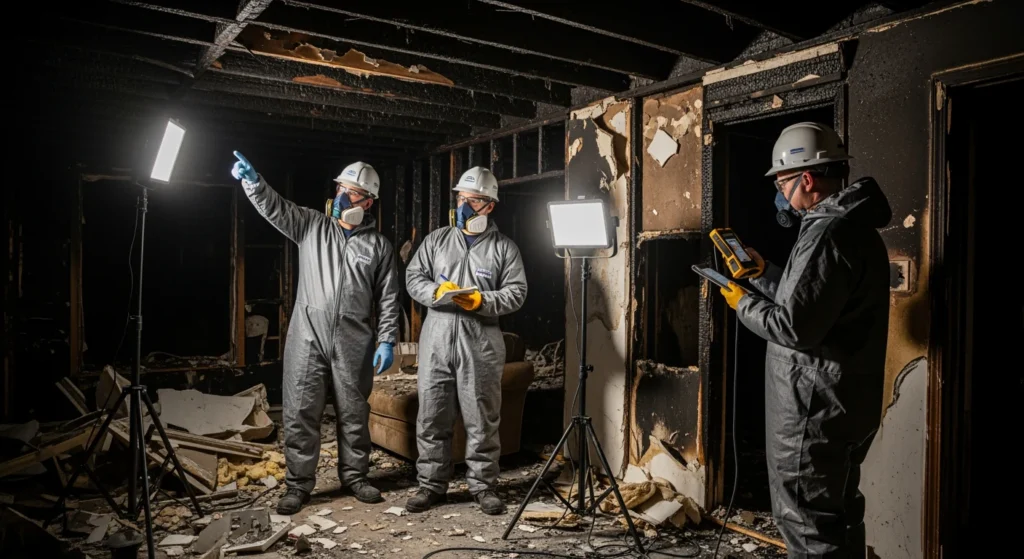
A furnace puffback is not a fire. No flame reaches the living space. There is no structural damage, no char, no burnthrough. But a puffback in a Levittown Cape Cod produces an event that looks, smells, and costs nearly as much to remediate as a kitchen fire: oily black soot distributed uniformly to every surface in every room of the affected structure, an acrid petroleum odor that penetrates into every porous material, and a restoration protocol that requires entirely different chemistry than the cleaning methods used for structural fire soot.
What Causes a Puffback
A puffback occurs when unburned oil vapor accumulates in the combustion chamber — typically during a startup cycle when the igniter fires late or fails to fire on the first cycle — and the accumulated vapor ignites as a single large combustion event rather than the controlled flame that normal ignition produces. The pressure wave from this event travels back through the heat exchanger and into the air distribution system, expelling combustion gases and oil soot into the ductwork and, from there, into every room served by the distribution system. In a central air system, this means the entire house is affected simultaneously.
Puffbacks are most common at heating season startup — October and November — when systems that have been dormant all summer have accumulated oil residue, water condensate, and in some cases partial blockages in the oil delivery line. They are also more common in systems with aging oil burners where ignition timing has drifted and systems that have not been serviced annually.
Why Oil Soot Is Different
The key to understanding why puffback cleanup is more complex than it appears is the chemistry of oil soot versus structural fire soot. Structural fire soot from burning wood, drywall, or furnishings is primarily dry carbon particulate — it can be removed from smooth surfaces by dry sponge wiping, vacuuming, and chemical sponge application. Oil soot from a puffback is a petroleum-based aerosol that bonds to surfaces and smears on contact when approached with standard dry cleaning methods. Attempting to wipe oil soot with a dry chemical sponge or standard cleaning cloth spreads the oil across a larger area rather than removing it. Oil soot requires solvent-based pre-conditioning applied to all surfaces before any contact cleaning — the solvent breaks the petroleum bond and allows the soot to be lifted rather than smeared.
The Puffback Cleanup Sequence
Upper Restoration’s puffback protocol for Nassau County Cape Cods follows a defined sequence: (1) HVAC system shutdown and oil burner lockout to prevent additional events. (2) Air filtration setup with HEPA air scrubbers to reduce airborne particulate during cleanup. (3) Surface pre-conditioning with solvent-based puffback cleaner applied by sprayer to all affected surfaces — walls, ceilings, woodwork, window frames — before any contact cleaning begins. (4) Systematic wipe-down from ceiling to floor using appropriate cleaning materials. (5) Ductwork cleaning by a qualified HVAC duct cleaning contractor — this is a separate scope from the structural surface cleaning. (6) Deodorization using hydroxyl generator or thermal fogging with oil-odor-specific deodorizing agent. (7) HEPA vacuuming of all soft goods and contents before removal to pack-out cleaning. The sequence matters — steps performed out of order or skipped produce incomplete results.
Cost Range for Long Island Puffbacks
Puffback cleanup in a standard 1,200-1,800 square foot Long Island Cape Cod or Colonial ranges from $4,500 to $13,000 depending on the extent of soot distribution and whether contents pack-out and cleaning is required. Oil-heated homes with central forced air distribution are total-house events by definition — all rooms served by the duct system receive soot. Homes with oil-fired baseboard hot water heating where the puffback occurred at a boiler rather than forced air furnace may have more localized soot distribution limited by the absence of duct distribution.