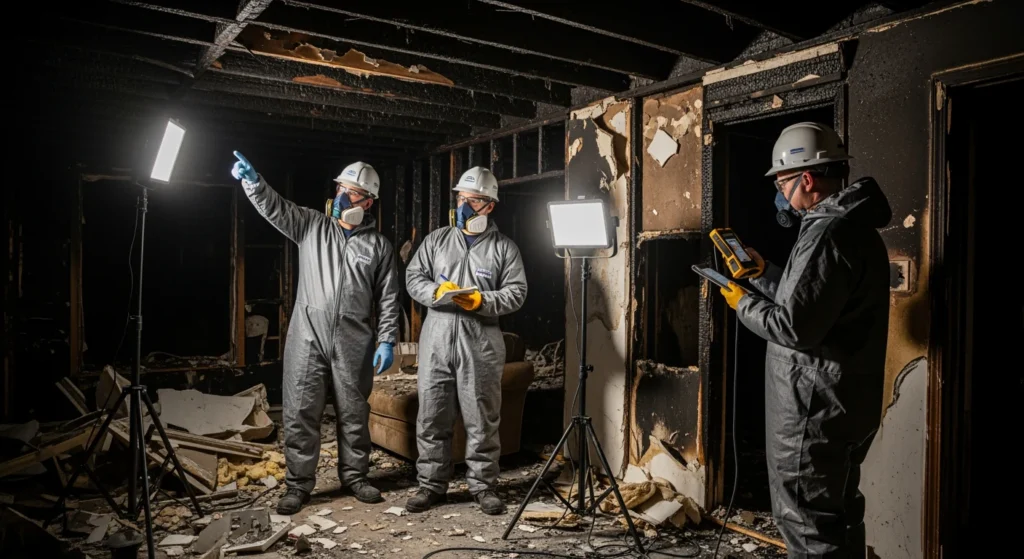
The Town of Huntington’s fire and smoke restoration landscape is shaped by two overlapping risk populations: the older north shore construction of Cold Spring Harbor, Centerport, and Lloyd Neck where aging electrical systems create fire initiation risk, and the interior suburban communities of Huntington Station and Dix Hills where oil-fired heating systems in 1960s–1970s split-levels produce the puffback events that are among the most common smoke damage calls on Long Island. For the county-level framework, see the Long Island Fire & Smoke Damage Restoration Master Guide.
North Shore Older Construction: Electrical Fire Risk
Cold Spring Harbor’s historic residential stock — some structures dating to the late 19th century, others to the 1920s–1940s era when Cold Spring Harbor was developed as a Sound shore retreat community — carries the full range of aging electrical system risk. Original knob-and-tube wiring in uninsulated attic spaces, 60-amp service panels insufficient for modern electrical loads, and partial rewiring that created hazardous junction points between old and new conductors are all present in Cold Spring Harbor and Centerport’s older housing stock. Electrical arcing in wall and ceiling cavities in these structures produces dry smoke — high-heat, fast-burning — that penetrates porous materials deeply and distributes through the home’s interconnected framing cavity system before it is visible on finished surfaces.
Huntington Station Split-Level Puffback
Huntington Station and Dix Hills’ 1960s–1970s split-levels are heated predominantly by oil-fired forced air — the same system configuration that produces the puffback events common throughout Long Island’s older oil-heat suburbs. The split-level’s duct system, which runs from the mechanical room in the below-grade level through the upper levels via wall and ceiling cavities, provides an efficient distribution network for puffback soot throughout the structure. A puffback in a Huntington Station split-level typically affects all three levels — the below-grade family room, the main living level, and the bedroom level — requiring a whole-structure cleanup scope that exceeds what many puffback events in single-story Cape Cods involve.
Pre-1980 Asbestos Protocol in Huntington
Huntington’s 1960s–1970s split-level and Colonial housing stock carries the joint compound asbestos risk common to Nassau County and western Suffolk construction from this era. Drywall joint compound containing 2 to 6 percent chrysotile asbestos was standard in Huntington Station and Dix Hills construction through the mid-1970s. Any fire restoration project requiring drywall demolition in these homes requires bulk asbestos sampling before demolition begins.
Cost Benchmarks
- Huntington Station split-level puffback (whole-structure scope): $7,000–$18,000 for three-level oily soot cleanup with HVAC duct cleaning.
- Cold Spring Harbor older construction electrical fire: $15,000–$45,000 for smoke remediation in balloon-frame or older construction with interconnected cavity smoke distribution.
- Fire demolition with joint compound asbestos (pre-1978 split-level): $3,000–$9,000 for required bulk sampling and abatement before structural demolition.