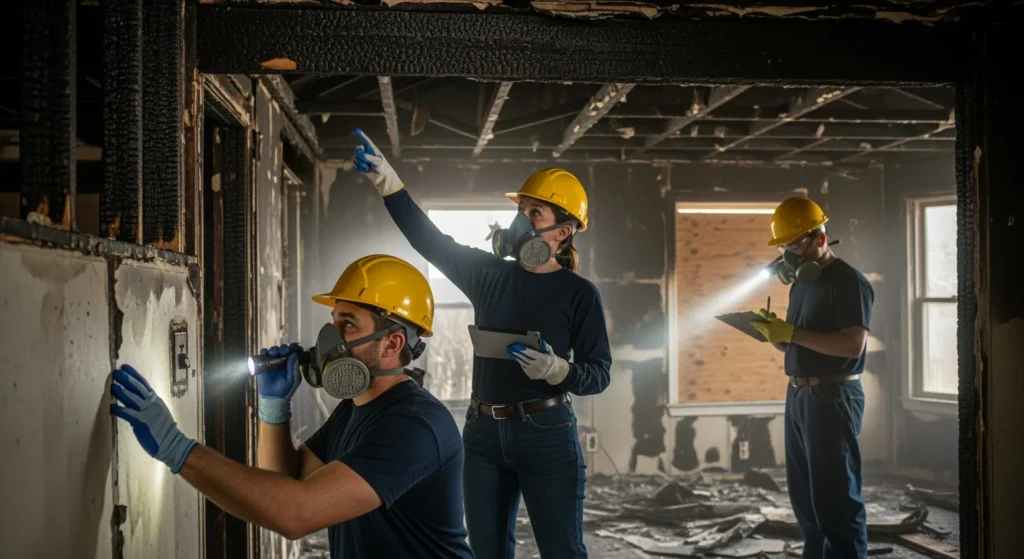
Fire and smoke damage restoration in the Town of North Hempstead spans a wide range, from the historic pre-war estates of Kings Point and Sands Point — where original electrical systems and historic building materials create fire risk conditions unlike any other Nassau township — to the dense multi-family and apartment stock of New Hyde Park and Mineola, where kitchen fires are the dominant fire event. The township’s Sound shore communities also carry puffback risk from oil-fired heating, though the prevalence of gas heat increases as you move south from the Sound shore into the interior communities. For the county-level framework, see the Long Island Fire & Smoke Damage Restoration Master Guide.
Pre-War Electrical Systems: The Fire Risk in Gold Coast Estates
North Hempstead’s pre-war estates — Tudors and Colonials built between 1900 and 1940 in Great Neck, Kings Point, Sands Point, and Manhasset — contain original electrical systems that represent a meaningful fire risk. Knob-and-tube wiring, standard in construction through the 1930s, has conductors insulated with cloth braid rather than the plastic insulation of modern wiring — this insulation degrades over 80+ years and can arc at connection points and junction boxes, producing fires that begin inside wall cavities without visible warning. Many pre-war North Hempstead estates have been partially rewired over the decades, but partial rewiring can create hazardous conditions at the junction points between old and new systems. Fires originating in electrical systems are among the most difficult to detect early — they smolder inside wall cavities long before breaking through finished surfaces.
Smoke damage in pre-war North Hempstead construction spreads through the original open-framing cavity systems that interconnect walls, floors, and ceilings in a way that modern platform-frame construction does not. Smoke from an electrical fire on the first floor can travel through the interconnected cavity to the attic before it is visible on any finished surface — creating smoke damage throughout a historic Great Neck estate from a fire that, from the exterior, appeared contained to one room.
Interior New Hyde Park and Mineola: Kitchen and Apartment Fire Profile
New Hyde Park and Mineola’s denser residential and apartment stock produces the kitchen fire pattern typical of multi-family housing: cooking fires, small appliance fires, and occasional electrical fires in older panel boxes. Protein smoke from cooking fires — nearly invisible, high-odor oil-based residue — is the most common smoke damage type in these communities and is notoriously resistant to standard cleaning without proper enzymatic treatment.
Cost Benchmarks
- Pre-war Great Neck or Kings Point estate — electrical fire, wall cavity smoke: $18,000–$55,000 for smoke remediation in interconnected historic framing cavities with preservation protocol for original finish materials.
- Interior New Hyde Park — kitchen fire or puffback: $5,000–$15,000 for standard scope with protein smoke cleaning and deodorization.
- Structural fire in pre-1978 construction — asbestos protocol add-on: $3,000–$12,000 for required asbestos sampling and abatement before demolition.