Commercial Restoration on Long Island: Water Damage, Fire, Mold & Asbestos for Nassau and Suffolk County Businesses (2026)
Commercial restoration on Long Island operates under different constraints than residential work in every dimension: larger affected square footage, stricter regulatory timelines for occupancy clearance, active business interruption insurance claims running concurrently with the physical restoration, multiple stakeholders (owner, tenant, insurer, lender, local building department), and the added complexity of pre-1980 commercial construction containing asbestos in quantities that exceed typical residential exposures.
Nassau and Suffolk County’s commercial real estate spans from the dense Route 110 office corridor in Melville and Farmingdale, through the retail and light industrial parks of Central Nassau, to the hospitality and retail businesses of the Hamptons and the North Fork. Each sector has distinct restoration needs and regulatory requirements. This guide covers what Long Island commercial property owners and managers need to know about emergency restoration response, the major commercial loss types, and cost expectations for 2026.
Commercial Water Damage Restoration on Long Island
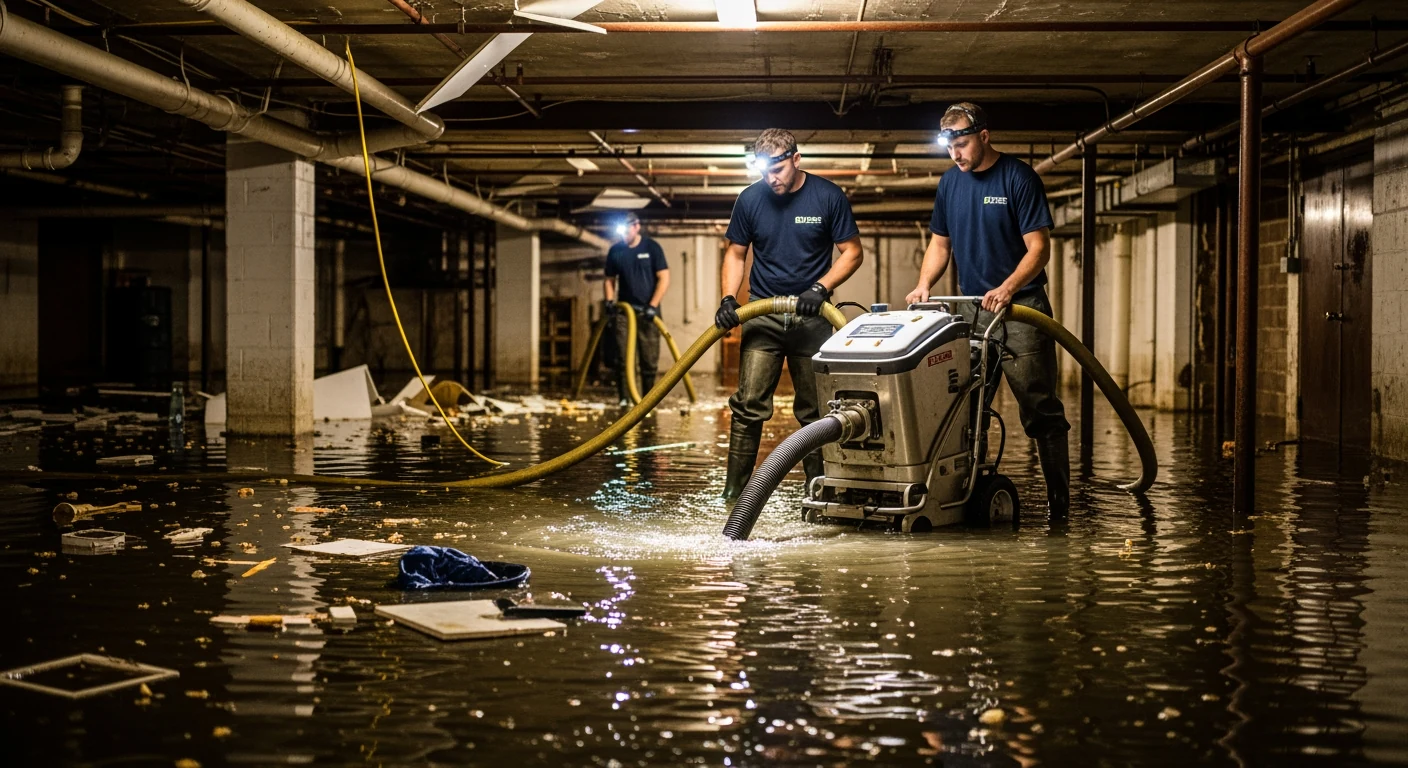
Commercial water damage events — pipe failures, roof leaks, fire suppression system discharges, and flooding — typically involve larger affected square footage than residential losses and require faster response to minimize business interruption. An office floor soaked by a burst supply line represents not just physical damage but daily revenue loss from occupied space that cannot be used until restoration is complete.
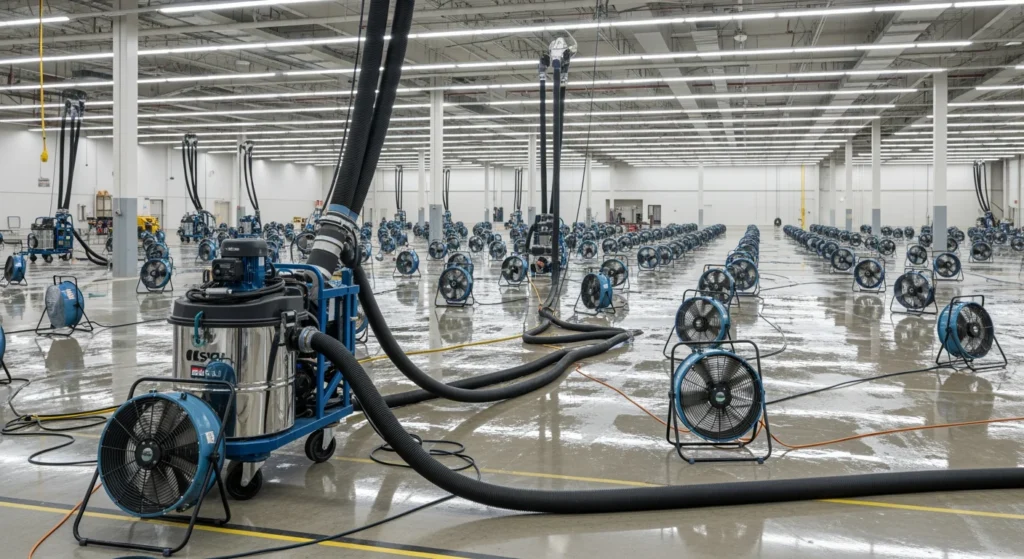
Professional commercial water damage response on Long Island follows IICRC S500 protocols adapted for commercial environments: large-scale extraction equipment capable of handling thousands of square feet of soaked carpet and flooring, commercial-grade LGR dehumidifiers at higher capacity than residential units, and psychrometric monitoring throughout large open-plan spaces. IICRC Large Loss certified contractors are equipped to handle commercial losses of 10,000 square feet or more in a single deployment.
Business interruption documentation begins at the same time as extraction. Every day of business closure or reduced capacity is a covered expense under commercial property policies with business interruption riders. The restoration contractor’s daily moisture logs, equipment placement records, and project timeline documentation are the business interruption claim’s evidentiary foundation. Start this documentation from the first hour on site — it cannot be recreated retroactively.
Route 110 corridor offices, Nassau County’s dense suburban retail, and Suffolk County’s commercial parks are predominantly mid-century to 1980s construction — the same asbestos-era housing stock issue applies to commercial buildings. Any commercial demolition in pre-1980 construction requires a pre-demolition asbestos survey under NYS Code Rule 56, and commercial abatement projects are subject to additional OSHA requirements beyond the residential framework. Industrial hygienist oversight and air monitoring during abatement are standard in commercial environments.
Commercial Fire Damage Restoration
Commercial fire losses on Long Island most frequently involve: kitchen fires in the county’s extensive restaurant and food service sector, electrical fires in aging commercial buildings with original wiring, and equipment fires in manufacturing and light industrial facilities in the Route 110 corridor, Central Islip, and Hauppauge industrial parks.
Commercial fire restoration follows the same sequence as residential — emergency stabilization, water extraction from suppression, soot and smoke cleaning by material type, odor treatment, asbestos survey if pre-1980 construction is involved — but at commercial scale with commercial-grade equipment and the additional regulatory layer of NYC Building Department or Nassau/Suffolk building code compliance for reconstruction.
Business interruption coverage for commercial fire losses can be substantial: a restaurant closed for 90 days while undergoing fire restoration loses three months of revenue. The insurance documentation for business interruption requires the same careful day-one attention as the physical documentation — revenue records, fixed expense records, and ongoing expenses incurred to minimize interruption (temporary relocation, equipment rental) are all claimable.
Commercial Mold Remediation Under NYS Article 32
NYS Article 32 applies to commercial properties as well as residential — licensed assessor, licensed remediator, Mold Remediation Plan, post-remediation clearance testing. Commercial mold events often involve HVAC systems in large buildings where contaminated ductwork distributes spores across multiple floors or suites. Commercial HVAC mold remediation requires specialized scope: negative air pressure in the mechanical room, duct sealing before system operation resumes, and clearance testing at all supply registers throughout the affected system.
Property managers for Nassau and Suffolk County commercial buildings subject to mold complaints from tenants should understand that New York State’s mold disclosure requirements apply to commercial as well as residential properties. Documented mold complaints that are not professionally addressed under Article 32 protocols create both regulatory and liability exposure for the building owner.
Commercial Restoration Costs on Long Island (2026)
Commercial water damage restoration: $8–$15 per square foot for extraction and structural drying of a standard commercial floor (carpet over concrete slab). Hard flooring with moisture under tile or in concrete requires additional scope. A 5,000-square-foot water loss typically runs $40,000–$75,000 for mitigation before reconstruction.
Commercial fire restoration: highly variable by loss severity. A contained kitchen fire in a 2,000-square-foot restaurant typically runs $35,000–$80,000 for cleaning, odor treatment, HVAC decontamination, and partial reconstruction. A significant fire with structural damage can run $150,000–$500,000+.
Commercial mold remediation: $12–$25 per square foot for HEPA vacuuming, antimicrobial treatment, and clearance testing. A 10,000-square-foot commercial floor with moderate mold coverage runs $60,000–$150,000 including all required Article 32 compliance.
Upper Restoration serves commercial clients throughout Nassau and Suffolk County with 24/7 emergency response, IICRC Large Loss certified capabilities, and dedicated project managers for commercial accounts.