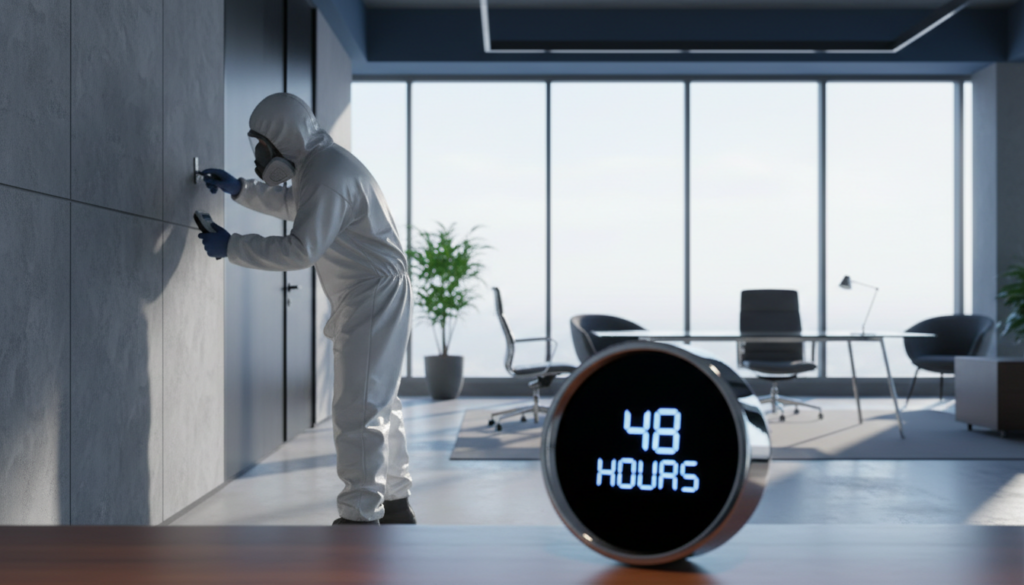
For commercial property managers, mold isn’t just a maintenance issue — it’s a potential business liability. Left unaddressed, it can lead to tenant complaints, costly repairs, and legal exposure. But here’s the thing most people overlook: Timing is everything.
Acting within the first 48 hours can mean the difference between a simple cleanup and a full-blown rebuild. And the financial impact? Massive.
Mold Isn’t Just a Maintenance Problem — It’s a Business Risk
Mold doesn’t just affect air quality — it affects your bottom line.
- Tenant turnover increases when indoor air quality suffers
- Insurance claims may be denied if action is delayed
- Repair costs rise exponentially after the 48-hour mark
- Regulatory fines may apply if mold violates building code or health standards
Delays also raise the chance of reputational damage — especially if your property serves vulnerable populations like seniors, students, or patients.
What Happens If You Wait More Than 48 Hours
- Mold spores begin to spread through HVAC systems
- Drywall and insulation absorb moisture deeply and require removal
- Odors set in and linger even after cleaning
- Occupants may experience allergy or respiratory issues
- Insurance coverage may be reduced due to “failure to mitigate”
The first two days after water intrusion or high humidity are critical. That’s the window where most mold can be stopped before it spreads — and before costs multiply.
Fast Response = Measurable ROI
Responding early reduces:
- Labor time (no demo or rebuild)
- Equipment hours (less drying, fewer machines)
- Tenant impact (no move-outs or closures)
- Legal exposure (clean documentation of immediate response)
- Claim friction (insurers reward documented mitigation efforts)
Waiting even one extra day can increase remediation costs by 2–3x depending on the severity and size of the space.
What’s Involved in Commercial Mold Remediation?
At Upper Restoration, we follow IICRC protocols for commercial mold work:
- On-site assessment and moisture mapping
- Source control and containment
- HEPA air filtration and spore capture
- Removal of affected materials (only when necessary)
- Post-remediation verification and clearance testing
- Full documentation for your property file and insurance submission
We mobilize fast — and we don’t overdo the scope just to drive the bill.
The Sooner You Move, the Less It Costs
Need commercial mold help now?
We mobilize quickly to prevent downtime, legal risk, and escalating costs.
Contact Us
FAQ
Q: Is mold in a commercial space a code violation?
A: It can be — especially if it affects air quality or poses a risk to tenants or employees.
Q: How fast does mold spread in an office or retail building?
A: In as little as 24–48 hours, especially if ventilation systems are running.
Q: Will insurance cover commercial mold removal?
A: Often yes — but insurers typically require proof that you responded promptly to avoid further damage.